

Most Miami sellers walk into the process believing that selling fast means accepting less. That assumption costs them real money. The sellers who close quickest and cleanest are almost never the ones who priced low to attract buyers fast. They are the ones who prepared well, priced precisely, and launched at the right moment.
If you are ready to sell my house in Miami and want to do it without a price cut or a listing that lingers, the mechanics matter more than the motivation. Miami is not a forgiving market when you get the fundamentals wrong. Buyers here are informed, often represented by experienced agents, and frequently comparing your home against three others in the same zip code. This article walks through what actually drives a successful sale in Miami-Dade from the first decision to the closing table.
What "Selling Fast" Actually Costs You If You Rush It Wrong
Speed is not the enemy of price. A bad launch is.
When a seller decides to list without preparation and goes live before the home is ready, they burn through the most valuable window in any Miami listing: the first 72 hours. Buyers on alerts see a new listing the moment it hits the MLS. If the photos are weak, the price is off, or the home feels unprepared, that window closes and never fully reopens.
A home that sits for 21 days in Miami starts generating a specific kind of buyer attention. Not the kind you want. Buyers and their agents begin asking what is wrong with it. Offers start coming in below asking because the market has signaled that the home has not been wanted. You end up negotiating from a weakened position that a better launch would have prevented entirely.
The sellers who try to sell my house in Miami quickly by pricing 5% below market to create urgency often find one of two outcomes: they attract investors and cash buyers who were already planning to offer below list anyway, or they leave equity on the table in a market where that equity was legitimately there.
Urgency is manufactured by preparation and pricing strategy, not by discounting.
The Miami Sale Timeline, Broken Down Honestly
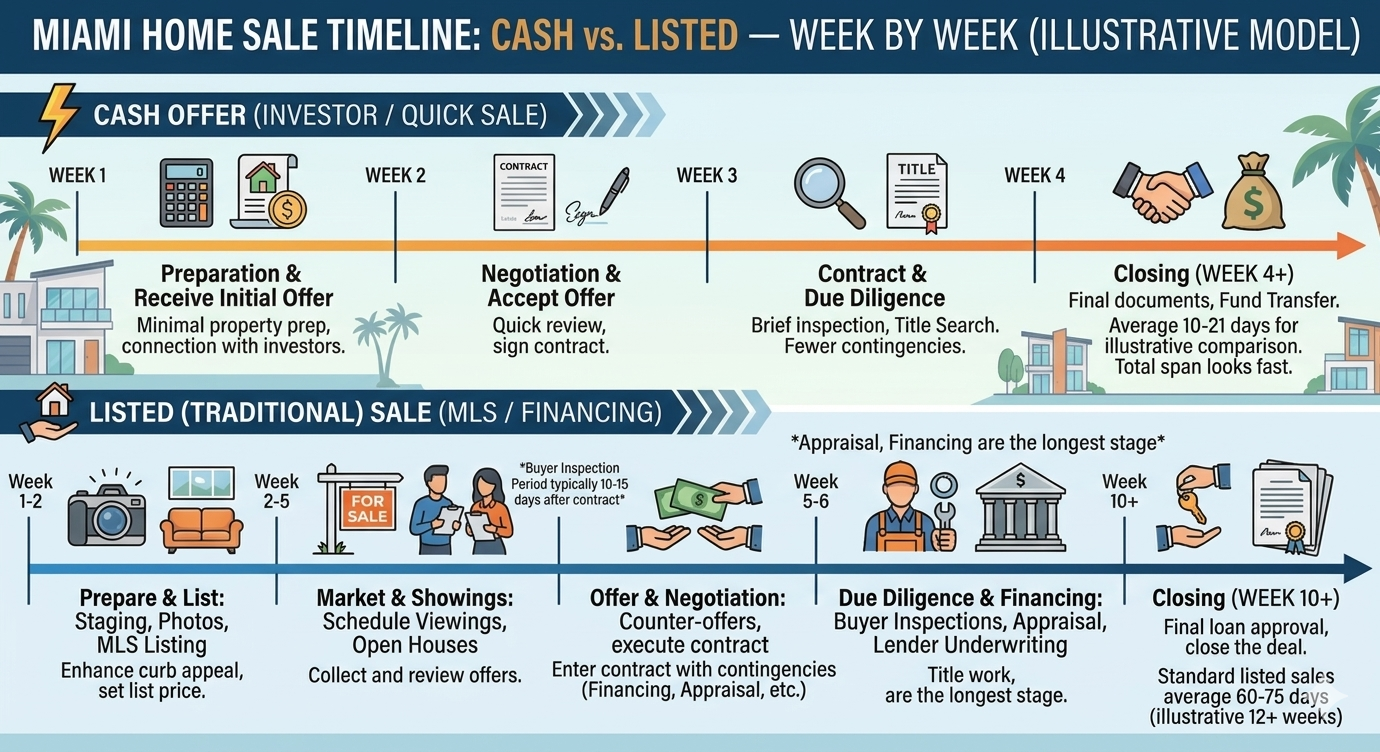
A realistic Miami home sale looks different depending on whether you are selling a single-family home or a condo, and whether the buyer is financing or paying cash.
Single-family home with a financed buyer:
- Week 1–2: Preparation, photography, MLS launch
- Week 2–3: Showings, offer negotiation, contract execution
- Week 3–5: Buyer inspection period (typically 10–15 days in Miami contracts)
- Week 5–10: Lender underwriting, appraisal, title work
- Week 10–12: Closing
That is roughly 60 to 75 days from list to close in a normal transaction. Sellers who expect 30 days and get a financed buyer are often surprised. If you need to sell my house in Miami quickly and are open to cash offers, the timeline compresses significantly. Cash closings in Miami-Dade can happen in 10 to 21 days once a contract is signed.
Condo sales carry an additional variable: the association approval process. Some buildings in Brickell and Miami Beach require board interviews, background checks, and document reviews that add 30 to 45 days to a transaction. If you are selling a condo in a building with a right of first refusal or a lengthy approval packet, that timeline needs to be built into your expectations from the start.
Insurance is another factor that has reshaped Miami deal timelines since 2022. Buyers using conventional financing need homeowners insurance bound before closing. In South Florida, that has become one of the most common deal-killers in the final two weeks of a transaction. Sellers who help buyers by having documentation ready on their current policy and any recent roof work shorten that friction considerably.
Pricing Strategy Is the Only Variable That Controls Everything Else
Here is how pricing actually works in Miami, and why most sellers get it wrong.
A seller lists at what they believe their home is worth, often anchored to what a neighbor got six months ago, what Zillow estimates, or what an agent told them to get the listing. None of those sources accounts for the micro-market conditions in their specific zip code right now.
Miami is not one market. Kendall, Coral Gables, Palmetto Bay, and Hialeah behave differently. Inventory levels, buyer profiles, and absorption rates vary block by block in some areas. A pricing strategy that works in Pinecrest fails in Kendall because the buyer pool, the price point, and the competition are entirely different.
A real example: A 4-bedroom home in The Hammocks listed at $685,000 in early 2024 sat for 38 days before the seller reduced to $649,000 and accepted $641,000. A comparable home two streets over listed at $659,000, generated 11 showings in the first weekend, and went under contract at $671,000 with an escalation clause. The difference was not the homes. It was the entry price and the pre-launch strategy.
Pricing to generate multiple offers is a deliberate technique, not an accident. It requires knowing current absorption rate, the number of active competing listings in the same zip code, and what financed buyers at that price point are actually qualifying for. Overpricing eliminates buyers before they ever schedule a showing.
If you want an accurate number to work from before committing to a price, a free home valuation gives you real market data rather than an algorithm guess.
What Miami Buyers Are Actually Looking For Right Now
Understanding buyer behavior in Miami-Dade helps sellers make smarter decisions on preparation, pricing, and negotiation.
Miami has a higher concentration of cash buyers than most U.S. markets. International buyers from Latin America and Europe, along with domestic investors and relocation buyers from high-cost states, frequently purchase without financing. Cash buyers move faster, but they negotiate harder on price because they know their certainty of closing is their leverage.
When negotiating with a cash buyer, do not assume their offer is the ceiling. In Miami, cash buyers often open at 5 to 8% below asking. Sellers who hold firm and demonstrate demand through multiple showing activity typically get better outcomes than sellers who accept the first cash offer out of excitement.
Financed buyers are more common in the $400,000 to $650,000 range, which covers a large portion of Miami-Dade single-family inventory. These buyers are rate-sensitive right now, and their purchasing power shifts meaningfully with each quarter-point change in rates. Sellers in this price range should expect longer due diligence periods and more inspection negotiation.
Foreign buyer behavior is distinct. Venezuelan, Colombian, and Brazilian buyers in particular often move quickly when they find the right property but require more time on the documentation and wire transfer side of a transaction. Sellers working with international buyers should build in extra time for proof of funds verification and international wire coordination.
One factor sellers consistently underestimate: the impact of HOA or condo association rules on buyer decisions. In Miami-Dade, a building that restricts rentals or has a pending special assessment loses a measurable percentage of its buyer pool. Sellers in HOA-heavy communities should pull their association financials and disclosure documents before listing so buyers are not surprised mid-contract.
The Preparation Window: What to Do in the 30 Days Before You List
The 30 days before your home goes live is where most of the outcome is determined.
Focus on these in order:
- Deep clean and depersonalize. Miami buyers, especially international buyers, respond strongly to neutral, well-maintained spaces. Remove personal photos, excess furniture, and anything that makes the home feel occupied rather than ownable.
- Address deferred maintenance. Buyers in Miami use inspections aggressively. A leaking faucet, old water heater, or soft spot in the ceiling will either kill the deal or come back as a credit negotiation. Fix the obvious things before they become a buyer's leverage point.
- Roof documentation. In Miami-Dade, a roof older than 15 years is a red flag for buyers and their insurance agents. If you have a newer roof, have the permit and inspection documentation ready before the first showing.
- Professional photography and video. This is not optional. Listings with professional photos generate 3 to 4 times the showing activity of listings with phone photos. In Miami's competitive online search environment, your first showing happens on a screen, not in person.
For a detailed breakdown of which specific upgrades move the needle before listing, the guide on top renovation moves before listing covers what actually returns money versus what wastes it.
Sellers who skip this window and list immediately are the ones calling their agent two weeks later asking about a price reduction. The preparation investment is almost always cheaper than a price cut.
How Labrada Realty Approaches a Miami Home Sale Differently
When a seller works with Labrada Realty to sell my house in Miami, the process is built around one principle: the first 72 hours of a listing determine most of what happens next.
Before a listing goes live, we run a micro-market analysis that goes beyond what automated tools show. We look at current active competition, absorption rate in the specific zip code, buyer activity levels, and what the last three closed sales actually cleared after concessions, not just what they listed for. That analysis sets the pricing strategy, not a formula.
The launch itself is coordinated. Photography, virtual tour, MLS syndication, and buyer network outreach happen simultaneously so the listing hits with maximum exposure on day one. Sellers who want to see what a prepared launch produces compared to a reactive one can review recently sold homes in Miami for real examples of how that strategy has played out across Miami-Dade.
On the negotiation side, knowing how to read a buyer's position matters as much as the offer itself. An offer $10,000 below asking from a cash buyer who needs to close in 15 days is a different conversation than the same number from a financed buyer at 90 days out with inspection contingencies. Most sellers cannot evaluate that distinction without experience in Miami-Dade contracts specifically.
For sellers who want to understand what the market actually says their home is worth before committing to a strategy, this is also covered in the detailed breakdown at what sellers leave on the table.
Miami-Specific Factors That Can Make or Break Your Sale
There are dynamics in Miami-Dade that do not exist the same way in other markets, and ignoring them is expensive.
Insurance market pressure: Since Citizens Property Insurance tightened its underwriting, getting a buyer through financing has become harder in certain price ranges and property types. Homes with older roofs, homes in certain flood zones, and older construction types now face a real buyer pool reduction because the monthly payment on insurance is pricing buyers out. Sellers in these categories may need to adjust pricing expectations or offer closing cost credits that help buyers offset the insurance impact.
Seasonal demand patterns: Miami's peak buyer activity runs from mid-November through April. Northeastern and international buyers are in market, weather is favorable, and showing activity is highest. Sellers who list in June through August often see lower traffic and are competing with each other for a smaller active buyer pool. If you can control your timing, listing in Q1 is a meaningful advantage in most price ranges. The exception is the ultra-luxury segment above $3 million, where buyer behavior is less seasonal and more relationship-driven.
Condo association timelines: Buildings vary enormously. Some South Brickell buildings have streamlined approval processes that clear in two weeks. Some older buildings in Miami Beach require full board review packets, financials from the buyer, and an in-person interview that takes six to eight weeks. If you own a condo, pull your building's approval requirements before you list so your expected closing date reflects reality, not optimism.
Micro-market price sensitivity: A $650,000 home in Doral competes differently than a $650,000 home in Palmetto Bay. Doral buyers at that price point are often young families comparing multiple new construction options. Palmetto Bay buyers at that price are often looking for lot size, school district quality, and renovation potential. The marketing message, the preparation focus, and the negotiation posture are different in each case. Treating Miami as one homogeneous market is one of the most common and costly mistakes sellers make.
FAQ
Q: How long does it take to sell a house in Miami from listing to closing?
A: For a single-family home with a financed buyer, the realistic range in Miami-Dade is 60 to 75 days from list date to closing. Cash transactions compress that to 21 to 30 days in most cases, though the contract negotiation and due diligence period still takes time even without a lender involved. Condos can add 30 to 45 days depending on the building's association approval process. Sellers who go in expecting a 30-day full-cycle sale with a financed buyer typically end up frustrated mid-transaction. Build the real timeline into your planning from day one.
Q: What's the fastest way to sell my house in Miami without dropping the price?
A: A strong launch is the answer, not a discounted price. In Miami-Dade, a well-priced listing in move-in condition with professional photos and coordinated MLS exposure typically attracts serious offers within 5 to 10 days. The factor that controls speed is what happens in the first 72 hours of the listing going live. Homes that generate 10 or more showings in the first weekend almost always close faster and at or above asking. Homes that don't usually see a price reduction within two to three weeks. Preparation before launch creates that demand window. Discounting after a slow launch tries to recreate it, and rarely does.
Q: Do I need to renovate before I sell my house in Miami?
A: Full renovations rarely return their full cost in a sale, but targeted preparation does. In Miami, the items that most directly affect buyer perception and inspection outcomes are the roof, HVAC system, water heater, and visible cosmetic condition. A fresh coat of paint, clean landscaping, and repaired minor deficiencies consistently return more than kitchen remodels in the resale context. The calculus also depends on your price point. At $400,000 to $600,000, move-in condition matters enormously because buyers in that range are often already stretching. Above $1 million, buyers expect to personalize and are less moved by a seller's taste in finishes.
Q: How does the condo approval process affect my Miami home sale timeline?
A: More than most sellers anticipate. Miami-Dade condo buildings each have their own approval requirements, and they range from a simple application form to a full board interview with background checks, financial statements, and a waiting period for the board to convene. Some buildings in Brickell and Edgewater process approvals in 10 to 14 days. Others in older Miami Beach buildings can run six to eight weeks. Sellers should request their building's current approval package before listing and disclose the timeline to any serious buyer before contracts are signed. A buyer who discovers a six-week approval process after going under contract is a buyer who may walk.
Q: What should I watch out for when reviewing a cash offer to sell my house fast in Miami FL?
A: Three things. First, verify proof of funds before signing anything. In Miami, cash offers occasionally come from buyers who are not fully liquid and intend to arrange financing after going under contract. Ask for a bank statement or letter of funds within 24 hours of the offer. Second, look at the inspection period and inspection rights the offer grants the buyer. Some cash buyers use aggressive inspection clauses to renegotiate after going under contract, which is a common strategy in this market. Third, evaluate the closing timeline against your own needs. A 10-day close sounds attractive but may not serve you if you need time to find your next home. The fastest cash offer is not always the best one.
If you want to know what your home is actually worth right now and how fast you could realistically close, a free home valuation gives you a real number to work from in about 60 seconds. No pressure, no commitment, just an honest starting point before you make any decisions.
Check out this article next