
Most buyers searching for homes for sale in Palmetto Bay start with Zillow or Realtor.com, scroll a few listings, and assume the price on the screen tells them what they need to know. It doesn't. Palmetto Bay real estate moves differently from the rest of Miami-Dade, and buyers who don't understand why end up either overpaying or missing the homes that actually fit their needs.
Palmetto Bay is not a condo market. It is not a high-rise market. It is not a rental-heavy community. It is one of the few places in Miami-Dade where you can still buy a single-family home on a real lot, with real yard space, in a zip code where the schools are rated among the best in the county. That combination is what drives demand, and it is also what makes pricing here hard to read from the outside.
This guide covers what the Palmetto Bay real estate market actually looks like right now, what different price points will get you, and how to position yourself to find and close on the right home without leaving money on the table or losing a deal you should have won.
What Palmetto Bay Is and Why the Market Behaves the Way It Does
Palmetto Bay is an incorporated village in Miami-Dade County, sitting south of Pinecrest and north of Cutler Bay along Old Cutler Road. The two primary zip codes are 33157 and 33158. There are no high-rises here. The village charter actively limits density, which is not an accident. Residents voted for incorporation in 2002 specifically to control development and preserve the area's suburban character.
That decision has compounding value. Palmetto Bay has stayed predominantly single-family, and the inventory reflects that. When you search houses for sale in Palmetto Bay, you are mostly looking at detached homes on 7,500 to 15,000 square foot lots. The housing stock ranges from 1960s ranch homes that survived Hurricane Andrew to newer builds and fully gut-renovated properties that have absorbed serious capital.
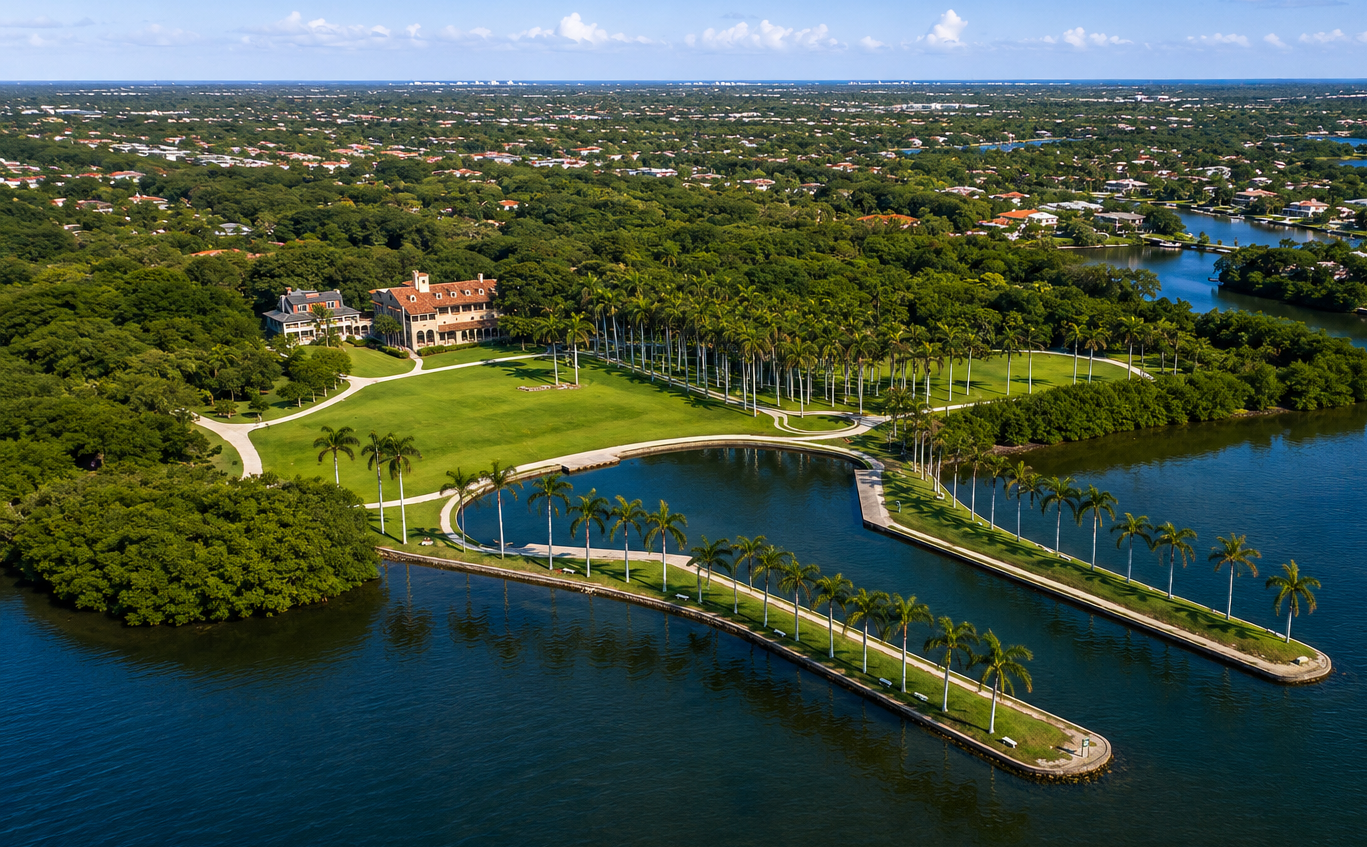
The park system matters more than most buyers realize. The village maintains more than 40 acres of parkland, including Coral Reef Park and Thalatta Estate, and it attracts a buyer who wants outdoor access without leaving the neighborhood. Combined with the school pipeline — Howard Drive Elementary in 33158, Southwood Middle, and Palmer Trinity private school a few blocks away — Palmetto Bay draws a specific type of buyer: Miami-Dade families who are upgrading from Kendall, Doral, or Miami Lakes and want more space, better schools, and lower density.
Out-of-state relocators do show up, but they are not the dominant buyer here. This is mostly a local move-up market, and that matters for how offers get structured and how sellers respond.
What the Palmetto Bay Real Estate Market Looks Like Right Now
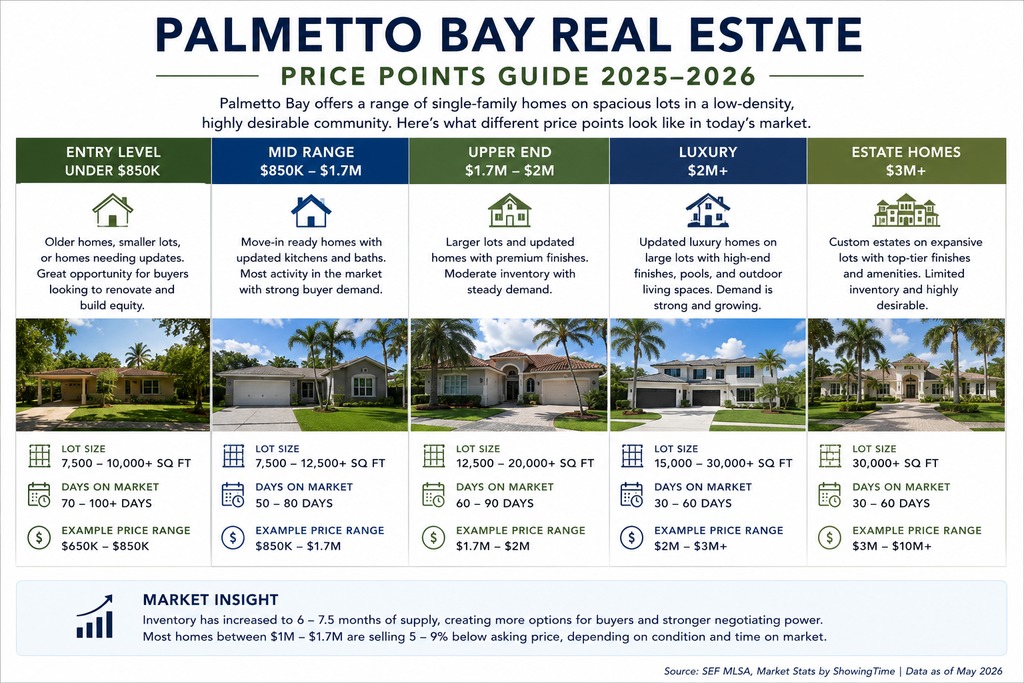
As of early 2026, the median sale price for a home in Palmetto Bay is approximately $1.1 million, up roughly 10% year over year. Price per square foot sits near $487. Homes are averaging around 58 to 82 days on market depending on price point and condition, compared to over 100 days in 2024. Inventory has grown to roughly 6 to 7.5 months of supply across most price tiers, which puts this squarely in balanced-to-buyer-leaning territory.
That last point is worth sitting with. From 2020 through early 2022, Palmetto Bay was a full seller's market. Multiple offers, waived inspections, homes going in days. That dynamic has shifted. Buyers now have options, and sellers — particularly those with older stock or aspirational pricing — are negotiating. Most homes in the $1M to $1.7M range are closing at 5 to 9% below asking, depending on condition and how long they have been sitting.
The exception is the luxury tier, specifically homes above $2 million with updated finishes. In that segment, days on market have actually dropped significantly and price per square foot has climbed to around $616 in recent sales. Demand for standout product at the top of the Palmetto Bay real estate market is real, and it is growing faster than the rest.
For buyers, the current conditions are about as close to favorable as this market gets. More listings to compare, sellers who have been waiting, and room to negotiate on price or terms. But that window is not permanent. Rates staying elevated keeps some buyers on the sideline, and when they come back in, the dynamics will shift again.
What Different Price Points Get You
Price ranges in Palmetto Bay are not just about size. They reflect condition, lot position, renovation status, and which zip code you are in. Here is a practical breakdown.
$700K to $1M: Entry-Level Single Family
This range still exists in zip code 33157, typically on the older housing stock. You are looking at 1,960 to 2,400 square feet, three to four bedrooms, and homes that were built in the late 1960s through early 1980s. Many of these have been partially updated but not fully renovated. Pools are common, but systems (AC, roof, electrical) may need near-term attention.
A home at this price point sold on SW 88th Avenue Road in early 2026 for $960,000 after just 10 days on market. It was a 4-bed, 2-bath at 1,880 square feet built in 1969. Clean, functional, and priced correctly. Homes like this move when they are priced right. When they are not, they sit.
$1M to $1.7M: The Core of the Market
This is where most of the activity is, and where buyers are most competitive. Four-bedroom, two-and-a-half to three-bath homes with updated kitchens and either a renovated pool or a large lot. Families driving this segment are not looking for projects. They want turnkey or close to it.
Demand is strongest for four-bedroom homes in the $1.6 to $1.7 million range that have been fully updated. Well-executed homes here move in the low-to-mid 40s for days on market. Homes that need work, or that are priced as if they don't, are sitting 90-plus days and taking price reductions.
$2M and Above: Fastest-Moving Luxury Segment
The $2M-plus segment in Palmetto Bay has grown from about 1% of total sales in 2021 to roughly 8% today. Days on market for standout homes in this tier have dropped to around 33 days, and price per square foot in recent sales has reached $616. Buyers here are often comparing to Coral Gables or Coconut Grove at similar price points, and choosing Palmetto Bay for the lot size, the privacy, and the school access that those areas cannot match at the same price.
The Mistakes Buyers Make in This Market
Buyers who want to dive deeper into common pitfalls should read these buying mistakes to avoid before scheduling showings. But the mistakes specific to Palmetto Bay are worth calling out directly.
The biggest one is treating days on market as a reliable signal on its own. A listing that shows 47 days on market might actually be a relisted property that spent 90 days under a different MLS number. Sellers in this market do this more often than buyers realize. A home that appears "fresh" may have been shopped and rejected at a higher price, relisted with a new agent and a photo refresh. Without access to the full listing history, you are making decisions on incomplete data.
Second: underestimating the insurance calculation. Florida homeowners insurance has gotten significantly more expensive in Miami-Dade. At the $1M to $1.5M price point, annual insurance can run $12,000 to $20,000 or more depending on age of roof, wind mitigation rating, and carrier availability. For a financed buyer, this adds meaningfully to the monthly payment and can affect debt-to-income qualification. Buyers who run the mortgage math without including insurance often get surprised at the underwriting stage.
Third: skipping pre-approval on the assumption they are "probably fine." At prices above $1M in Palmetto Bay, sellers and their agents expect proof of financing before taking an offer seriously. A pre-qualification letter is not a pre-approval. They are different documents with very different weight.
How Palmetto Bay Compares to Pinecrest and Cutler Bay
Buyers often end up comparing houses for sale in Palmetto Bay against similar searches in Pinecrest to the north and Cutler Bay to the south. The price differences are real, and so are the reasons for them.
Pinecrest consistently trades at a premium over Palmetto Bay. Median prices there run 15 to 25% higher depending on the street, and the lots tend to be larger. The school ratings are comparable, but Pinecrest has more name recognition for buyers coming from outside Miami-Dade. If you are a local family, you may find that Palmetto Bay gives you 80% of what Pinecrest offers at a meaningfully lower price per square foot.
Cutler Bay is more affordable, with median prices well below Palmetto Bay's $1.1M mark. But the school zoning, the lot sizes, and the community character are different. Buyers who are seriously considering Cutler Bay are usually in a different budget range, not a direct comparison group.
One thing Palmetto Bay has that neither neighbor fully replicates: a non-HOA single-family environment at scale. Pinecrest is also largely non-HOA, but Palmetto Bay's size, park system, and village identity give it a community feel without the rule-heavy oversight of HOA-heavy developments you find in Kendall or Doral. For buyers who want a real neighborhood without someone policing their driveway, that distinction matters.
Insurance considerations also vary by micro-market. Homes closer to the water in Palmetto Bay, particularly near Biscayne Bay in areas like Royal Harbour, will carry higher flood insurance requirements than homes farther west. Before making offers in those areas, run the FEMA flood zone lookup for the specific parcel. A home in Zone AE carries mandatory flood insurance. In some cases that adds $2,000 to $5,000 per year in carrying costs that the listing price does not reflect. Explore our Palmetto Bay area page to see current listings sorted by sub-area.
How to Actually Find and Win the Right Home
Searching portals like Zillow is a starting point, not a strategy. By the time a listing appears on Zillow, it has often been on the MLS for 12 to 24 hours, and in a market with limited inventory, the better homes get showings booked within hours of going live.
Setting up a VIP home search gives you MLS access directly, with alerts the moment a property matching your criteria hits the market. It also gives you listing history, which matters for the reasons described above.
When you find a home worth pursuing, the offer structure matters as much as the price. In a balanced market, sellers still have leverage on a well-maintained, correctly priced home. Coming in low without a clear reason is not a strategy, it is a way to get ignored. What actually works: a clean offer at or near asking, a strong pre-approval, a reasonable inspection window (not waived, but not 15 days either), and a closing timeline that works for the seller.
On financing: at prices above $1M, the difference between a buyer who controls their financing and one who is relying on a lender they found online two weeks ago is enormous. Lenders unfamiliar with Florida insurance requirements, or who cannot move quickly on a jumbo approval, create delays that kill deals. When the broker handling your search also controls your financing, the coordination is tighter, the approval moves faster, and sellers take the offer more seriously.
Before you start budgeting, run the numbers on our mortgage calculator to get a realistic monthly payment figure that includes taxes and insurance, not just principal and interest.
Alberto Labrada handles real estate, financing, and title under one roof at Labrada Realty. For buyers in the $1M-plus range, that single-point coordination is not a convenience, it is often what separates an accepted offer from a missed one. Visit our buyers page to see how the process works and what to expect at each step.
Frequently Asked Questions
Q: How much do homes for sale in Palmetto Bay typically cost in 2026?
A: The median sale price in Palmetto Bay is approximately $1.1 million as of late 2025 and early 2026, up about 10% from the prior year. Price per square foot runs around $487 for most of the market. Entry-level single-family homes in zip code 33157 can be found in the $700K to $950K range, while the bulk of transactions happen between $1M and $1.7M. The $2M-plus segment is growing fastest in terms of demand, with recent sales recording price per square foot as high as $616 on fully updated properties.
Q: Is Palmetto Bay a good place to buy a home for families?
A: Few areas in Miami-Dade combine what Palmetto Bay offers families: low density, predominantly single-family zoning, more than 40 acres of maintained village parkland, and access to some of the county's better-rated public schools. Howard Drive Elementary in zip code 33158 has been serving the area for over 60 years, and Southwood Middle draws from across the village. For families comparing Palmetto Bay to Pinecrest, the lifestyle is very similar and the price per square foot is generally lower. Westminster Christian and Palmer Trinity are both within the village boundaries for families considering private school options.
Q: What zip codes cover Palmetto Bay, FL?
A: Palmetto Bay spans three zip codes: 33157, 33158, and a portion of 33176. Most of the residential activity falls in 33157 and 33158. The zip code matters more than people expect. Some school zones and flood risk profiles shift between them, and the character of the housing stock is slightly different. The northern portion of Palmetto Bay in zip code 33158 tends to sit at higher elevations and includes Howard Drive Elementary's school zone. Zip code 33157 covers more of the southern and central village areas, with a broader mix of price points and home ages.
Q: How long does it take to close on a home in Palmetto Bay?
A: For a financed purchase, expect 35 to 50 days from executed contract to close. Jumbo loans above the conforming loan limit require additional underwriting steps, and Florida's insurance market adds a wrinkle: lenders want confirmed insurance bound before closing, and not every carrier writes policies in Miami-Dade on the same timeline. Cash transactions can move in 14 to 21 days in most cases. One thing that consistently slows closings in Palmetto Bay is a buyer arriving with a lender who is unfamiliar with Florida's insurance requirements or who underestimated the property's coverage costs. Having a broker who coordinates real estate, financing, and title in-house keeps that process tighter.
Q: Can I get financing on a home in Palmetto Bay, or is this mostly a cash market?
A: Palmetto Bay runs about 12% cash buyers, which means roughly 88% of transactions are financed. This is primarily a financed-buyer market, unlike some parts of Miami Beach or Brickell where cash deals are more common. That said, at prices above $1M, most loans are jumbo products, which have stricter qualification standards and different processing timelines than conforming loans. Pre-approval on a jumbo is not interchangeable with a standard pre-approval, and sellers' agents in Palmetto Bay will look at the specifics. If your pre-approval came from an online lender who has never closed a jumbo in Florida, expect pushback.
Ready to Search Palmetto Bay Homes?
If you are serious about finding a home in Palmetto Bay and want to see everything on the market, not just what the portals show, set up a VIP home search through Labrada Realty. You get real-time MLS access, full listing history, and direct guidance on what each property is actually worth in the current market. Because Alberto handles real estate, financing, and title from one office, you are not passing the ball between three different professionals every time a question comes up. For buyers in this price range, that matters.
Check out this article next