


FOR FLORIDA LANDLORDS

Should I Sell My Rental Property?

Selling a rental is not the same decision as selling the home you live in. A landlord has to weigh what the property earns, what it costs to keep, what a sale would cost in taxes and fees, and what the equity could do elsewhere. If you're considering selling your rental property, start with the numbers. Sometimes the right answer is to keep it.

I'm Alberto Labrada, a licensed Florida real estate broker, mortgage broker, and title agent with more than 20 years in Miami-Dade real estate. I'm not an attorney or a CPA, and nothing on this page is legal or tax advice.

Thinking About Selling Your Rental Property?
Get My Property Value & Net Estimate

Get My VIP Home Valuation

Should I 

Sell My Rental Property?

Not every landlord should sell, and a strong rental can be worth keeping. Before you sell investment property, here are the questions I ask first.

  • Has your equity changed? If the property has appreciated a lot, a large share of your money is sitting still. Equity that earns nothing is a cost.
  • What is the return after everything? Count property taxes, insurance, HOA or condo fees, repairs, vacancy and any management fee. Then divide by what you could walk away with today, not what you paid years ago.
  • Are expenses growing faster than rent? Insurance and association costs in South Florida have moved faster than many leases, and a rent increase has limits.
  • Is a big expense coming? A roof, an air conditioning system, a building assessment or a re-pipe can erase a year of income.
  • Could the equity work harder elsewhere? Compare the net return on the property with what the same dollars could earn after tax.
  • Do you still want the work? Calls, turnovers and repairs have a cost even when a manager handles them.

If most of those answers favor the property, keep it. If you are tired of the work, my post on being tired of being a landlord walks through that side of the decision. This page is about the money.

Tired of Being a Landlord?

How much is

My Rental Property Worth?

Value comes from two directions. Comparable sales tell you what buyers have recently paid for similar properties. Investment economics tell you what an investor would pay for the income. For most Miami-Dade single-family homes, condos and townhomes, comparable sales carry the most weight, because owner-occupants compete with investors for them. A duplex or a small multifamily building leans harder on rent and expenses.

The split matters in places like Kendall and Doral, where one townhome community can attract both a family that wants to live there and an investor who wants the rent. Your price depends on which buyer your property fits better. A broker price opinion gives you a realistic range before you commit to anything.

Get my VIP Home Valuation

Can I Sell My Rental Property With a Tenant?

Generally, yes. A rental property can be sold while it is occupied. The lease, the tenant's rights, showing logistics, the security deposit and what happens after closing all need to be handled correctly, and the contract should say how. Showings usually take coordination with the tenant, so plan the schedule with the lease in hand.

This question has its own page, because the answer depends on your lease and your timeline.

Selling a House With Tenants

Professional Highlights

Experience Matters

0

+

Years in Miami Real Estate

0

Professional Licenses
(Real Estate | Mortgage | Title)

$

0

M+

Closed Sales

0

+

Closed Transactions

Should I Sell

Vacant or With the Tenant in Place?

The better strategy depends on who is most likely to buy.

An investor may pay more for a reliable tenant, a lease with time left and a documented rent history. An owner-occupant, including a buyer using low down payment financing, usually cannot use a tenant-occupied property as a home and may place more value on vacant possession.

Property condition, lease expiration, rent level and the buyer pool decide which route nets you more. A tenant paying well below market rent can work against you with an investor. A tenant paying above market on a lease with 18 months left can work for you. I price both routes before recommending one.

Should I sell

As-Is or Make Repairs First?

The question is not whether renovations raise the price. They often do. The question is whether they raise your net proceeds enough to justify the cost, the time and the risk.

Say a $20,000 update lifts the price by $15,000. You lost money, and you held the property longer to do it. Say a $3,000 repair removes an inspection objection that would have cost you $10,000 in negotiation. That one pays for itself. Selling investment property to another investor changes the repair math, because cosmetic work often adds little when the buyer plans to redo it anyway.

Get a repair opinion tied to your likely buyer before you spend. When you sell investment property, the cheapest fix is usually the one that removes a financing or insurance problem, not the one that makes the kitchen look new.

How much will I

Keep If I Sell?

Start with a simple formula:

Sale price, minus mortgage and lien payoffs, minus selling expenses, equals estimated net proceeds.

Estimated net proceeds are cash in hand before income taxes. When you sell rental property, that is the number to compare against what the property earns each year. A landlord who sees only the sale price is looking at the wrong number.

What does it cost to

Sell a Rental Property in Florida?

The main costs when you sell rental property in Florida are:

  • Broker compensation, which is negotiable
  • Documentary stamp tax on the deed
  • Title and closing charges where they apply, including who pays for the owner's title policy
  • Mortgage and lien payoffs
  • HOA or condo charges, and estoppel fees
  • Prorated property taxes
  • Any concessions you negotiate

I keep the detail on a separate page so this one stays focused on your decision. Our complete guide to seller closing costs in Florida covers each line item.

Seller Closing Costs in Florida

Calculate Your

Estimated Net Proceeds

Enter your expected price, payoff and closing costs and see a realistic number in about a minute. It is built for Miami-Dade and Broward sales and lets you compare up to three price scenarios, so you can see how a lower or higher sale price changes what you keep.

Calculate my net proceeds
See a Net Sheet Breakdown

Sale Example

Here is a hypothetical, using round numbers. It is an illustration, not a quote.
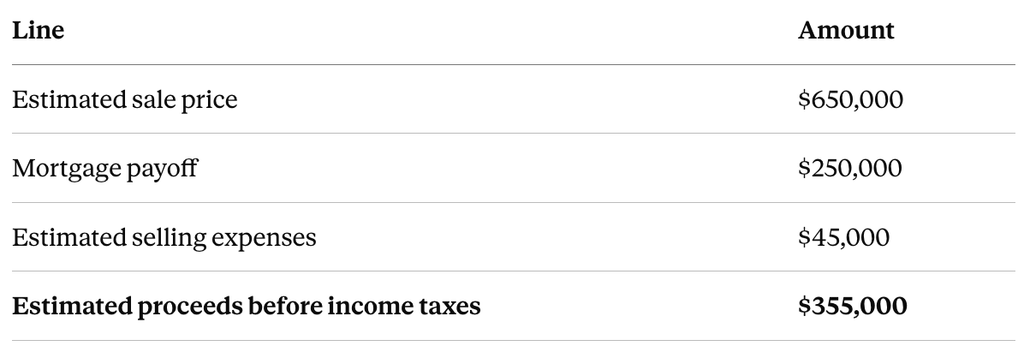
Hypothetical sell my rental property net proceeds example, $355,000 before income taxes

Net sale proceeds and taxable gain are different calculations. Proceeds are the cash that reaches you. Taxable gain is generally based on the amount realized from the sale compared with your adjusted basis, which can reflect your original basis, qualifying improvements, depreciation allowed or allowable, and other applicable adjustments. Your mortgage payoff reduces your cash, but it does not reduce your gain. Two landlords with the same $355,000 in proceeds can owe very different amounts in tax.

What About

Capital Gains and Depreciation?

Selling investment property can have federal tax consequences, and they are different from the ones that apply to a primary residence. At a high level, two things matter. The profit on the sale can be a capital gain. And depreciation you claimed, or were allowed to claim, while renting the property can be taxed differently from the rest of the gain. Your basis, your improvements, how long you owned it and your own tax situation all change the result.

The home sale exclusion most owners have heard of has use requirements, and a long-term rental often does not meet them. For background, the IRS explains the rules in Topic 409 on capital gains and losses, Publication 544 on sales of property and Publication 527 on residential rental property.

I won't estimate your tax bill. Bring the question to your CPA or tax adviser before you list. The same goes for whether a tax-deferred exchange could fit your plans, because the timing rules can limit your options once you are under contract.

How we approach

a Rental Property Sale

Here is the sequence I follow with landlords. The point is to learn what selling would accomplish financially before anything goes on the market.

  1. Establish the value. Comparable sales and, where it applies, the income the property produces set the range. A VIP home valuation gives you a number built on both.
  2. Review the tenant and lease. Lease end date, current rent compared with the market, deposit and the tenant's rights shape the strategy and the timing.
  3. Walk the condition. List what is deferred, such as roof, air conditioning, plumbing and electrical, and what a buyer's lender or insurer will require.
  4. Identify the likely buyer pool. An investor, an owner-occupant or both, and what each would pay.
  5. Estimate the selling expenses. Commission, doc stamps, title and closing charges, association costs and prorations.
  6. Calculate the estimated net. Price minus payoffs minus costs, run in the calculator before the first conversation about listing.
  7. Compare selling with keeping. If keeping is the better financial result, I tell you so.

I do not just tell you what the property might sell for. The question is what selling accomplishes for you compared with holding on, and that is different from a generic "what's my home worth" request.

Selling a Property

In Miami-Dade and Broward

Statewide rules get you started, but a rental in Miami-Dade or Broward still needs local pricing and local knowledge. I have spent more than 20 years in Miami-Dade real estate, and rentals here come with wrinkles a generic checklist misses.

  • Condo and HOA rules. Many Miami-Dade buildings restrict or limit rentals, and some require buyer approval, so the building's rules shape who can buy your unit and how fast. An investor needs to know them before offering. Order the estoppel early, because it adds time and can surface unpaid dues or special assessments.
  • Insurance and roofs. Older roofs can make it harder for a buyer to bind insurance, which can delay financing. A roof age, a wind mitigation report and a recent four-point inspection answer the question before it is asked.
  • Micro-markets. A Kendall townhome, a Doral condo and a Brickell unit each draw a different mix of investors and owner-occupants, so pricing is decided building by building and block by block, not county-wide.
  • Inherited rentals. If you inherited the property rather than bought it, the steps change, including who has authority to sign. Our page on selling inherited property in Florida covers them.

Because I hold broker, mortgage, and title licenses, I can look at pricing, a buyer's likely financing, and the closing mechanics together instead of passing you between three offices.

Selling Inherited Property in Florida

Frequently Asked Questions

Should I sell my rental property?

It depends on your net return, not your sale price. Compare what the property earns after taxes, insurance, repairs and vacancy against what your equity could earn if you sold. Also weigh upcoming major expenses and how much of the work you want to keep doing. A strong rental can be worth keeping. A property with rising costs and a large amount of idle equity is a candidate to sell.

How much tax will I pay if I sell a rental property?

It varies by owner. A sale of rental property can involve capital gain and depreciation recapture, and your basis, improvements, holding period and income all matter. Net proceeds and taxable gain are different numbers, and your mortgage payoff does not reduce your gain. I cannot calculate your tax, so take your figures to your CPA or tax adviser. The IRS explains the rules in Publication 544.

Can I sell a rental property with tenants?

Generally, yes. An occupied rental can be sold, but the lease, the tenant's rights, showing access, the deposit and the transition at closing need to be addressed in the contract. Showings usually take coordination with the tenant, so plan the schedule with the lease in hand. Our selling a house with tenants page walks through the process.

Is it better to sell a rental property vacant or occupied?

Neither wins every time. Investors may pay more for a dependable tenant and documented rent history, while owner-occupants often prefer vacant possession. Lease length, rent compared with the market, condition and the likely buyer pool decide it. In a condo, the association's rental rules also affect who can buy. Weigh both routes by net proceeds.

Should I renovate my rental property before selling?

Only if the work raises your net proceeds by more than it costs in money, time and risk. Repairs that remove an inspection, insurance or financing obstacle tend to pay off. Cosmetic updates on a property headed to an investor often do not. Get a repair opinion tied to your likely buyer before you spend.

How much will I net from selling my rental property?

Subtract your mortgage and lien payoffs and your selling expenses from the sale price. That gives you proceeds before income taxes, which is the figure to compare against what the property earns each year. Our Seller Net Proceeds Calculator handles Miami-Dade and Broward sales and compares up to three prices. Confirm the tax side with your CPA.

In the Words of our Clients

Success Stories

"Absolutely love the job done by Albert , he was professional, caring and extremely knowledgeable. He handled both the sale of our home in Miami as well as the purchase of our new home in Punta Gorda. He made a challenging situation very easy and comf…
"Albert Labrada handled the sale of our home in Miami in a most professional manner from start to finish. He walked us through the entire process and managed the negotiation with real skill, keeping us confident every step of the way. What really stoo…
"We recently moved to Miami from out of state, and we couldn’t have done it without Albert & Luis. They worked with us remotely over MONTHS - curating properties to see, doing FaceTime viewings, and ultimately finding us the most perfect home. Incredi…
"I cannot recommend enough Alberto Labrada and Labrada Realty in general. From the moment I reached out to him, he was on top of everything, assessing my needs, carrying me through the whole process and finding the best place for me and my daughter. T…
"Strong guidance was provided by this real estate agency during an investment property search. Financial expectations and long-term goals were first understood before presenting any options. Market insights were shared clearly, including pricing trend…
"Trabajar con Albert es una excelente experiencia y lo recomiendo plenamente. Abert cuenta con un gran conocimiento del proceso de compra - venta, atención al detalle y una capacidad para anticiparse a cada paso, transmitiendo tranquilidad y seguridad…

"Working with Alberto and his team was truly an exceptional experience. From beginning to end, he demonstrated professionalism, deep market knowledge, and genuine dedication. He made what could have been a stressful process feel smooth, organized, and…
"We have worked with Alberto over the last decade to rent our home. He has thoroughly vetted tenants ensuring a mutual fit. He is reliable and consistently communicates, it is great to work with him."
"Excelentes Profesionales, muy grata experiencia trabajar con Labrada Realty. 100% recomendados."
"We had the pleasure of working with Albert from Labrada Realty, and we couldn’t be happier with our experience. From start to finish, Albert was professional, knowledgeable, and truly dedicated to helping us find the perfect home for our family. He …
read all

Should you

Keep or Sell Your Rental Property?

If you are still deciding, we can go through the numbers together: value, expected net and what the property earns today. No listing agreement required.

VIP HOME VALUATION
Net Proceeds Calculator

Estimates only. This page is general information, not tax or legal advice. Confirm tax questions with your CPA or tax adviser and legal questions with an attorney.