
Most people searching for luxury homes for sale in Miami assume the market works like everywhere else, just with bigger price tags. It doesn't. Above roughly $5 million, the rules change entirely. Comparables stop working the way buyers expect. Price per square foot becomes close to meaningless. And the properties that actually define this tier, the ones on Star Island, Fisher Island, Indian Creek Island, Golden Beach, and inside Gables Estates, rarely behave like a typical listing. Buyers who treat these five enclaves as one category lose leverage before they make an offer. Sellers who price them like standard waterfront homes leave money sitting on the table. Here's how each one actually works, and what separates real value from a number that just looks impressive.
What Counts as Luxury Homes for Sale in Miami Right Now
Ten years ago, $2 million bought entry into most of Miami-Dade's better waterfront pockets. This threshold has moved. Between construction cost increases, insurance repricing, and a wave of buyers relocating from the Northeast and California, the practical floor for luxury homes for sale in Miami now sits closer to $4 million for a genuine waterfront single-family home, and well above $6 million for anything inside a gated island community.
Condos follow a separate scale entirely. A well-located Brickell tower unit can carry a luxury price tag at $2 million, while a comparable unit on Fisher Island rarely trades below $3.5 million because access itself is part of what a buyer is paying for. Current price-per-square-foot averages across Miami-Dade's top waterfront zip codes now run between $1,100 and $2,400, with the islands routinely clearing that range on land value alone.
This distinction matters because national portals and generic market reports still use a flat $1 million cutoff for "luxury." That number describes a nice house in Palmetto Bay. It does not describe anything in the five enclaves that actually define Miami's top tier, and pricing a search around it wastes time on inventory that was never comparable to begin with. Anyone typing generic terms like homes for sale Miami Dade into a national search bar will get a results page that mixes a starter home in West Kendall with a $30 million estate, sorted only by price, with no context for why either number exists.
Seasonal demand also behaves differently at this tier than it does elsewhere in the county. Standard single-family activity in Miami-Dade slows in the summer heat and picks up in the fall. Luxury demand across these five enclaves peaks between November and April instead, tracking snowbird arrivals and the winter social calendar, which means a listing that sits quietly in August can draw multiple offers the moment season buyers land in October. Sellers who list Miami county homes for sale at this level in late spring, hoping for a slow-season discount from a motivated buyer, usually end up waiting for a fall relaunch instead.
The Five Enclaves That Define Luxury Homes for Sale in Miami
Each of these five places restricts who can even view a listing, not just who can afford one. Access is the first filter, and it works differently in each location.
Star Island
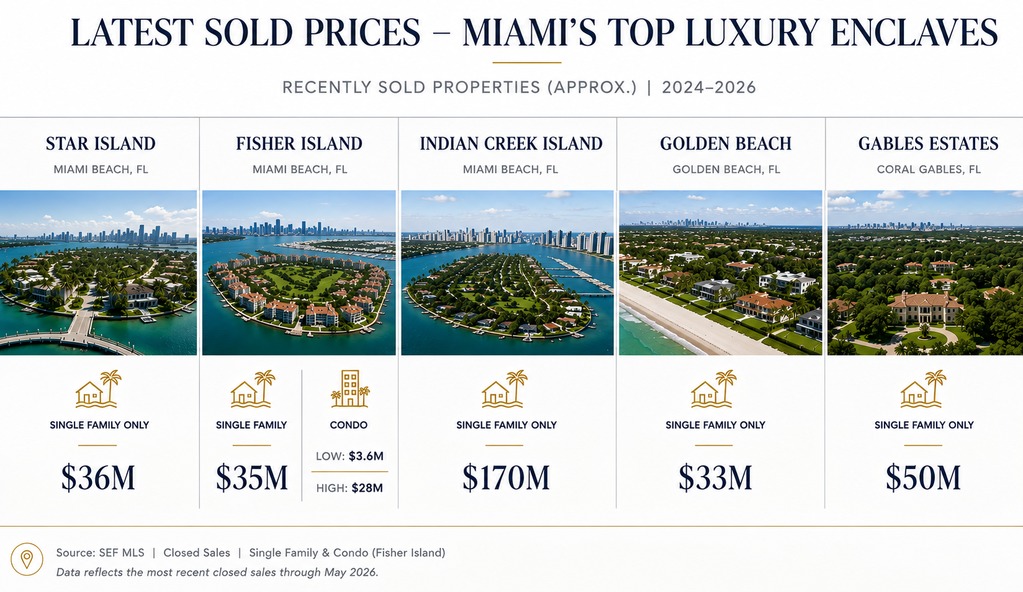
It sits on a single spur off the MacArthur Causeway, reachable only through a guarded gate that logs every vehicle entering. Roughly 34 lots make up the entire island, and turnover is slow enough that a single new listing can move the island's median price by a meaningful margin. Waterfront lots here regularly trade for land value alone, with the existing structure treated as a teardown.
Fisher Island
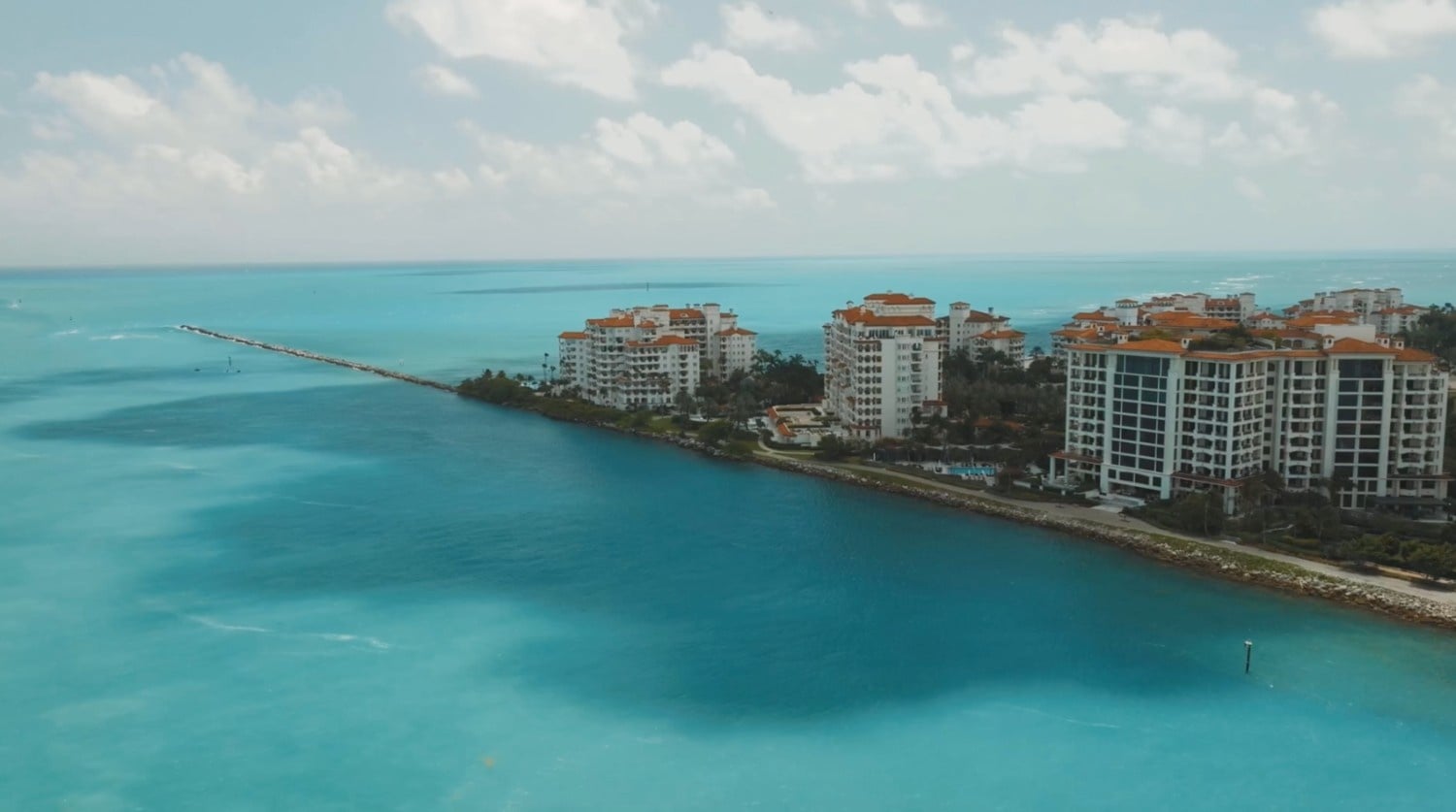
Ferry-access only, with no bridge or causeway connecting it to the mainland. This lack of a land connection does more to control price than any HOA rule could. Current Fisher Island listings range from roughly $3.75 million for a two-bedroom unit up to a $42 million estate-style residence, and inventory moves through a private membership structure that most buyers never see coming.
Indian Creek Island
Maintains its own police department, a detail that tells you everything about the buyer profile. With around 40 properties total and almost no turnover, a single sale here can define pricing for the entire market for the following year. Privacy, not square footage, is the primary product.
Golden Beach
Sits north of Sunny Isles as its own incorporated town, distinct from the city of Miami Beach, with direct beachfront lots and a lower-key profile than its southern neighbors. Buyers who want oceanfront land without the density of Sunny Isles condo towers gravitate here, and lot sizes tend to run larger than comparable oceanfront parcels farther south.
Gables Estates
Operates behind a guarded gatehouse off Old Cutler Road in Coral Gables, with deep-water canal access built for yachts rather than smaller boats. Unlike the islands above, it's a mainland community inside the broader Coral Gables market, which means slightly more inventory turnover and a buyer pool that skews toward established Miami families alongside newer arrivals.
Search platforms that aggregate houses for sale in Miami Dade county rarely separate these five from the surrounding market, which means a buyer scrolling a generic portal sees a Kendall single-family listing next to a $30 million Star Island estate with no context for why the price gap exists. Buyers who want the fuller neighborhood picture around Miami Beach's luxury towers and mansions can find that depth covered separately in our Miami Beach luxury market breakdown.
Why Price Per Square Foot Fails at the Top of the Market
Below $2 million, price per square foot is a useful shorthand. Above $6 million, it starts to mislead buyers badly.
A 6,000 square foot home on a standard lot and a 6,000 square foot home on 200 feet of deep-water frontage with a private dock are not the same asset, even if the finishes are identical. The dock alone, particularly one that can accommodate a yacht over 100 feet, can represent millions in value that has nothing to do with the structure sitting on the land.
This is where buyers new to the market get pricing wrong. They compare a Gables Estates listing to a Coral Gables interior-lot home using dollars per square foot and conclude the waterfront property is overpriced. It isn't. The land, the dockage, and the access are the product. The house is almost secondary, and appraisers working these five enclaves know to weight the lot and the water rights heavily rather than defaulting to a countywide per-foot average.
The Two Bottlenecks That Kill Luxury Deals: Board Approval and Insurance
Two mechanical issues stall more luxury transactions than pricing disputes ever do, and both catch out-of-town buyers off guard.
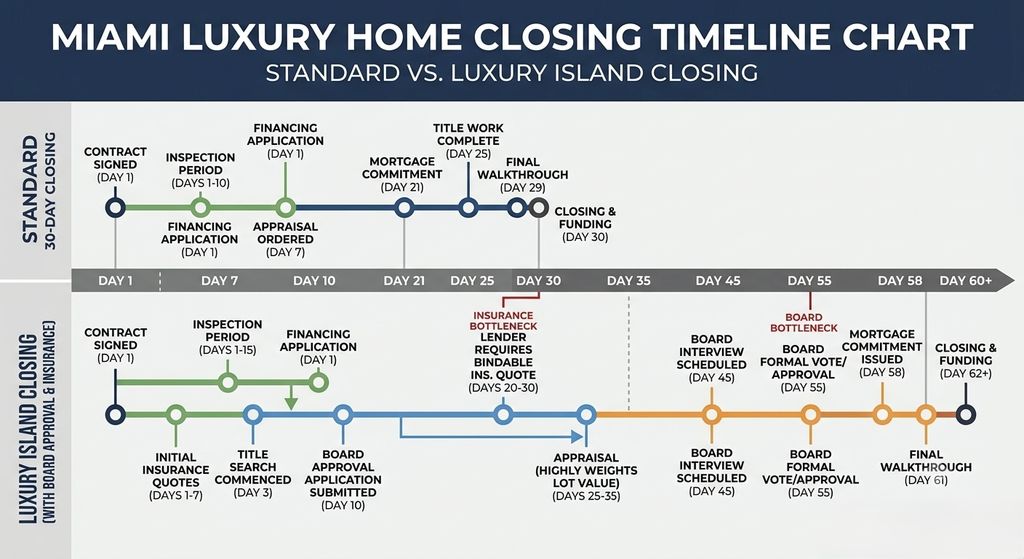
Fisher Island and several Star Island condo associations run board approval processes that can take four to eight weeks, including financial disclosure, personal interviews, and in some cases a formal vote. A buyer who assumes this works like a standard Florida condo closing, thirty days from contract to keys, will blow past their financing contingency before the board even schedules a meeting. Building this timeline into the contract from day one protects the buyer's deposit and keeps the seller's exposure limited if the deal falls through for reasons unrelated to price.
Insurance is the newer problem. Coastal luxury properties, especially older construction on the islands, have seen windstorm and flood premiums rise sharply since 2023. Lenders now require a bindable insurance quote earlier in the process than they used to, and on properties built before current wind-mitigation standards, that quote can take one to two weeks longer to generate. Deals that used to close in 45 days now regularly need 60, and buyers who don't plan for that gap end up asking for extensions from a position of weakness rather than strength.
Foreign buyers, who represent a meaningful share of activity in these five enclaves, often sidestep the insurance timeline entirely by paying cash, but they introduce a different friction point: funds verification and source-of-funds documentation for anti-money-laundering compliance can add its own week or two, particularly for buyers wiring funds from outside the United States for the first time. This pattern shows up consistently enough across Miami county homes for sale at the top of the market that it should be planned for on every contract involving an international buyer, not treated as an exception.
The Mistake That Costs Luxury Buyers Leverage
A buyer shopping Golden Beach in late 2025 found an oceanfront lot listed at $8.9 million, sitting on the market for 140 days with no price movement. Assuming a stale listing meant a motivated seller, the buyer waited to make an offer, expecting the price to drop further.
It didn't. The seller had priced the lot correctly from the start based on land value and buildable square footage under current beachfront setback rules, not on days on market. A second buyer moved during that waiting period and closed near asking price. The lot the first buyer wanted was gone, and comparable oceanfront lots that came to market afterward were priced 12 percent higher based on the new closed sale.
The lesson holds across all five enclaves: at this tier, days on market rarely signals desperation the way it does in a standard single-family market. Low inventory means sellers can hold their number, and buyers who wait for a discount that isn't coming usually end up paying more later for a lesser property, or losing the one they actually wanted. This is also why serious buyers run financing pre-approval through a mortgage calculator and get a real number before they start touring, rather than after they've already fallen behind a competing offer.
Why the Broker Handling the Deal Should Also Control the Financing and Title
The bottlenecks above, board approval timing, insurance turnaround, and funds verification, all share one thing in common: they get worse when three separate professionals, an agent, a loan officer, and a title agent, aren't communicating on the same timeline.
A broker who also holds a Florida mortgage broker license and a title agent license can move a bindable insurance quote and a title search forward in parallel with the board approval process instead of waiting for each step to finish sequentially. On a Fisher Island or Star Island transaction where the board process alone can eat six weeks, running financing and title concurrently rather than sequentially can be the difference between closing on schedule and losing a deposit to a blown contingency date.
This is also where buyers searching broader terms like homes for sale Miami dade or houses for sale in Miami Dade county end up underserved. Generic portal searches return listings, not the closing infrastructure needed to actually get one of these five enclaves across the finish line, and sellers weighing a listing price benefit from the same coordinated approach, which starts with an accurate home valuation built around comparable island and enclave sales rather than a countywide algorithm.
Luxury homes for sale in Miami reward buyers and sellers who understand that the five enclaves above don't behave like the rest of Miami-Dade's market, and who plan their financing, insurance, and approval timelines around that reality instead of a standard 30-day closing.
Frequently Asked Questions
Q: What is considered a luxury home for sale in Miami?
A: The practical floor has moved to roughly $4 million for a genuine waterfront single-family home, and above $6 million for anything inside a gated island community like Star Island or Indian Creek. National portals that use a flat $1 million cutoff are describing a nice home in an area like Pinecrest, not the properties that define Miami's actual top tier. Condos follow a separate scale, since access can add more to price than square footage does.
Q: How much do luxury homes in Miami-Dade County cost per square foot?
A: Per-square-foot pricing becomes unreliable above roughly $6 million because land, dockage, and access drive value more than the structure itself. Current averages across Miami-Dade's top waterfront zip codes run between $1,100 and $2,400 per square foot, and a deep-water lot with 100-plus feet of frontage on Gables Estates or Star Island can carry millions in value that has nothing to do with the home sitting on it.
Q: Can foreign buyers purchase luxury homes for sale in Miami with cash only?
A: Yes, and a significant share of activity in Star Island, Fisher Island, and Indian Creek Island comes from all-cash foreign buyers. Cash avoids the insurance-driven financing delays lenders now require on coastal properties, but it introduces its own friction: source-of-funds documentation and anti-money-laundering verification, especially for buyers wiring funds internationally for the first time, can add one to two weeks to closing.
Q: How long does board approval take on Fisher Island or Star Island?
A: Association approval on Fisher Island and several Star Island buildings typically runs four to eight weeks, and can include financial disclosure, a personal interview, and a formal board vote. Buyers who assume this works like a standard thirty-day Florida condo closing frequently run past their financing contingency before the board even schedules a meeting, which is why the timeline needs to be built into the contract from the start.
Q: Is Golden Beach part of Miami-Dade's luxury home market or a separate town?
A: Golden Beach is its own incorporated town north of Sunny Isles, distinct from the city of Miami Beach, though it sits within Miami-Dade County. It offers direct beachfront lots with less density than the condo towers farther south, and lot sizes tend to run larger than comparable oceanfront parcels elsewhere in the county, which appeals to buyers who want land without high-rise neighbors.
If you're weighing one of these five enclaves against another, explore current luxury listings across Miami and get a straight answer on what the board approval and insurance timeline will actually look like for the specific property you're considering.
Check out this article next