


Every divorcing couple I sit down with assumes the house is frozen until the settlement is signed. It is not. Selling property before divorce settlement is legal in Florida, and in plenty of cases it puts more cash in both spouses' pockets than waiting on a court date. The people who get hurt are the ones who let uncertainty stall the decision for months while carrying two mortgage payments, rising insurance premiums, and a listing that loses leverage the longer it sits. I have handled sales that closed while the divorce was still active, and the outcome depended almost entirely on timing, not on who wanted out faster. This article walks through what Florida law actually requires, how equitable distribution affects the split, and exactly where couples give up money they didn't have to.
Do You Actually Have to Sell the House in a Florida Divorce?
The question I hear most often is Do I have to sell my house in a divorce, and the honest answer is no, not automatically. Florida courts do not order a mandatory sale in every case. A judge can award the home to one spouse, approve a buyout where one party refinances and pays the other their share of equity, or approve continued co-ownership under a settlement agreement for a defined period, usually until kids finish out a school year.
In Kendall and Westchester, I have watched spouses attempt a nesting arrangement, where the kids stay in the house and the parents rotate in and out, for six months before realizing the carrying costs outweighed the benefit. The sale conversation restarts anyway, usually with less equity to split than if they had listed on day one.
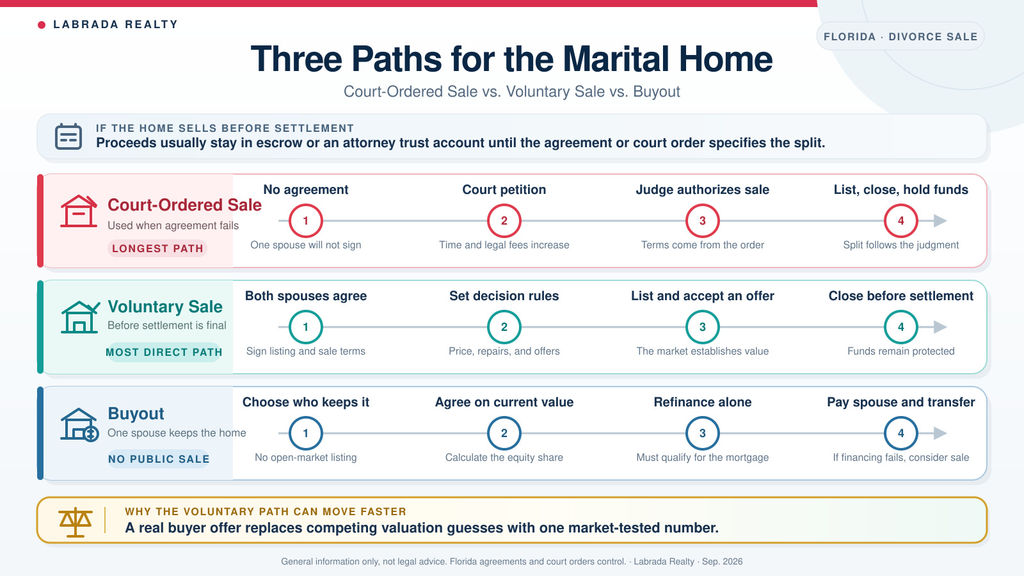
Divorce selling house decisions usually fall into one of three categories: a court-ordered sale, a negotiated buyout, or a voluntary sale before the settlement is signed. A sale becomes the realistic outcome in three situations. Neither spouse can qualify to refinance the mortgage solo. Neither wants to keep a property tied to the marriage. Or liquidating is the only clean way to divide the equity without one party owing the other a lump sum they cannot produce. If any of those apply, waiting rarely improves the outcome.
Marital Property vs. Separate Property: What Actually Gets Divided
Florida draws a line between marital property, which is anything acquired during the marriage, and separate property, which includes assets owned before the marriage or received individually through inheritance or gift. On paper, a house purchased before the wedding should stay separate.
In practice, commingling changes that. If mortgage payments came from a joint account, if the couple refinanced together, or if marital funds paid for a kitchen renovation or a new roof, part or all of the appreciation on that home can become marital property subject to division. I have seen this catch homeowners off guard more than any other part of the process. For a clear breakdown of how commingling reshapes ownership, Nolo's guide to dividing property in a divorce walks through the distinction state by state.
How Florida Splits the House in a Divorce (Equitable Distribution, Not 50/50)
How do you split the house in a divorce in Florida comes down to one governing standard: equitable distribution, not automatic fifty fifty. Judges start from the premise that the split should be equal, then adjust based on factors laid out in Florida Statute 61.075, including the length of the marriage, each spouse's financial and non-financial contributions, and the economic circumstances each party will face after the divorce.
Non-financial contributions carry more weight than most people expect. A spouse who stayed home to raise kids or managed the household while the other worked can receive a larger share of the home's equity even without a matching paycheck history. Judges have real discretion here, and equitable can land at sixty forty or wider depending on need.
Valuation is where a lot of these cases stall before they ever reach a courtroom. One spouse pulls a number from an online estimate, the other hires an appraiser, and the two figures can be sixty or eighty thousand dollars apart in a competitive zip code. A licensed appraisal or a real comparative market analysis from an agent who knows the specific area settles this faster than either spouse arguing from a number they found on a listing portal.
Selling Property Before Divorce Settlement: What Actually Changes
Selling property before divorce settlement changes the negotiation dynamic in a way most attorneys do not explain clearly upfront. Once a signed contract exists, the number stops being theoretical. Appraised value guesses and dueling opinions about what the home is worth disappear, replaced by an actual buyer's offer sitting on the table.
Selling home in divorce cases works differently depending on whether the sale closes before or after the settlement is signed. Divorce and selling house timelines rarely align on their own, which is exactly why couples who list before the settlement is finalized usually settle faster. A firm number ends arguments that shifting estimates keep alive.
I worked a case in Cutler Bay where the couple disagreed for four months over a one hundred eighty thousand dollar valuation gap between two competing appraisals. Once we listed and received an offer within nine days at six hundred twelve thousand dollars, the number stopped being an argument. The settlement closed six weeks later because there was nothing left to fight about.
There is a real cost to waiting on the other side of this too. A pending sale can actually speed up settlement talks because both attorneys are negotiating against a closing date instead of an open-ended timeline, which tends to sharpen everyone's focus.
Before you list, put in writing who has final say on price reductions, repair negotiations, and accepting an offer. I ask both spouses to sign off on a pricing strategy and a floor number before the first showing happens, because a listing that stalls waiting on one spouse to respond to an offer loses momentum fast, and momentum is worth real money in the first three weeks on market.
Sale Proceeds When Selling Property Before Divorce Settlement Is Final
Sale proceeds when selling property before divorce settlement is finalized do not go directly into either spouse's checking account. Divorce selling house proceeds typically land in an escrow account or the trust account of one of the attorneys, held there until the settlement agreement or final judgment specifies how the money gets divided.
Title companies in Miami-Dade will not release funds to either spouse individually without a signed agreement or a court order spelling out the split, even when both names are on the deed. This protects both parties, but it also means you should ask your closing agent about the net figure well before you sign anything. A Florida seller net sheet shows exactly what leaves the table for commissions, taxes, and payoff before anyone sees a dollar.
Tax treatment adds another layer. Transfers of property between spouses that happen as part of a divorce are generally not taxable events under federal law, but once the home sells to a third party before the divorce is final, standard home sale exclusion rules apply based on ownership and use. For the specifics on how the exclusion works when a marriage is ending, IRS Publication 504 covers divorced and separated individuals directly, and our breakdown of capital gains tax on a Florida home sale walks through the numbers for local sellers.
How Property Type and Location Affect Your Sale Timeline During a Divorce
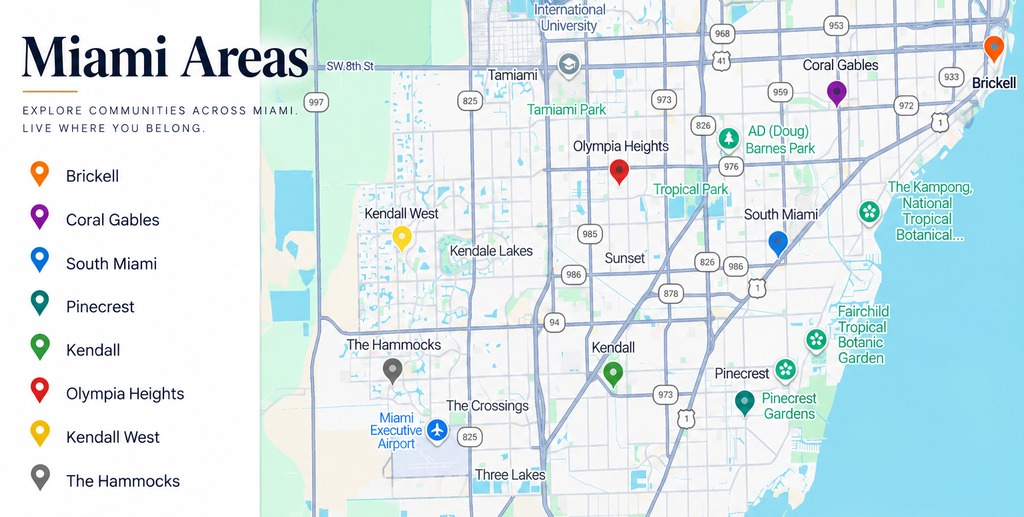
Property type and location change how fast this whole process moves, and that matters more when a settlement has a deadline attached to it. Condo associations in areas like Brickell can take thirty to forty five days to approve a buyer's application, which eats directly into a court-ordered timeline if nobody accounts for it in advance.
Insurance is the other variable slowing things down. Lenders underwriting older condo buildings are taking a harder look at structural inspection compliance and reserve funding since the post-Surfside SB 4-D requirements took effect, and that scrutiny can add weeks to a buyer's financing approval that would not exist on a single-family sale.
Single-family homes in areas like Kendall and Westchester are moving in the twenty eight to thirty five day range right now, while condo listings inside older buildings closer to the coast are frequently taking fifty or more days once association approval gets factored in. This difference changes how much runway you need to budget before a settlement deadline.
Timing inside the calendar year matters too. Listings that launch in January through March in South Florida tend to draw faster offers from the seasonal buyer pool, while a listing that goes up in late summer competes with more inventory and slower decision-making from buyers who are not in a hurry. If your attorneys are working toward a settlement deadline, launching in the stronger window is worth planning around.
Micro-market differences matter just as much. A house in Hialeah and a house in Palmetto Bay can sit ten miles apart and sell at completely different price points and paces, which is exactly why a generic online estimate is the wrong number to build a settlement negotiation around. Cash offers in this market typically land eight to twelve percent under a comparable financed offer, a gap worth knowing before either spouse assumes a quick cash sale nets the same number as a listed one.
The Most Expensive Mistake Divorcing Couples Make When Selling
The most expensive mistake I see divorcing couples make is refusing to agree on a price because neither spouse wants to be the one who "gave in." A couple in Palmetto Bay listed fifty thousand dollars above what comparable homes were closing at because neither would budge. The home sat seventy one days, went through two price reductions, and closed thirty eight thousand dollars below the original list price, money that came straight out of the equity that was supposed to be split evenly.
Divorce and selling house situations inside a condo building carry an extra variable that single-family sellers do not deal with: an association approval timeline that will not bend for anyone's court date, no matter how urgent the settlement feels.
Selling home in divorce circumstances works best when one agent manages pricing objectively, instead of two spouses negotiating through separate attorneys over every dollar. I price based on what the current data supports, not on what either spouse hopes to hear, because a stale listing costs both of you more than an honest number ever will. Once you're ready to move, the actual mechanics of showings, disclosures, and living separately during the process work the same as selling a house during a divorce in general, just compressed against a settlement deadline.
Selling property before divorce settlement is not the right call for every couple, but it is a legitimate option more people should be weighing before they assume the court has to decide first. How do you split the house in a divorce when neither of you agrees on value is usually the real question underneath all of this, and a real offer resolves that faster than another round of appraisals ever will.
Do I have to sell my house in a divorce comes up in nearly every consultation I have with someone going through this, and the honest answer depends less on the law than on whether either of you can actually afford to keep the property alone. If neither of you can, the sooner you get a real number, the sooner your attorneys can stop negotiating around guesses.
FAQ
Can I sell my house before my divorce is final in Florida?
Yes, and I have closed sales while a divorce was still active in court. Florida does not require a final judgment before a home sale can close, as long as both spouses on the deed agree to the transaction or a court order authorizes it. The complication is not legal permission, it is proceeds handling. Money from the sale typically sits in escrow or an attorney trust account until the settlement specifies the split, so you get the sale done without necessarily getting your share right away.
Do both spouses have to agree to sell the house in a divorce?
Generally, both spouses need to sign off if both names are on the deed, since a title company will not close a sale with only one signature on a jointly owned property. If one spouse refuses, the other can petition the court for an order compelling the sale, but that route adds months and legal fees neither of you gets back. Most of my clients find it cheaper and faster to negotiate a listing agreement than to litigate the disagreement.
Who gets the profit if we sell the house during a divorce?
Profit distribution comes down to what your settlement agreement or final judgment specifies, not simply whose name is on the title. In Miami-Dade, I have seen proceeds split anywhere from a straight fifty fifty to sixty five thirty five when one spouse contributed significantly more to the down payment or made all the mortgage payments after separation. Your attorney and the court weigh those contributions under Florida's equitable distribution rules before the check gets released.
Can my spouse force me to sell our house in a divorce?
Not without either your agreement or a court order. A spouse can petition the court to force a sale if the parties cannot agree and neither can afford to buy the other out, but a judge will not typically order this without giving both sides a chance to negotiate a buyout or a deferred sale first. If you are being pressured to sign a listing agreement you have not reviewed with your own attorney, that is worth slowing down for.
What happens to home equity in a Florida divorce settlement?
Home equity gets classified as marital or separate property first, then divided under equitable distribution if it qualifies as marital. If the home has appreciated significantly since the wedding, and marital funds paid the mortgage or funded improvements, that appreciation is very likely subject to division even if one spouse owned the property before the marriage. This is the single most contested calculation I see in Miami-Dade divorce sales, and it is worth getting a professional valuation rather than guessing.
If you and your spouse need a real number to work from, request a VIP home valuation takes just ten seconds to submit, and you'll have an accurate, broker-prepared value in your inbox within 24 hours, the same number I'd use with your attorneys to make the timing decision with facts instead of guesses.
Check out this article next