

Sellers in Florida almost always assume the most expensive line on the closing disclosure will be the commission. For many, that turns out to be wrong, and in Miami-Dade specifically, the full cost picture looks nothing like what sellers from other states, or even other parts of Florida, expect.
Understanding who pays closing costs in Florida before you commit to a list price changes how you negotiate, what you can realistically walk away with, and where you have room to push back. The rules here divide into two categories: costs set by Florida statute, and costs that follow regional custom. The documentary stamp tax falls in the first group. Title insurance falls in the second. In Miami-Dade, both work differently from the rest of the state in ways that shift thousands of dollars depending on your property type.
Who Pays Closing Costs in Florida: The Split Sellers Get Wrong
The assumption that buyers carry most of the closing costs because they are borrowing the money falls apart quickly in Florida. Sellers carry a significant share of the load, and in Miami-Dade, two factors make the picture more specific than most sellers anticipate.
The most counterintuitive fact about who pays closing costs in Florida involves title insurance. In Miami-Dade and Broward, the buyer pays the owner's title insurance premium. In 44 of Florida's other 67 counties, that cost sits on the seller's side of the closing disclosure. The reversal means Miami-Dade sellers are not paying the owner's title premium. But the buyer gains something in return for carrying that cost: the right to select the title company and closing agent.
What sellers do carry in Miami-Dade: the documentary stamp tax on the deed, the title search and municipal lien search fees, the commission, prorated property taxes, and any HOA-related charges. The amounts vary significantly by property type, which is covered in detail below.
What the Seller Pays at Closing in Florida
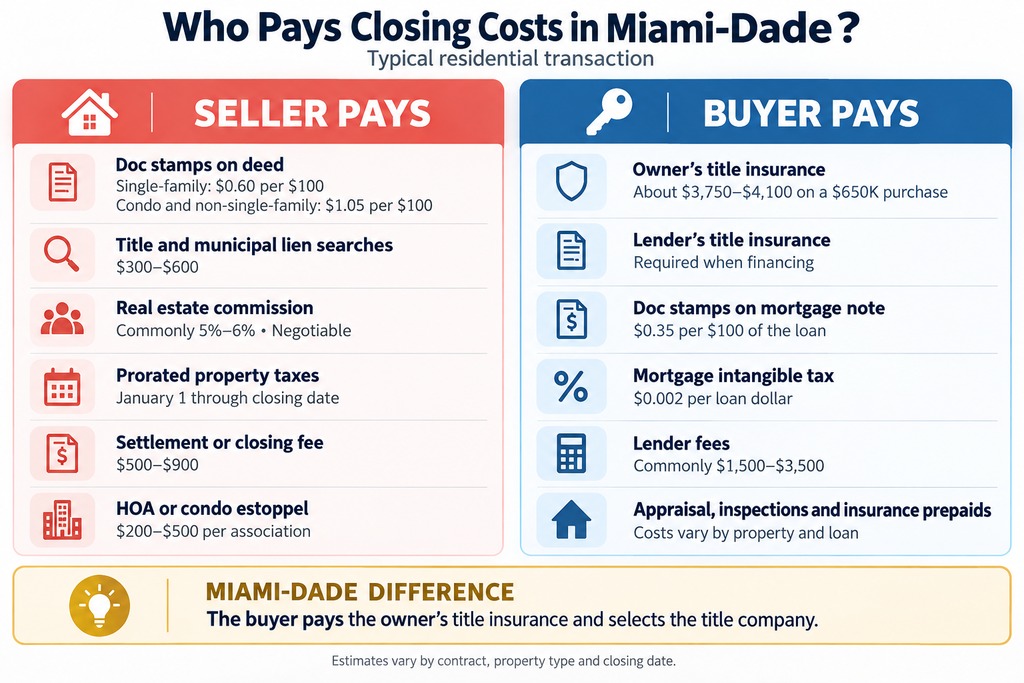
Here is the standard seller-side closing cost list for a Miami-Dade transaction:
Documentary stamp tax on the deed
Statutory and non-negotiable. In Miami-Dade, the rate depends on property type. Single-family homes and qualifying single-family townhomes pay $0.60 per $100 of the sale price. Condominiums, co-ops, multifamily properties, and commercial real estate pay $1.05 per $100, which is a $0.60 base rate plus a $0.45 county surtax. Every other Florida county charges $0.70 per $100 across all residential deed transfers. On a $650,000 single-family home in Kendall, doc stamps run $3,900. On a $650,000 condo in Brickell, they run $6,825. Same price, same county, and a $2,925 difference that comes entirely from property type.
Title search and municipal lien search
Because the buyer pays the owner's title insurance in Miami-Dade, the seller picks up the cost of the underlying searches: the title chain review and the lien search that confirms no outstanding city violations, code enforcement actions, or unpaid special assessments are attached to the property before closing. Expect $300-$600 total for both, depending on the title company and the property's history.
Real estate commission
Negotiable. Following the changes to buyer broker compensation that took effect after August 2024, sellers should confirm exactly what they are agreeing to pay in the listing contract before signing. Total commission in Miami-Dade commonly runs 5-6% of the sale price, but the portion allocated to the buyer's broker is now a separate negotiation in most transactions.
Prorated property taxes
Florida's tax year runs January 1 through December 31. Bills arrive in arrears. The seller owes property taxes from January 1 through the closing date regardless of when the bill is due. On a home in Coral Gables closing in September with a $14,000 annual tax bill, the seller owes approximately $10,500 at the closing table. On a November closing at the same rate, that figure climbs to roughly $12,800.
Settlement and closing agent fee
Typically $500-$900. Because the buyer selects the closing agent in Miami-Dade, the seller often pays this fee to an agent they did not choose. Confirm it before signing the contract.
HOA and condo estoppel fee
Required by Florida law in any transaction involving a homeowners or condo association. Sellers in Kendall, Doral, The Hammocks, Country Walk, and other HOA-dense Miami-Dade communities typically see estoppel fees of $200-$500 per association. Properties carrying both a community HOA and a master HOA pay it twice.
Recording fee for mortgage satisfaction
Typically $10-$15 per page to record the mortgage release with the Miami-Dade County Clerk.
If you are planning on selling your home in Miami, this is the baseline before negotiation begins.
The Documentary Stamp Tax Florida Sellers Owe on Every Sale
No closing cost line item surprises sellers more consistently than this one, and none is more fixed by law. The documentary stamp tax Florida imposes on deed transfers is a state tax collected at closing by the title company and remitted to the Florida Department of Revenue. It is always the seller's obligation unless the purchase contract explicitly reassigns it, which is uncommon in standard Florida residential transactions.
The structure in Miami-Dade is property-type specific, governed by Chapter 201 of the Florida Statutes:
- Single-family residences in Miami-Dade County: $0.60 per $100 of the sale price
- All other Miami-Dade property types (condos, co-ops, duplexes, multifamily, commercial): $1.05 per $100
- All other Florida counties, all property types: $0.70 per $100
Working through real Miami-Dade price points:
- $500,000 single-family in Homestead: $3,000 in documentary stamp taxes
- $650,000 single-family in Kendall: $3,900 in documentary stamp taxes
- $650,000 condo in Brickell: $6,825 in documentary stamp taxes
- $750,000 single-family in Doral: $4,500 in documentary stamp taxes
- $900,000 condo in Edgewater: $9,450 in documentary stamp taxes
- $1,200,000 single-family in Coral Gables: $7,200 in documentary stamp taxes
The single-family rate in Miami-Dade is actually below the statewide rate. A seller closing on a $650,000 home in Kendall pays $3,900 in doc stamps, which is $650 less than the $4,550 a seller would pay at the same price in Broward, Palm Beach, or Orange County. The picture reverses for condo sellers: at $1.05 per $100, a Miami-Dade condo seller pays 50% more in documentary stamp taxes than a condo seller anywhere else in Florida.
With more than $100 million in closed Miami-Dade transactions, I have sat at enough closing tables to know this line catches sellers unprepared when it is not built into the early estimate. On the $2.65 million single-family sale we closed on Los Pinos Circle in Coral Gables, after 280 days on market, the documentary stamp taxes on that deed were $15,900. Significant, but still below the $18,550 that same sale would have generated in Broward County. The single-family discount in Miami-Dade is real, and it compounds at higher price points.
Current rates and guidance are published by the Florida Department of Revenue. The governing statute is Chapter 201, Florida Statutes.
This section discusses statutory tax obligations and is provided for general informational purposes only. It does not constitute legal or tax advice. Consult a licensed Florida real estate attorney or CPA for guidance specific to your transaction.
What Buyers Pay at Closing in Florida, Including the Owner's Title Insurance
In Miami-Dade, the buyer's closing cost list includes something that buyers in most other Florida counties do not pay: the owner's title insurance premium.
Owner's title insurance premium
By longstanding Miami-Dade custom, confirmed in the AS IS Residential Contract for Sale and Purchase published by Florida Realtors, where the buyer pays the owner's policy and selects the title company. This is the policy that protects the buyer's ownership rights against any future title defect or claim. On a $650,000 purchase, the premium runs approximately $3,750-$4,100. The buyer choosing the title agent is why settlement fees in Miami-Dade sometimes land with a company the seller has never worked with.
Lender-required title insurance
Separate from the owner's policy and always the buyer's obligation regardless of county. Protects the lender's interest in the property.
Documentary stamps on the promissory note
$0.35 per $100 of the loan amount. On a $480,000 mortgage, the documentary stamps on the note come to $1,680.
Intangible tax on the mortgage
Florida charges $0.002 per dollar of the mortgage principal. On a $480,000 loan, the intangible tax is $960.
Lender origination, underwriting, and processing fees
These vary by lender and loan product but commonly run $1,500-$3,500 on a conventional purchase in Miami-Dade.
Appraisal and inspection fees
A licensed appraisal typically runs $550-$750 on a single-family home in Miami-Dade. A general inspection adds $450-$650. Most South Florida lenders and buyers also require a wind mitigation report ($150-$200) and a four-point inspection ($100-$200) because of the insurance market's underwriting requirements.
Prepaid homeowner's insurance and escrow deposits
Lenders require one full year of homeowner's insurance at closing plus two to three months in escrow. Florida's property insurance contraction has pushed premiums significantly higher. On a mid-range single-family in Miami-Dade, total insurance-related prepaid costs can reach $12,000-$18,000. This is the cost that catches qualified buyers off guard when they have the down payment but did not budget for it.
How to Build Your Seller Net Sheet Florida Before You List
Getting a seller net sheet florida before you set your list price is the single most underused step in the Florida home selling process. A net sheet translates your expected sale price into the dollar amount you actually take home. Without one, you are negotiating off a number you cannot verify.
The formula is straightforward:
Expected sale price Minus: mortgage payoff (call your lender for the exact 30-day or 60-day payoff amount) Minus: all seller-paid closing costs (documentary stamp taxes, lien searches, commission, prorated property taxes, estoppel, and settlement fee) Minus: any outstanding HOA arrears or liens Equals: your estimated net proceeds
A real example: A seller in The Hammocks lists at $620,000. Their mortgage payoff is $380,000. Documentary stamp taxes on a single-family home at $0.60 per $100 come to $3,720. Lien search fees: $500. Commission at 5%: $31,000. Prorated taxes through October on a $9,000 annual bill: $7,500. HOA estoppel: $400. Settlement fee: $700. Total seller costs: $43,820. Estimated net: $196,180, before any repair credits or concessions the buyer negotiates.
Every input changes the outcome. A different payoff balance, a different commission structure, a closing in November instead of March: all of it moves the net.
The most common mistake I see at this stage: sellers who include the commission but forget the property tax proration. On a late-year closing (October, November, or December), the proration is often the second-largest seller cost, because the full year's taxes have not been paid and the seller owes nearly all of them at once. A seller in Doral closing in December on a $700,000 home with an $11,000 annual tax bill could owe close to $11,000 in prorated taxes at the table. Sellers who do not model this number have a difficult conversation at closing.
The seller net sheet florida that comes out of that work is the number every subsequent decision depends on. Our Net Proceeds Calculator models the full Miami-Dade math in real time, including the property-type-specific doc stamp rate and prorated taxes. For a line-by-line breakdown of each closing disclosure item, the post on our Florida seller net sheet covers every component in detail.
Who Pays Closing Costs in Florida Depends on the County
Who pays closing costs in Florida is not a single statewide answer. Two variables shift everything: what county the property is in, and what type of property is being sold.
The county-by-county title insurance divide
In 44 of Florida's 67 counties, the seller pays the owner's title insurance premium. In Miami-Dade, Broward, Sarasota, Collier, and Martin counties, the buyer pays it. This divide catches out-of-state agents regularly. A buyer's agent from Georgia, New York, or the Midwest may present a contract that tries to shift the owner's title cost to the seller. Miami-Dade sellers who agree to that are absorbing a cost that is not theirs to carry.
For a broader look at what happens to your sale proceeds from a tax perspective, the post on capital gains tax on your Florida home sale covers the federal and state tax picture after the sale closes.
The documentary stamp tax split by property type
Miami-Dade's property-type distinction in the documentary stamp structure is not widely known outside of professional circles. Single-family sellers pay $0.60 per $100, which is less than sellers everywhere else in Florida. Condo and non-single-family sellers pay $1.05 per $100, which is 50% more than any other county in the state.
HOA estoppel timelines
Miami-Dade's inventory is HOA-dense. Kendall, Doral, The Hammocks, Fontainebleau, Country Walk: all carry mandatory association structures. Florida law requires an estoppel certificate before title can close. This document, issued by the association or its management company, confirms what the seller owes and what transfer fees the buyer must pay.
Some management companies issue estoppels in five business days; others take fifteen. In a 30-day close, that gap eliminates any buffer. Sellers should request the estoppel within the first five business days of going under contract.
How the insurance market creates hidden seller risk
Florida's property insurance market has contracted sharply. Citizens Property Insurance now carries a large portion of the Miami-Dade single-family market, and a buyer who cannot secure affordable coverage before closing will not close. A re-listing after a failed insurance-stage deal always prompts the next buyer to ask why.
Sellers who can document a 2019 or newer roof, a current wind mitigation report, and a recent four-point inspection move buyers through the underwriting stage faster. Producing these before listing rather than waiting for the buyer to request them removes one of the most common late-stage obstacles in a Miami-Dade transaction.
Knowing who pays closing costs in Florida is the foundation of any realistic net proceeds conversation. The documentary stamp tax rate depends on your property type and county. Title insurance goes to the buyer in Miami-Dade, not the seller. And the property tax proration on a late-year closing can rival the commission as the largest seller cost on the disclosure. Account for all of it before you list, and the closing table holds no surprises.
FAQ
Who pays the documentary stamp tax in Florida, the buyer or the seller?
The seller pays the documentary stamp tax on the deed in every Florida transaction. The rate varies by county and property type. In Miami-Dade, single-family homes are taxed at $0.60 per $100 of the sale price, slightly less than the $0.70 per $100 rate charged in all other Florida counties. Condominiums, co-ops, and all non-single-family property types in Miami-Dade pay $1.05 per $100, which is 50% higher than any other county in the state. Buyers pay a separate, lower documentary stamp tax on their mortgage note at $0.35 per $100 of the loan amount, which is always a buyer-side cost.
How much does it cost to sell a home in Florida as a percentage of the sale price?
Seller closing costs in Florida typically run between 6% and 9% of the final sale price when commission is included, depending on the property type, county, and time of year. In Miami-Dade specifically, the total shifts based on what you are selling: single-family home sellers do not pay the owner's title insurance and benefit from a slightly lower documentary stamp rate, while condo sellers face the $1.05 per $100 surtax on doc stamps that adds meaningfully to the total. Commission is almost always the largest single line item, but property tax prorations on late-year closings in high-tax areas like Coral Gables or Pinecrest can rival it.
Does the seller pay the owner's title insurance in Miami-Dade?
No. In Miami-Dade and Broward counties, the buyer pays the owner's title insurance premium, and as a result, the buyer also selects the title company and closing agent. This is the opposite of the custom in most other Florida counties, where the seller pays the owner's policy and selects the title agent. For sellers, this means the owner's title premium is not your cost in Miami-Dade. You do, however, pay for the title search and municipal lien search as a related obligation when the buyer carries title insurance. These combined searches typically run $300-$600.
What is a seller net sheet in Florida and when should I get one?
Getting a net sheet before you set your list price is one of the most underused steps in the Florida home selling process. A seller net sheet takes your expected sale price, subtracts your mortgage payoff and every seller-side closing cost: doc stamps, searches, commission, prorated property taxes, estoppel, and settlement fees, and produces what you actually keep. In Miami-Dade, where the doc stamp rate depends on property type and a late-year closing can add thousands in tax proration, building an accurate net sheet before going under contract prevents the difficult conversation at the closing table when the final number lands lower than expected.
Does Miami-Dade have higher or lower closing costs than other Florida counties?
For sellers, it depends on the property type. Single-family home sellers in Miami-Dade pay $0.60 per $100 in documentary stamp taxes, which is actually less than the $0.70 per $100 rate in every other Florida county. They also do not pay the owner's title insurance, which in most of Florida falls to the seller. Condo and non-single-family sellers in Miami-Dade pay $1.05 per $100 in doc stamps, 50% higher than anywhere else in the state. The cost profile for a Miami-Dade seller depends almost entirely on what type of property they are selling.
This FAQ is for general informational purposes only and does not constitute legal or tax advice. Closing cost customs, statutory tax rates, and county practices are subject to change. Consult a licensed Florida real estate attorney or CPA before making decisions about your specific transaction.
Ready to know what your home is actually worth before you commit to a number? A free home valuation from Labrada Realty gives you a property-specific estimate in about 60 seconds, and it is the starting point every net proceeds conversation depends on.
Check out this article next