
Most people moving to Miami start with a name: Brickell, Coral Gables, maybe Wynwood if they saw it on Instagram. They search it, fall in love with the aesthetic, request a showing, and then discover the condo has a two-year waitlist for rentals, or the commute to their job in Doral adds 45 minutes each way. The problem isn't that they chose wrong. The problem is they chose without context.
Miami neighborhoods don't just differ in price. They differ in lifestyle, building type, school zone, flood zone, HOA culture, commute logic, and the kind of neighbor you'll have. Before you commit to a search area, you need to understand what each part of this city is actually built for. This guide walks through the areas that come up most, what makes each one distinct, and how to tell which one fits your life before you waste weekends on the wrong zip code.
The "Best Neighborhood in Miami" Question Has No Universal Answer
Here's what nobody says in those listicles: the best neighborhoods in miami depend entirely on what you need your life to look like. A single professional who walks to work, orders food three times a week, and travels every other month has a completely different best answer than a family of four with two kids in middle school and a dog that needs a yard.
The trap is treating "best" like a ranking when it's really a match.
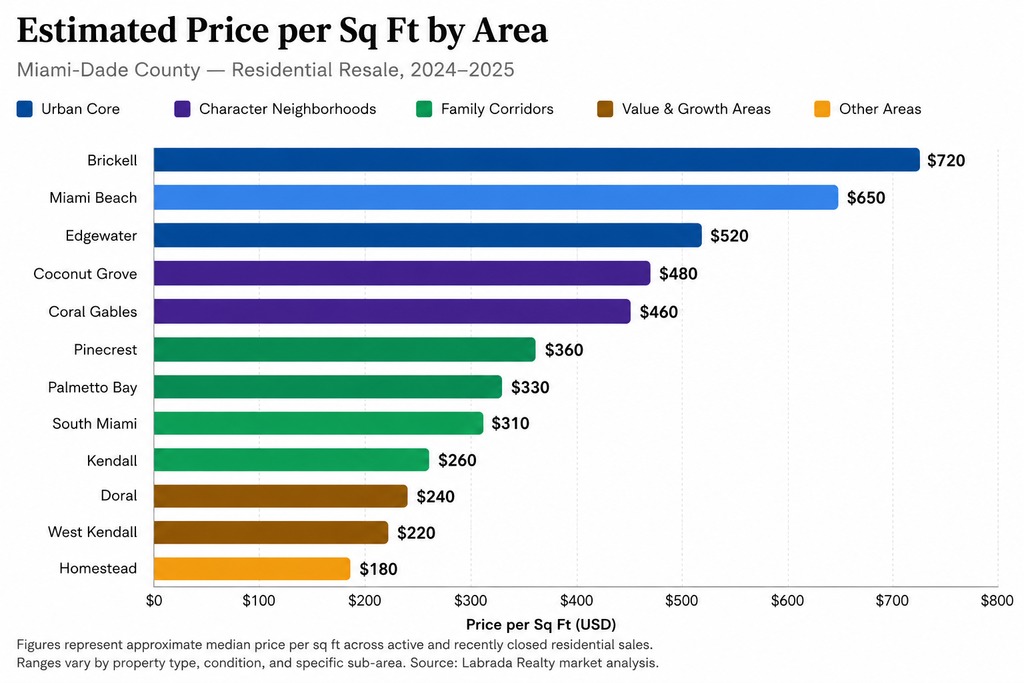
Miami is not one market. Brickell prices in the $500s per square foot. Homestead prices under $200 per square foot. The people buying in each are not making better or worse decisions. They're making different ones, based on different priorities. Understanding the areas to live in miami as distinct ecosystems rather than a ranked list is the only framework that actually helps.
One thing that surprises people when they start exploring: the best areas to live in miami often depend more on what's 10 minutes away (school, workplace, airport, family) than on the neighborhood itself. Always run your life logistics against the map before you run the search.
The Urban Core: Brickell, Downtown, and Edgewater
Brickell is the name that comes up first for people relocating from New York, Chicago, or any major city where walkability is a baseline expectation. It delivers on that. Brickell City Centre, Mary Brickell Village, the waterfront, the gym culture, the banking corridor — it's genuinely urban in a way most of Miami-Dade is not.
But there are things buyers don't know until they're in the process.
First, condo associations in Brickell are strict and slow. Many buildings have buyer approval processes that run 30 to 60 days, require board interviews, and restrict rentals for the first one to two years of ownership. If you're buying with the intention to eventually rent it out, you need to check the specific condo docs, not just the building's reputation.
Second, pricing is deceptive at the unit level. A $650,000 one-bedroom sounds reasonable for the finishes and location until you add the HOA fee, which in many Brickell buildings runs $1,000 to $1,500 per month. Finance that into your monthly cost and the picture changes. Many buyers who came from Chicago or New York are used to HOA fees and absorb this without issue. Buyers coming from the suburbs of Miami-Dade are sometimes blindsided.
Third, Edgewater has emerged as the more affordable and less crowded alternative to Brickell for people who still want bay views and a city feel. Pricing per square foot runs lower, the restaurant and arts scene is growing, and it doesn't have the same corporate-corridor density. Worth adding to the shortlist if Brickell feels like too much.
Downtown Miami sits between the two, heavier on commercial activity and lighter on the residential polish. Fine for investors, less ideal as a primary residence for most buyers unless they specifically want proximity to the courthouse, Port Miami, or the cultural institutions.
The Family Corridors: Kendall, Palmetto Bay, and Pinecrest
If school zones, yards, and space drive the search, the south corridor is where Miami-Dade delivers. These three areas cover a lot of ground both geographically and in price point, and the differences between them matter.
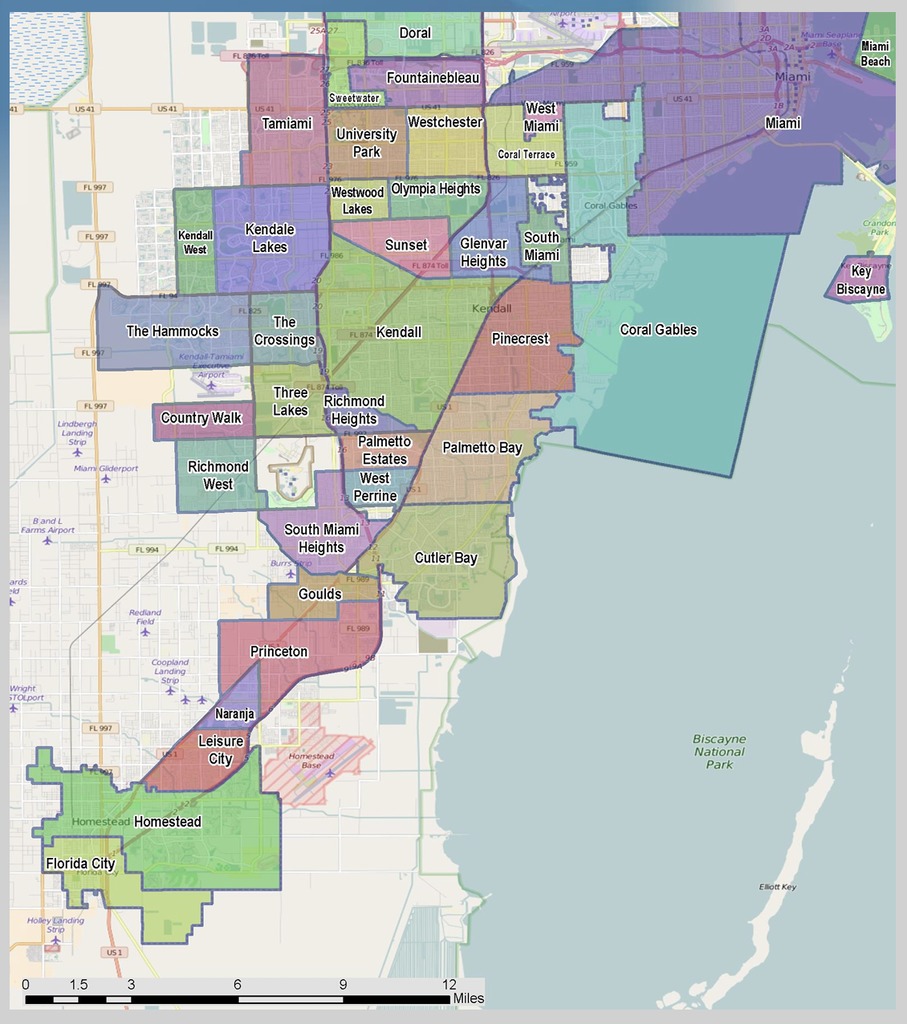
Kendall is large. People often talk about it as one place when it's really a collection of communities with different HOA structures, school zones, and price ranges. The Hammocks and Kendale Lakes sit within Kendall and have their own dynamics. Generally, Kendall is where you find the widest selection of single-family homes in the $550,000 to $850,000 range with community pools, gates, and maintained common areas. HOA fees are a given in most communities here, typically running $150 to $400 per month depending on the amenities. Non-HOA single-family homes exist but are fewer and tend to move fast.
Palmetto Bay is where Kendall families often migrate when they're ready to move up. It's quieter, greener, closer to the water, and the school zone is strong. Homes here typically run $750,000 to $1.5 million for single-family, and the community feels intentional in a way that suburbs built purely for volume don't. A fair number of buyers in this zip code are physicians, school administrators, and professionals who work in the Baptist Health and Mercy Hospital corridor just north.
Pinecrest sits above Palmetto Bay on the map and above it in price as well. North and South Pinecrest have slightly different price floors. In South Pinecrest, entry for a three-bedroom on a decent lot starts around $900,000 and climbs quickly. North Pinecrest pushes higher. The public schools here consistently rank among the best in Miami-Dade County, and that reputation drives demand from families even when the price requires stretching. Resale in Pinecrest tends to be stable because the school zone buyers don't leave voluntarily.
A real example: a family relocating from Bogota in early 2024 came in with a $1.1 million budget and an initial shortlist of Brickell and Coral Gables. After mapping school zones and commute times to Brickell Key (where one spouse worked), they shifted the search to Pinecrest. They closed on a four-bedroom, pool home on a corner lot at $1.05 million. The Brickell commute ran 18 minutes off-peak. The school zone was exactly what they wanted. The home has appreciated modestly but has received zero pressure to sell because everything about the purchase still fits.
The Character Neighborhoods: Coconut Grove, Coral Gables, and South Miami
These three areas share a common quality: they feel like places that grew up rather than were built out. The trees are older, the lots are irregular, and the streets have names instead of just numbers.
Coral Gables operates under its own city government with zoning and architectural standards that are significantly stricter than the rest of Miami-Dade. You cannot change your roof color without approval. You cannot build an addition without review. Some buyers see this as a burden. Most who live there see it as the reason the neighborhood stays what it is. Cocoplum and Gables by the Sea sit within Coral Gables and are the gated, waterfront expressions of it. Pricing in the Gables ranges from $800,000 for a modest three-bedroom to $5 million-plus for estate properties near the canals. The international buyer community is highly concentrated here. Venezuelan and Colombian families in particular have bought in the Gables for decades, and that community continuity affects how homes are priced and how quickly deals close. Sellers in this area often receive full-price or above-asking offers from buyers who know the neighborhood well and don't negotiate on emotion.
Coconut Grove attracts a different buyer: creative professionals, architects, people who sail, attorneys who want nothing to do with a gated community. Bay Heights and The Moorings are its most prestigious pockets. The Grove has been through cycles of neglect and revival, and right now it's in a strong position. New restaurants, art galleries, and a marina that draws actual boaters rather than people who like the idea of boats. Pricing for single-family starts around $900,000 and gets high fast as you approach the bay. One thing buyers learn quickly: the Grove has a surprising amount of flood zone exposure. Always check the specific parcel's flood designation before making an offer. Insurance costs have changed dramatically in the last two years, and a home that looks affordable at list price can carry $15,000 to $25,000 in annual insurance depending on its zone and elevation.
South Miami is the most undervalued of the three from a name-recognition standpoint. It sits between Coral Gables, Pinecrest, and the University of Miami, has a functioning walkable downtown on Sunset Drive, and prices that still run $100,000 to $200,000 below comparable properties in the adjacent areas. Buyers who discover South Miami through the search often stay.
The Value and Growth Areas: Doral, Homestead, and West Kendall
Not every buyer is optimizing for prestige or walkability. Some are optimizing for square footage per dollar, commute to a specific employment zone, or first-time buyer entry into ownership. These three areas each serve a distinct version of that need.
Doral has become one of the most interesting markets in Miami-Dade over the last decade. Its proximity to the airport and business corridor made it the landing pad of choice for Venezuelan, Colombian, and Peruvian business owners and professionals, and that community has driven significant commercial and residential development. Townhome and single-family pricing typically runs $550,000 to $850,000. The schools score well. The traffic on 107th Avenue during peak hours is real and should be driven before a decision is made, not just Google-mapped. Foreign buyers who want to place capital in Miami real estate, stay close to a Latin business community, and maintain access to the airport have made Doral one of the most consistently active markets in the county regardless of overall market conditions.
Homestead is where first-time buyers in Miami-Dade go when the rest of the county has priced them out. New construction townhomes and single-family homes are available in the $380,000 to $500,000 range, which is essentially unavailable anywhere else in Miami-Dade at this point. Investors also watch this area closely. Rental demand from agricultural workers, healthcare workers at the Homestead VA and area clinics, and the military presence at Homestead Air Reserve Base creates a tenant base that doesn't disappear. The commute to urban Miami is long. That's the honest trade.
West Kendall runs parallel to Kendall geographically and fills the gap between established Kendall communities and Homestead. New construction has been consistent here, and you'll find developments with amenities that would cost $200,000 more per home in central Kendall. If someone asks about the best neighborhoods to live in miami on a budget while still wanting a new build with a garage and community pool, West Kendall is the answer worth exploring first.
Reading about the rent vs. buy decision for any of these areas? The analysis in Should I Rent or Buy a Home? covers the Miami-specific numbers that most generic guides skip.
What No Neighborhood List Will Tell You: Miami-Specific Factors That Change the Decision
This is where most guides stop being useful. Miami operates under a set of market conditions that affect buying decisions in ways that don't apply in Atlanta, Dallas, or Phoenix. If you're relocating from one of those markets, these are the variables you need to understand before you finalize your search area.
Insurance costs have restructured affordability by zip code.
In 2022 and 2023, several major insurers exited Florida entirely. What's left is a market where annual homeowner's insurance premiums can range from $4,000 in a non-coastal, higher-elevation zip code to $22,000 or more for a waterfront property in a high-risk flood zone. This isn't a scare tactic. It's arithmetic. If you're financing, your lender will require flood insurance in designated zones, and that cost goes into your DTI calculation. Some buyers who qualify for a loan based on the purchase price do not qualify once the correct insurance number is added to the monthly payment. Know your zone before you fall in love with a property.
Condo approval timelines affect your closing date.
In Brickell, Edgewater, Miami Beach, and high-rise developments across Miami-Dade, condo association approvals run 30 to 60 days in many buildings. If you're in a lease that ends on a fixed date, or you have a job start date, or you sold your previous home and are working within a specific timeline, condo approvals can create real problems. Budget for this time when making offers. Always ask for the association's approval timeline as part of your due diligence, not as an afterthought.
Seasonal demand shifts pricing and leverage.
Miami's peak buying season runs October through April, when northeastern and international buyers are in market and inventory is competed for most aggressively. June through September is slower. Sellers who list in summer often see fewer showings, longer days on market, and more negotiating leverage going to buyers. For people who can control their timeline, summer is generally when you find the best-priced opportunities in neighborhoods in miami that see heavy snowbird and foreign buyer activity. Brickell, Miami Beach, Coral Gables, and Key Biscayne feel this most sharply.
Foreign buyer concentration affects negotiation dynamics.
In certain zip codes, particularly Coral Gables, Doral, Brickell, and Miami Beach, a significant share of buyers are foreign nationals or recent immigrants. This community of buyers tends to negotiate differently from domestic buyers. Cash offers are more common. Price reductions are sometimes taken personally by sellers within these communities, which affects strategy. Buyers coming from markets where aggressive counter-offers are standard sometimes lose deals in these zip codes by negotiating in a way the seller reads as dismissive rather than strategic. Understanding who else is likely to be bidding in a specific neighborhood changes how you write your offer.
To explore Miami neighborhoods by area and see current listing activity in each, the Labrada Realty area pages give you micro-market context alongside active inventory. Browsing by area before narrowing to a search saves a significant amount of time in the showing process.
Matching the Area to Your Life: Where Labrada Realty Fits In
Here's what no map or article can do: tell you which of these areas matches your specific combination of budget, commute, family situation, lifestyle preference, and five-year plan.
That's a conversation that takes 20 minutes and saves months.
When buyers work with Labrada Realty, the first conversation is never about listings. It's about priorities. Where do you work? What schools matter? Do you need a yard, or would you trade it for a rooftop pool? Are you buying to stay or buying to eventually build equity toward something bigger? Are you open to a 30-minute commute if it means a 3,000-square-foot home instead of 1,400?
Once those questions have real answers, the search area becomes obvious. And the homes that come up stop feeling like compromises and start feeling like matches.
Use the VIP Home Search to set up customized alerts for the areas that fit your profile. You'll see listings as they hit the market, often before they're widely visible, which matters most in the neighborhoods where good inventory moves in under two weeks.
FAQ
Q: Which Miami neighborhoods are best for families with kids in public school?
A: Pinecrest and Palmetto Bay consistently rank at the top for public school quality within Miami-Dade County. Both serve elementary through high school within strong-performing clusters, and homebuyers specifically target these zip codes for that reason. Kendall also performs well and carries a lower price floor, which makes it more accessible for families buying in the $600,000 to $800,000 range. The important detail: school assignments in Miami-Dade are zone-based and occasionally adjusted. Always verify the specific parcel's school zone assignment through the Miami-Dade County Public Schools address lookup before closing, not after. A neighbor one block away can be in a different zone.
Q: What are the most affordable neighborhoods in Miami for first-time buyers right now?
A: Homestead and West Kendall are the two areas where first-time buyers can still find single-family homes and new construction townhomes under $500,000 in Miami-Dade. Hialeah and parts of North Miami also have inventory in that range, though the product mix differs. Homestead offers new builds with more square footage per dollar, while West Kendall tends to deliver newer community amenities and shorter commutes to central Miami. Buyers in these areas should account for HOA fees in newer communities, which typically run $200 to $350 per month and are sometimes overlooked when budgeting the monthly payment.
Q: Is it better to live in Brickell or Coral Gables?
A: These two areas serve almost entirely different buyer profiles, so the comparison only works once you know what you're optimizing for. Brickell delivers urban density, walkability, and the feel of a major city center. Coral Gables delivers tree-lined streets, historic architecture, single-family homes, and one of the most stable long-term real estate markets in Miami-Dade. Brickell living is predominantly vertical. Coral Gables is horizontal. Brickell buyers tend to be younger, single or couples without children, and often tied to finance or tech. Coral Gables buyers skew toward families, established professionals, and international buyers building long-term Miami roots. If you're choosing between the two, start with your day-to-day life and work backward, not with the name.
Q: Which Miami areas have the strongest long-term resale value?
A: Coral Gables, Pinecrest, and Coconut Grove have historically maintained the strongest price floors during down markets and recovered fastest in up cycles. The reason is structural: limited supply, strong school zones (for Pinecrest), zoning restrictions (for Coral Gables), and community identity (for Coconut Grove) all reduce the speculative volatility that hits newer developments harder. Brickell and Miami Beach have delivered strong appreciation during peak cycles but also see sharper corrections. Investors focused on long-term wealth preservation tend to favor the supply-constrained, family-demand-driven markets over the condo-heavy urban core.
Q: How do I know which Miami neighborhood fits my budget before I start searching?
A: Run this quick filter before you look at a single listing. Take your target monthly payment and subtract what insurance will actually cost in each area, which varies by $500 to $1,500 per month depending on flood zone and distance from the coast. Then factor in HOA fees, which in some Brickell buildings run $1,200 to $1,500 per month on top of the mortgage. What's left is your real purchasing power for that specific area. A $600,000 budget in Homestead gives you a 2,000-square-foot home. The same budget in Brickell gets you a one-bedroom with $900 monthly HOA. Neither answer is wrong, but only one of them is right for your life.
If you want a direct read on which Miami neighborhoods match your budget, timeline, and priorities before committing to a search area, the VIP Home Search sets you up with customized alerts and puts you in direct contact with someone who knows these micro-markets from the inside. Takes two minutes to set up and changes how the search feels from the first day.
Check out this article next