
Most buyers searching for condos for sale in Miami Beach start with the same mistake: they search the island as if it were one market. It is not. A condo priced at $650,000 in North Beach and a condo priced at $650,000 in South of Fifth are not comparable properties. They sit in different risk environments, serve different buyer profiles, and perform very differently at resale. Treating them the same at the start of your search is how buyers end up confused by the pricing, frustrated by what they see, and unprepared for what actually goes into a decision.
This guide covers what it actually takes to buy a condo in Miami Beach right now. That means understanding how pricing works across the island, what the 2025 condo safety legislation means for your offer, how financing has changed in 2026, and when the best window to negotiate actually opens. The goal is not to overwhelm you. It is to make sure you go into this market knowing what the people who close successfully already knew.
Condos for Sale in Miami Beach: The Island Is Not One Market
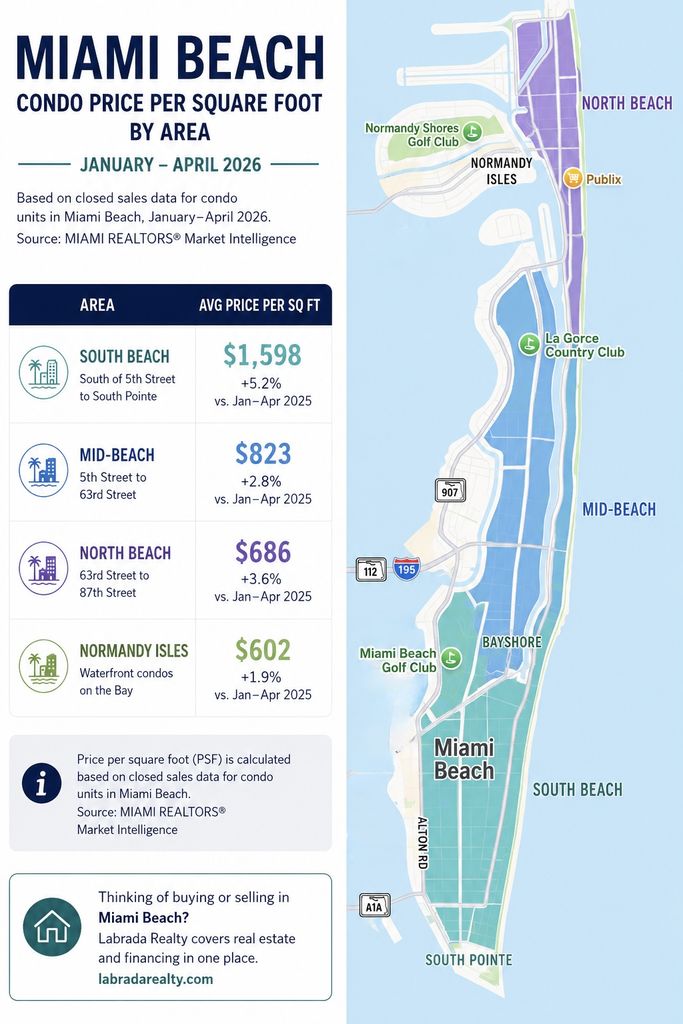
Miami Beach runs roughly seven miles from the southern tip of South Beach to the northern end of North Beach, and the difference between buying in zip code 33139 versus 33141 can be $400 to $600 per square foot. Buyers who lump all of Miami Beach into one search end up comparing properties that have almost nothing in common.
Here is a working framework for how the island actually breaks down:
South Beach and South of Fifth (SoFi)
South of Fifth Street is its own micro-market within South Beach. Pricing per square foot frequently hits $1,500 and above in newer or renovated buildings. The buyer profile here skews toward primary-residence purchasers and second-home buyers from the Northeast and Latin America who want walkability, restaurant access, and the address itself. Inventory is limited, seller leverage is higher than the rest of the island, and buildings tend to be newer or substantially renovated. If you are searching for a condo for sale in Miami Beach and budget is a concern, this is not the starting point.
Mid-Beach
Mid-Beach, roughly from 23rd Street to 63rd Street, is where the branded oceanfront product lives. Buildings like the Perigon and the Faena House operate at their own pricing tier. Resale units here average $1,200 to $1,400 per square foot in well-maintained or updated buildings. Mid-Beach attracts buyers who want oceanfront without the South Beach density and noise, and it is where you find the most significant bifurcation between newer branded buildings and older concrete towers from the 1970s and 1980s.
North Beach
North Beach offers the most accessible entry point on the island. Buildings here typically price between $500 and $900 per square foot depending on condition, views, and age. For buyers who want a condo for sale Miami Beach at a more accessible price point, North Beach is where that search starts. The buyer pool includes primary-residence purchasers, price-conscious second-home buyers, and investors looking at longer-hold plays as the area continues to redevelop. Days on market run longer here than in South Beach or SoFi, which works in a buyer's favor during negotiation.
What Condos for Sale in Miami Beach Oceanfront Actually Cost in 2026
Buyers searching for miami beach condos for sale oceanfront are entering a market shaped by two competing forces: trophy scarcity at the top and significant repricing pressure in the aging mid-tier stock below it.
Trophy oceanfront in Miami Beach, meaning newer branded product with direct water views and competitive amenities, continues to set record pricing references. South of Fifth, the Bal Harbour corridor, and Mid-Beach branded buildings have seen price-per-square-foot figures push above $2,000 in recent transactions. That pricing is driven by something buyers need to understand: genuine land scarcity. There is no more oceanfront land to build on in Miami Beach. Trophy buildings sit on irreplaceable sites, and that scarcity compounds into value over time in ways that inland product does not.
The dynamic looks completely different in older oceanfront buildings from the 1970s through mid-1990s. These buildings are repricing under significant pressure from two directions simultaneously: the cost of compliance with Florida's new condo safety legislation, and the financing restrictions that compliance issues trigger. A unit in a 1980s oceanfront tower may ask $750,000, but a buyer who does not understand what is coming in special assessments and reserves can find themselves holding an asset that costs $900,000 before the first year is out.
To understand what this looks like with real numbers: in early 2026, 1975 to 1995 towers across Miami-Dade are issuing special assessments that range from $30,000 to over $100,000 per unit for combined roof, concrete, and waterproofing projects. These are not hypothetical risks. They are active transactions happening right now in buildings that buyers are actively considering.
The Due Diligence Layer Most Buyers Skip on a Condo for Sale in Miami Beach
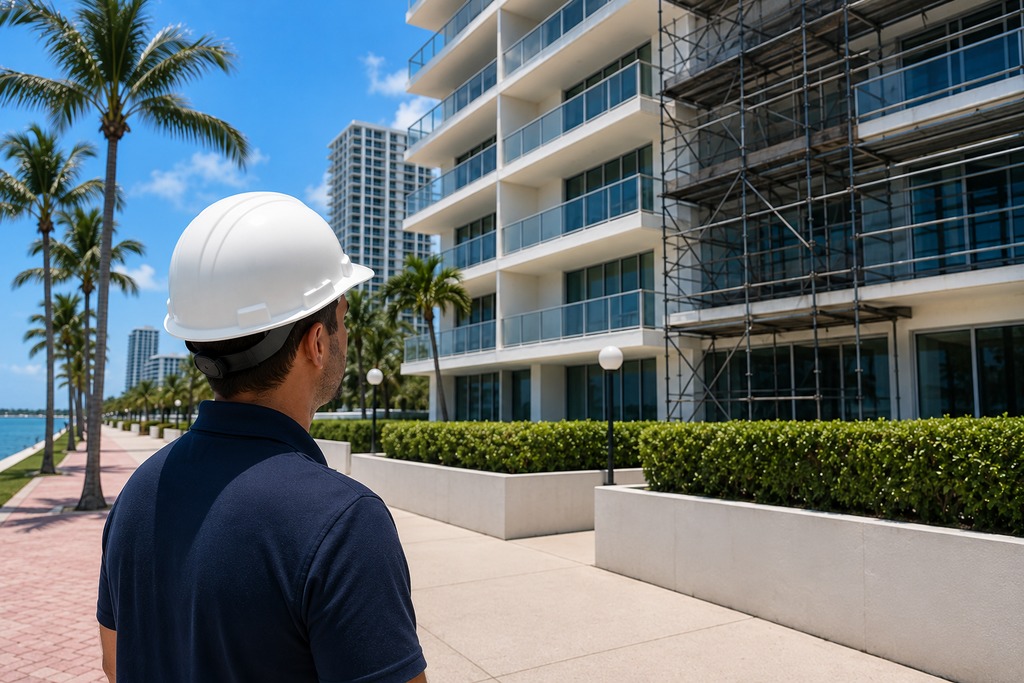 Florida's SB 4-D legislation, passed in 2022 and updated through HB 913 in 2025, fundamentally changed what it means to buy a condo in a building that is 30 or more years old. For buyers searching in Miami Beach, where a large share of the inventory falls in that age range, this legislation is not background reading. It is front-line due diligence.
Here is what the law requires and why it matters to your offer:
- Milestone inspections: Buildings three stories or taller must complete a Phase I structural inspection at 30 years of age, and then every 10 years after that. Coastal buildings within three miles of the shoreline trigger the requirement at 25 years. Given that most of Miami Beach sits within that coastal window, nearly every older building on the island is subject to this timeline. Phase I is a visual examination by a licensed engineer. If the engineer finds structural distress, a Phase II inspection follows, which involves physical testing of the structure.
- Structural Integrity Reserve Studies (SIRS): Associations must conduct a SIRS every 10 years and, as of January 2025, can no longer allow owners to vote to waive or reduce reserve funding for structural components. Before Surfside, condo associations regularly voted to underfund reserves to keep HOA fees low. That is now illegal. The bill for years of deferred maintenance is landing on current owners and, in many cases, on buyers who did not ask the right questions before going under contract.
- Three documents to request before writing an offer: (1) The Structural Integrity Reserve Study, (2) the Milestone Inspection Report if the building is 30 or more years old, and (3) a written disclosure of all current, pending, and anticipated special assessments. If a seller or listing agent cannot produce these documents, that is the answer.
The buyers who get hurt in this market are not careless people. They are buyers who fall in love with a unit, skip or rush the document review, and discover a $60,000 special assessment after closing. The common mistake is treating condo document review as a closing-table formality rather than a pre-offer filter.
If you want to understand how to vet a building before you fall in love with it, reviewing the common buyer mistakes that cost money at closing is a useful starting point before you write your first offer.
Financing a Condo for Sale in Miami Beach Is Different From Financing a House
Conventional mortgage financing for a Miami Beach condo does not begin with your credit score and income. It begins with the building. If the building does not meet Fannie Mae and Freddie Mac project standards, conventional financing is not available, regardless of how strong a borrower you are.
This is called a non-warrantable condo, and in Miami Beach in 2026, it is far more common than most buyers expect. As of March 2026, both Fannie Mae and Freddie Mac updated their project standards under Lender Letter LL-2026-03. Among the most significant changes: the minimum reserve allocation for structural maintenance rose from 10% to 15% of annual assessment income, the streamlined Limited Review path was eliminated, and every condo purchase now requires a full project review. Buildings that miss the reserve threshold lose warrantable status, which shrinks the buyer pool immediately and puts downward pressure on price.
A building becomes non-warrantable if it fails any one of the key eligibility tests. In Miami Beach, the most common disqualifying factors in older buildings are insufficient reserves and issues tied to unresolved structural findings. Short-term rental allowances, high investor concentration, and pending litigation are other common disqualifiers across the island's condo-hotel and boutique buildings.
When a building is non-warrantable, financing shifts to portfolio loans, non-QM products, or jumbo products with higher down payment requirements. Current 2026 lender matrices for non-warrantable condos typically cap loan-to-value around 70% to 80%. That effectively means buyers need 20% to 30% down instead of 5% to 10%. For many buyers, that math changes what is affordable or forces a different building selection entirely.
This is precisely where having a buyer's agent who also handles financing in-house changes the outcome. When the real estate search and the mortgage review happen simultaneously, buyers know before they fall in love with a building whether financing is going to be conventional, non-QM, or cash-only. Run your numbers on a Miami Beach condo with a mortgage calculator as a starting point, but understand that the building review needs to come before the loan application.
Condos in South Beach Miami for Sale: What the Address Premium Means in Practice
Buyers searching specifically for condos in South Beach Miami for sale are looking at a distinct sub-market with its own pricing logic and its own buyer competition. South Beach, and South of Fifth in particular, prices at a premium for reasons that go beyond views and amenities. Every condo for sale Miami Beach buyers find in this corridor carries a price tag shaped by the address as much as the unit itself.
South of Fifth has perhaps the best walkable restaurant and nightlife density of any Miami Beach sub-area, paired with quieter residential streets above Fifth Street. Buildings here tend to be newer or substantially renovated, which means the SB 4-D compliance risk that affects older stock is largely absent. Buyers here pay for the address, the lifestyle concentration, and the reduced structural uncertainty relative to older beach inventory.
The trade-off is price per square foot. South of Fifth regularly prices at $1,500 and above per square foot. The median sale price for condos in the South Beach corridor reached $1,237,000 in Q4 2025, with luxury inventory pushing well past $25 million at the top of the market. For buyers with a budget below $1 million, the math in South of Fifth works only in smaller units, and competition for those units from both domestic buyers and international buyers is consistent.
One buying dynamic worth understanding: South Beach attracts a significant share of Venezuelan, Colombian, and Argentine buyers, particularly at the $1 million to $3 million price point. These buyers move quickly when they find the right unit, often with cash or pre-arranged financing from their home country. Buyers using conventional financing who are competing against this pool need to be pre-approved, document-ready, and willing to move on timeline rather than try to negotiate extended review periods. A 15-day inspection period is standard. Asking for 30 days signals hesitation in a market where motivated sellers have multiple options.
You can explore Miami Beach listings by area to compare active inventory across South Beach, Mid-Beach, and North Beach side by side before narrowing your search.
When to Search and When to Negotiate: Seasonal Timing in the Miami Beach Condo Market
Miami Beach follows a buyer and seller cycle tied directly to snowbird migration and Latin American buyer patterns. Understanding this rhythm gives buyers a real negotiation advantage that has nothing to do with making low offers.
Peak season in Miami Beach runs January through March. This is when seller leverage is highest. Buyers from the Northeast and Midwest are in town. Latin American buyers who travel north for extended stays are actively searching. Sellers know the window and price accordingly. Listings that launch in January or February attract the most competition, and sellers in desirable buildings rarely discount during this period.
The strategic window for buyers opens in late summer and early fall, roughly August through October. Inventory is still available, many snowbird sellers who did not close during peak season are sitting on properties they want to move, and buyer competition drops sharply. Q3 data from 2025 showed Miami Beach luxury condos averaging over 80 days on market during this period, with months of inventory running at 19 to 20 months across the market. In a normal market, six months of inventory represents balance. At 19 or 20 months, sellers feel it. Buyers who enter the market in September with a clean pre-approval and clear parameters can negotiate concessions, credits, or price adjustments that would not be available four months later.
A real example: a Mid-Beach resale unit listed in July 2025 at $1.1 million sat for 90 days with minimal activity. The seller, a relocating New Yorker who had already bought elsewhere, accepted a $985,000 offer in October with a $15,000 credit toward closing costs. The same unit, relisted in February of the following year, would likely have attracted competing offers within two to three weeks of its launch. The difference was entirely timing, not price reduction strategy.
If you are ready to start your search with a clear advantage, set up a custom Miami Beach condo search so you see new inventory the moment it hits the market, before it reaches peak exposure.
Frequently Asked Questions
Q: What are the most affordable condos for sale in Miami Beach right now?
North Beach and parts of Mid-Beach offer the most accessible price points on the island, with some resale units available in the $400,000 to $650,000 range depending on building, floor, and condition. The catch is that many of these buildings are older, which means buyers need to look carefully at milestone inspection status and reserve funding before making an offer. A well-priced condo for sale Miami Beach at $500,000 that sits in a building with a $50,000 special assessment pending is not actually affordable. In Miami Beach in 2026, affordability calculations have to include the building's financial posture, not just the purchase price.
Q: Can I get a conventional mortgage on a condo in South Beach Miami?
Possibly, but the building determines the answer more than your borrower profile does. Many South Beach buildings pass Fannie Mae's full review because they are newer, well-funded, and owner-occupied at the right ratios. But buildings with deferred maintenance findings, reserve shortfalls, or unresolved litigation will be flagged as non-warrantable, and conventional financing will not be available on those units regardless of your credit score. The 2026 updates to Fannie Mae's project standards raised the reserve funding requirement and eliminated the streamlined Limited Review pathway, which means more buildings face full project scrutiny than before. Verify the building's warrantable status before you fall in love with a unit.
Q: What is the real difference between Mid-Beach and South Beach when buying a condo?
The lifestyle difference is bigger than most buyers expect. South Beach, and South of Fifth specifically, offers walkability to restaurants, nightlife, and the cultural energy of the Art Deco district. Mid-Beach trades that density for quieter streets and, in the branded buildings, a more resort-style environment. Pricing reflects this: South of Fifth regularly exceeds $1,500 per square foot, while Mid-Beach resale in non-branded buildings runs closer to $900 to $1,200. The structural risk profile also differs. South Beach's newer construction tends to be cleaner from a compliance standpoint. Mid-Beach has a broader mix of building ages, and older towers here require the same milestone inspection due diligence as anywhere else on the island.
Q: How do I know if a Miami Beach condo building has a pending special assessment?
You ask for it in writing before you make an offer, not during the inspection period. Florida law requires condo associations to disclose known special assessments, but timing and completeness of disclosure vary. The three documents that give you the clearest picture are the Structural Integrity Reserve Study, the Milestone Inspection Report for buildings 30 or more years old, and the association's most recent board meeting minutes, which often flag upcoming votes on capital expenditures before they become formal assessments. In Miami-Dade coastal buildings right now, any pre-1995 tower that has not yet disclosed its SIRS findings is a building worth pausing on.
Q: Is buying a Miami Beach condos for sale oceanfront property a good investment in 2026?
For newer or well-maintained oceanfront buildings, the long-term case remains strong. Trophy oceanfront in Miami Beach sits on genuinely irreplaceable land, and that scarcity has historically supported appreciation even through market corrections. Any condo for sale Miami Beach buyers are evaluating in the oceanfront category needs to be assessed on two separate tracks: the land and location fundamentals, and the building's current financial and structural posture. The risk sits in older oceanfront stock. Buildings from the 1970s and 1980s that are now absorbing the cost of SB 4-D compliance are seeing pricing pressure and extended days on market. Cash buyers and investors who can do the due diligence thoroughly and price the compliance costs into their offer are finding negotiating room in that older stock that did not exist two or three years ago.
Ready to Start Your Miami Beach Condo Search?
If you have done the research, know the market, and want to search with someone who can check a building's financing eligibility, review the reserve documents, and structure your offer correctly the first time, set up your custom Miami Beach condo search here. Alberto Labrada handles the real estate, the mortgage, and the title under one roof, which means fewer moving parts and fewer surprises between offer and close.
Check out this article next