


Most people relocating to Miami start with the wrong question. They ask which neighborhood is "best," then spend three weekends touring Brickell condos and Kendall houses that have nothing in common and nothing to do with how they actually live. Figuring out where to live in Miami, Florida is not about finding the highest-rated area. It is about matching a handful of personal constraints, your commute, your budget band, your tolerance for HOA rules, your timeline, to the areas built around those same constraints. Skip that step and you end up either overpaying for a lifestyle you don't use or underbuying in a spot that fights your daily routine for the next five years. This guide walks through the framework first, then applies it to a real example: Kendall, one of the most common landing spots for people moving to Miami from out of state.
Why Generic Lists Don't Answer Where to Live in Miami Florida
Search "best neighborhoods in Miami" and you get the same ten names in a slightly different order every time. Brickell for young professionals, Coral Gables for families, Miami Beach for the view. None of that is wrong exactly, but it assumes you already know what you're optimizing for, and most relocators don't yet.
A list ranks areas against each other. It doesn't rank areas against your life. Someone earning a Miami salary and commuting downtown five days a week has different math than someone working remotely three days a week from a home office. A retired couple downsizing has different math than a family with two kids starting school in August. The list treats all of them the same.
That's the actual problem with area-by-area guides, including our own full directory of Miami areas. They're useful once you know your constraints. They're close to useless before that, because they answer "where is nice" instead of "where fits."
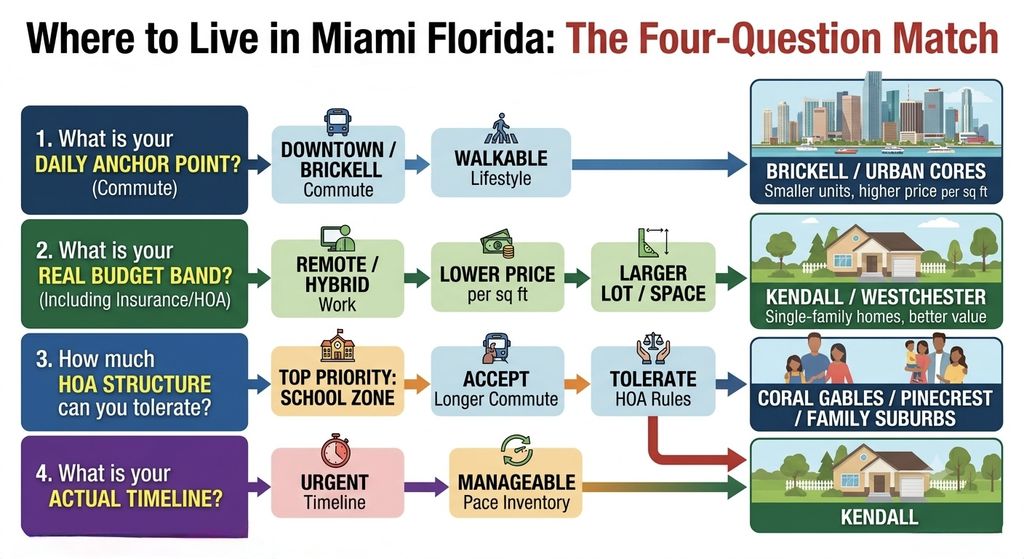
The Real Framework: Four Questions That Decide Where to Live in Miami Florida
Before touring a single house, answer these in order. Each one narrows the map more than the last.
1. What's your daily anchor point?
If you commute to an office, downtown, Brickell, Coral Gables, or Doral, drive time at 8 AM matters more than square footage. Miami traffic doesn't scale linearly with distance. Twelve miles on the Palmetto at rush hour can take 45 minutes, while the same distance on a side-street route takes 20.
2. What's your real budget band, not your approved amount?
A lender might approve $650,000. That number and the number you're comfortable carrying with insurance, HOA dues, and property tax in Miami-Dade are frequently two different figures, especially post-2022 when insurance premiums reshaped monthly payments across the county. Working through whether renting or buying makes more sense first and reviewing what things actually cost month to month before house hunting keeps this number honest.
3. How much HOA structure can you tolerate?
Some buyers want a gated community with rules, a landscaping crew, and predictable aesthetics. Others want a single-family lot with no HOA and no say from a board about their fence color. This single preference eliminates or includes entire zip codes before you look at a single listing.
4. What's your actual timeline?
Relocating with a school-age child in June forces a decision by July. Relocating solo with flexible remote work gives you months to rent first and decide slowly. Timeline pressure changes how much you can afford to be picky.
Answer those four honestly and most of Miami's map falls away on its own. What's left is a short list of areas worth actually touring.
Applying the Framework to Kendall: Why It Fits a Specific Kind of Relocator
Kendall is one of the most searched destinations for people moving to Miami from out of state, and running it through the framework above shows exactly why.
Commute-wise, Kendall works best for anyone whose daily anchor is south or west, Baptist Health, Miami Zoo, FIU, or a hybrid schedule that only requires downtown a couple of days a week. It is not the move if your job is a five-day-a-week Brickell commute; that drive at 8 AM regularly runs 40 to 50 minutes each way.
Budget-wise, kendall miami homes for sale typically run below Coral Gables and South Miami for comparable square footage, which is the main reason it shows up on so many relocation shortlists. A four-bedroom single-family home in the Kendall area often prices meaningfully lower per square foot than the same layout closer to the coast.
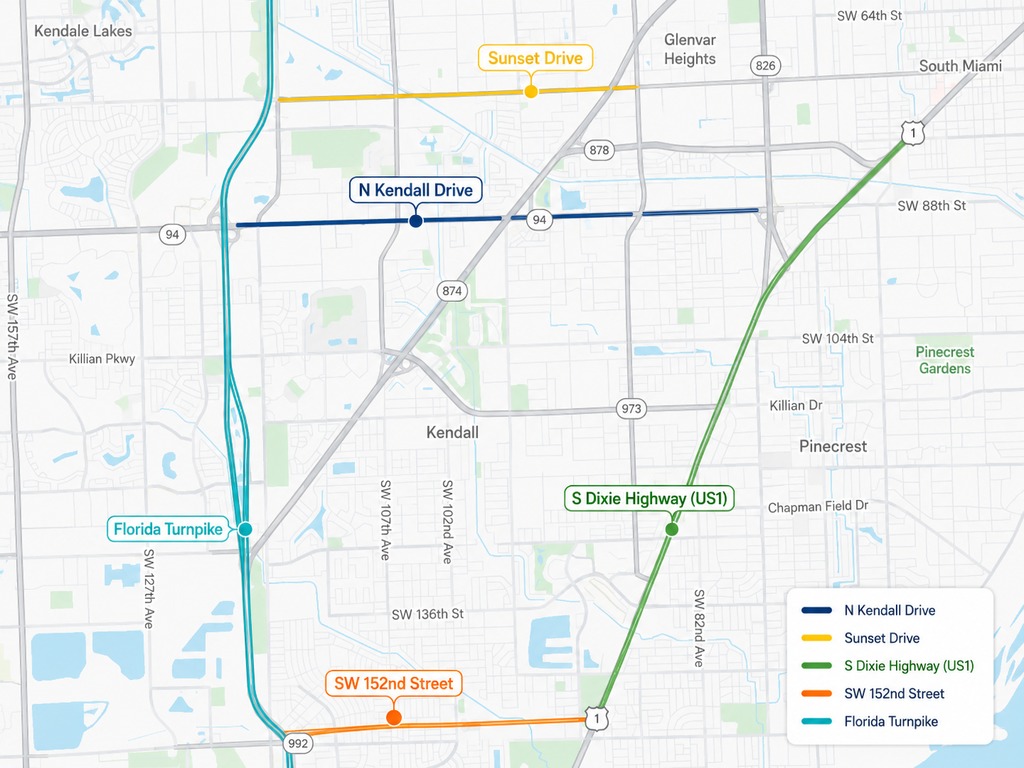
On HOA tolerance, Kendall is split down the middle. Streets around the Sunset Drive corridor, zoned for Kenwood K-8 Center, include both HOA-governed communities with shared pools and non-HOA single-family blocks where owners have full control over their lot. That mix is unusual for the area and worth flagging specifically to a buyer's agent, because two houses three blocks apart can have completely different rules. Browsing Kendall Miami homes for sale without filtering by HOA status is one of the more common ways relocators end up under contract on a property that doesn't match what they actually wanted.
Timeline-wise, Kendall inventory moves at a manageable pace compared to hotter coastal submarkets, giving relocators more room to negotiate than they'd get in Brickell or the Gables during peak season. That pace also means a relocator working with a hard deadline can usually find and close on a home in Kendall faster than in a submarket where every listing draws multiple offers within the first weekend.
When the Framework Points You Somewhere Else Entirely
Not every relocator lands where Kendall does, and that's the point of running the framework instead of picking from a list.
If your daily anchor is downtown or Brickell and you want to walk to dinner without a car, the framework points toward an urban, walkable area instead, smaller units, higher price per square foot, but a completely different daily rhythm than a Kendall single-family street.
If your top priority is a specific school zone above everything else, including commute and HOA tolerance, the framework points toward areas built around school reputation first, where families accept a longer drive to secure a specific zone. This is also where most lists of the best Miami suburbs for families fall short, since they rank school ratings alone without weighing what a family gives up in commute time or price per square foot to get into that zone. Two families with identical budgets and identical priorities on paper can land in different suburbs once you factor in whether one parent works from home three days a week and the other doesn't.
This is exactly why we keep a full area-by-area breakdown of Miami's neighborhoods separate from this framework. Once you know your four answers, that directory becomes useful for finding the specific streets and buildings that match. Before you know your answers, it's just a longer version of the same list problem.
For families weighing multiple areas at once, it also helps to see the tradeoffs side by side rather than one area at a time, since the best Miami suburbs for families rarely win on every category, they usually win on the two or three categories that matter most to that specific household. A family choosing between Pinecrest and Kendall, for example, is usually trading a higher price per square foot in Pinecrest for a specific school zone, against more house and yard for the same budget in Kendall.
The comparison changes again once you move north or west of the framework's typical Kendall answer. Brickell, Kendall, and Hialeah sit within twenty minutes of each other on a map but function like three different cities. Brickell trades space for walkability and a four to five-figure HOA on many buildings. Kendall trades walkability for yard space and a lower price per square foot. Hialeah trades both walkability and yard size for the lowest entry price in the county, which is why it draws a different kind of relocator entirely, usually one prioritizing budget above every other factor on the framework. Among Miami areas to live, few pairs illustrate the tradeoffs as clearly as these three, which is also why a list ranking them against each other misses the point. None of them is objectively better. Each one answers a different set of the four questions.
The Relocation Mistake That Adds Months to Your Move
The single most expensive mistake we see with people moving to Miami from out of state is picking a neighborhood, then discovering the financing and approval realities after they're already under contract.
Here's how it plays out. A buyer relocating from Ohio falls in love with a Kendall condo, submits an offer, and only during the association application process learns the building requires 60 to 90 days for board approval, on top of a 20 percent down payment minimum the association enforces regardless of what the lender requires. The buyer's closing date, tied to a job start date, blows past by six weeks. What should have been a two-month process stretches into four, and the buyer ends up renting temporarily anyway, the exact outcome they were trying to avoid by buying quickly.
The fix isn't complicated. It's sequencing. Confirm HOA and condo association approval timelines before writing an offer, not after. A buyer's agent who knows which Kendall and broader Miami-Dade buildings run fast self-managed approvals versus slow board-review approvals can save a relocating buyer six to eight weeks on a hard deadline.
What Changes When You're Relocating From Out of State or Overseas
Four factors hit relocators harder than local buyers, and they rarely show up in generic advice.
HOA and condo approval timelines. Local buyers often already know which buildings move fast. Someone moving to Miami from out of state usually doesn't, and finds out the hard way, mid-contract, that a board only meets monthly.
Insurance and its effect on financing speed. Florida's post-2022 insurance market means lenders now request insurance quotes earlier in underwriting than they used to. Buyers can check current filing activity directly through the Florida Office of Insurance Regulation rather than relying on secondhand estimates. A relocator unfamiliar with Miami-Dade wind mitigation requirements or four-point inspections can lose a week just gathering documentation a local buyer would already have on hand.
Foreign buyer behavior and negotiation style. International buyers, a meaningful share of Miami's market, often negotiate on closing speed and cash terms rather than price, a pattern Florida Realtors tracks in its statewide market reports. Domestic relocators competing against an all-cash international offer need a different strategy than competing against another financed local buyer. General landlord-tenant and property basics for anyone weighing a rent-first approach are also laid out in plain language by HUD.
Seasonal demand by price point. Miami's high season, roughly November through April, brings more competition to move-in-ready homes under $700,000 than to homes above $1.5 million, where demand is steadier year-round. A relocator timing a move for summer often faces less competition than one arriving in February.
Understanding these four before house hunting starts is the difference between a relocation that closes on schedule and one that drags for months past a start date.
Deciding Where to Live in Miami Florida Starts Before You Look at Listings
Where to live in Miami Florida isn't a ranking question, it's a matching question. Answer your commute, your real budget band, your HOA tolerance, and your timeline first, and the right areas surface on their own, whether that's Kendall or somewhere the framework points instead. Skip that step and you'll spend months touring homes that were never a fit to begin with.
FAQ
Q: What is the best area to live in Miami for someone relocating from out of state?
A: There isn't one universal answer, and anyone who gives you a single name without asking about your commute or budget is guessing. Relocators prioritizing space and a lower price per square foot often land in Kendall or Westchester. Relocators prioritizing walkability without a car gravitate toward Brickell or parts of Coconut Grove. The honest starting point is running your own commute, budget, HOA tolerance, and timeline through the framework above before picking a name off a list.
Q: Is Kendall a good place to live in Miami for families relocating with kids?
A: For many families, yes, particularly around the Sunset Drive corridor zoned for Kenwood K-8 Center, where lot sizes and price per square foot beat comparable homes closer to the coast. Kendall works less well if your job requires a five-day Brickell commute, since that drive regularly runs 40 to 50 minutes during peak hours. Families should weigh school zone against commute rather than assuming Kendall fits every household equally.
Q: Should I rent for a few months before buying when I'm relocating to Miami?
A: If your timeline allows it, renting for three to six months lets you test a commute and a neighborhood before committing to a mortgage in an unfamiliar market. Checking current Miami-Dade rental options is a reasonable first move if you're not ready to commit to an area yet. This matters more in Miami than in many cities because HOA rules, insurance costs, and flood zone requirements vary block by block in ways that aren't obvious from out of state. Buyers on a hard deadline, tied to a job start date, don't always have this option, which is why sequencing HOA and insurance checks early matters even more for them.
Q: How long does HOA or condo association approval take when buying in Miami-Dade?
A: It ranges widely, from a few days for self-managed associations to 60 or 90 days for board-review buildings that only meet monthly. This is one of the most common surprises for relocators, since a buyer from a state without similar HOA structures often doesn't think to ask before writing an offer. Confirming approval timelines during the showing phase, not after going under contract, protects a relocation deadline tied to a job start date.
Q: What part of Miami has the easiest commute for remote or hybrid workers?
A: Remote and hybrid workers have more flexibility than full-time commuters, which usually shifts the decision toward budget and lifestyle rather than proximity to an office. Areas like Kendall, Westchester, and parts of Palmetto Bay become far more attractive once daily traffic isn't a fixed constraint, since the tradeoff of a longer occasional commute two days a week is easier to absorb than five.
If you're relocating and still weighing where to live in Miami Florida, talk through your commute, budget, and timeline with a local buyer's agent before you tour a single home, it's the fastest way to narrow eleven areas down to two or three worth actually seeing.
Check out this article next