
Most buyers searching for new homes in Miami Dade County make the same mistake: they picture Brickell or Coral Gables, get frustrated by the prices, and either give up or compromise on the wrong things. Miami-Dade has a significant amount of active new construction, but it is concentrated in specific sub-markets for specific reasons. Understanding where builders are operating, what price points are realistic, and what is buried inside a standard builder contract will determine whether you end up in the right home or locked into a deal you did not fully understand. This guide covers all of it.
The New Construction Map Has Shifted: Here Is Where Activity Is Concentrated
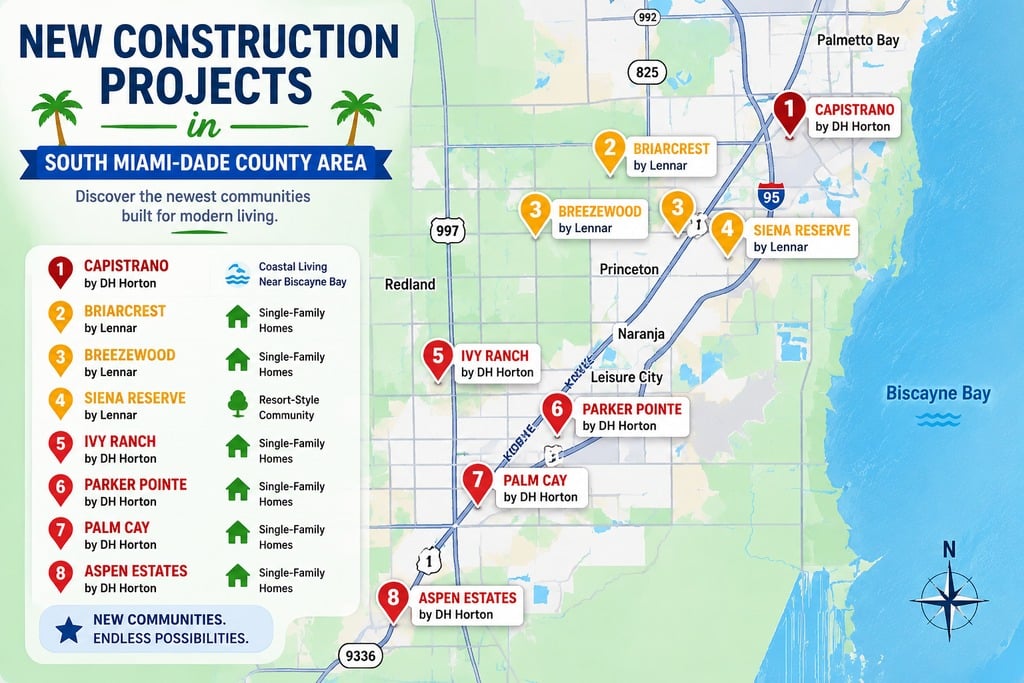
Land cost and availability have pushed most ground-up single-family development to the southern and western edges of the county. That is not a consolation prize. For buyers who do their homework, it is actually where the value is.
South Dade and Homestead carry the heaviest builder activity right now. Communities like Heron Pointe by Lennar sit near South Dade Park and the SW 336th Street corridor, with single-family floor plans starting around $700,000 for three bedrooms and scaling past $800,000 for larger five-bedroom layouts on the same street. D.R. Horton is active in Florida City and Homestead with townhome communities starting in the high $300s. Century Homebuilders has multiple phases open across Homestead as well. For buyers priced out of established areas, homes for sale in Homestead represent some of the most legitimate new construction value left in Miami-Dade.
Doral sits at the opposite end of the spectrum. Builder activity there targets move-up buyers and corporate relocators. Lennar's Islands at Doral communities and D.R. Horton's Doral-area projects attract buyers who want new construction with walkability, strong school ratings, and proximity to the airport corridor. Homes for sale in Doral reflect a market where new construction carries a real premium, with pricing typically starting above $600,000 for townhomes and running well past $1 million for single-family product.
Miami Gardens and North Miami-Dade have more limited new construction inventory, but Lennar has had recent activity in Miami Gardens, and townhome communities targeting first-time buyers have appeared along the US-1 and Turnpike corridors in Cutler Bay.
The core of Miami (Brickell, Edgewater, Wynwood) is almost entirely a vertical condo market. Buyers looking for a house in those areas are looking at resale, not new construction.
What New Construction Homes Miami Dade County Actually Cost Right Now
The starting price a builder advertises and the price you actually pay are rarely the same number. Understanding the gap is one of the most useful things a buyer can do before setting foot in a model home.
Across Miami-Dade, new construction homes Miami Dade County currently start around $350,000 for entry-level townhome product and reach well past $1.5 million at the median for the broader county market when luxury condo inventory is included. For practical purposes, realistic price bands by product type look like this:
- Entry townhomes (Homestead, Florida City): $379,000 to $490,000
- Single-family starter (South Dade, Cutler Bay): $500,000 to $600,000
- Move-up single-family (Doral, West Kendall adjacent): $650,000 to $900,000
- Luxury new construction (Doral estates, Brickell condos): $1 million and up
Those base prices do not include lot premiums, which can add $15,000 to $60,000 depending on community phase and lot position. They also do not include design center upgrades. In a Lennar "Everything's Included" community, you are largely protected from upgrade sticker shock because finishes come standard. In a D.R. Horton or Century community, a buyer who visits the design center and selects premium flooring, cabinetry, and appliances can add $30,000 to $80,000 above the base contract price.
Builder incentives such as closing cost credits and interest rate buydowns do exist right now and can be meaningful. The catch is that most builders require you to use their affiliated lender to access those incentives. That is a financial calculation worth examining carefully, not just accepting.
Builder Incentives Sound Great Until You Read the Fine Print
Builders are skilled at presenting incentives in a way that feels like they are doing you a favor. A 3.99% rate buydown sounds excellent. A $20,000 closing cost credit sounds like found money. But these incentives come with conditions that most buyers do not fully process in a model home sales center.
The most common structure: the builder's affiliated lender funds the rate buydown. Use an outside lender and the incentive disappears. That is not inherently wrong, but it means you need to compare the builder lender's full loan terms, not just the headline rate, against what an independent mortgage broker can offer. In some cases the builder's package wins. In others it does not.
Rate lock windows are another friction point. Many builder contracts lock the rate 30 to 60 days before closing, not at contract signing. If your home is delivered 10 months from now and rates move between now and the lock window, you carry that risk.
Design center upgrade markups are consistently the biggest budget surprise for buyers doing new construction miami for the first time. Builders typically mark up design center options at 20% to 40% above what those same finishes would cost you to install after closing. If you are buying on a tight budget, taking the base finishes and upgrading after move-in through your own contractor is often the better financial decision.
These are the kinds of details that experienced buyers and their agents catch. First-time buyers often do not, and the consequences show up in the final closing disclosure. For a broader look at how these mistakes play out, first-time buyer mistakes in Miami covers the pattern in detail.
New Construction Miami vs. Resale: The Tradeoffs That Actually Matter
The comparison most buyers are actually trying to make is not just about price. It is about total cost of ownership, risk, and lifestyle fit.
Insurance is where new construction miami wins decisively in Miami-Dade. A home built to current Miami-Dade Edition building codes with impact-resistant windows and doors, reinforced roof-to-wall connections, and a hip roof design qualifies for significantly lower homeowner's insurance premiums than a resale home built before 2002. In a county where insurance costs have made national headlines, that gap can amount to $3,000 to $8,000 per year in premium savings. Over a five-year holding period, that is real money.
HOA structure is worth examining closely in new construction communities. Many master-planned developments carry both a base HOA and a Community Development District (CDD) assessment. The CDD is a taxing mechanism the builder uses to finance community infrastructure. It shows up on your property tax bill, not your HOA statement, and it does not go away. Buyers who do not ask about CDD assessments upfront are often surprised when their first tax bill arrives.
Timing and certainty favor resale. A "quick move-in" home in a new community typically means 60 to 90 days to close. A home under construction from contract can run 8 to 14 months in South Florida depending on permitting, supply chain, and the builder's pipeline. If you are in a lease with a specific end date or relocating from out of state with a firm start date, that timeline requires careful planning.
Here is how the tradeoff played out for a buyer in Homestead in late 2025: they contracted a four-bedroom Lennar single-family home at $639,000 with a projected close in 11 months. During that window, the community's Phase 2 pricing increased to $689,000. Their Phase 1 contract price was protected. They closed with $40,000 in embedded equity before moving in. A real outcome that resale buyers in the same price range did not experience.
Miami-Dade-Specific Factors That Change How New Construction Plays Out
Flood zone siting affects where new construction goes and how it is priced. FEMA flood zone maps in Miami-Dade are granular, and builders in South Dade are acutely aware of which parcels require elevated foundation designs. Buyers searching in Homestead, Florida City, and the southern Cutler Bay corridor should confirm the flood zone designation of any specific lot before contracting. A Zone AE designation triggers mandatory flood insurance through the National Flood Insurance Program, which adds to carrying costs. Many newer communities in South Dade have been deliberately sited on higher ground or engineered with fill to achieve Zone X designations, which carry no mandatory flood insurance requirement.
Insurance underwriting on new builds is genuinely different in Miami-Dade compared to the rest of Florida. The Miami-Dade Edition building code is the strictest in the country following Hurricane Andrew. Homes built to current code receive the maximum wind mitigation credits from insurers. Buyers coming from other states are frequently surprised by how competitive insurance quotes are on new construction in this county relative to their expectations.
Seasonal demand patterns matter for negotiation. Builder communities in Miami-Dade see stronger foot traffic and fewer incentives from January through April, when out-of-state and international relocators are most active. If your timeline allows, shopping in May through August, when builder sales slow and incentive packages tend to improve, can produce better terms. Foreign buyers, particularly from Venezuela, Colombia, and Brazil, are active in Doral's new construction market year-round, which keeps pricing there firmer across all seasons.
Deposit structure and contract terms in new construction differ significantly from resale. Builder contracts are written by the builder's legal team and heavily favor the builder. Inspection rights, change order costs, and termination provisions are all negotiable to varying degrees, but most buyers do not know what to push on. This is an area where having a buyer's agent who has closed multiple builder transactions in Miami-Dade is not a luxury.
How to Search New Construction Homes in Miami Dade County Without Getting Trapped
The single most expensive mistake buyers make in new construction is walking into a builder's sales office without representation. The builder's on-site sales agent works for the builder. Their job is to sell the home at the highest price with the fewest concessions. Bringing your own agent costs you nothing in a builder transaction. Builder commissions are already built into the project's cost structure, and it gives you someone whose entire job is to advocate for your position.
Representation matters specifically in new construction because the negotiation happens before the contract is signed, not after. Once you are under contract with a builder, your leverage is limited. Before signing, a buyer's agent can negotiate on lot premiums, upgrade credits, closing cost assistance, rate lock terms, and move-in date flexibility. After signing, most of those levers are gone.
Searching new construction homes in miami dade county across multiple builder websites also fragments your picture of what is available. A single search that pulls active inventory across all builders and communities gives you a cleaner comparison. Browse the current new construction homes in Miami-Dade County inventory on Labrada Realty's platform to see what is active right now by area and price range.
For buyers who also need financing, the builder transaction adds a layer of complexity. If you want to compare the builder's lender against outside options, you need a mortgage broker who can pull that comparison quickly. And if you are handling title separately from the builder's preferred title company, closing coordination becomes its own process. Working with a brokerage that handles real estate, mortgage, and title under one roof removes a significant amount of friction from new construction transactions, particularly when timing is tight and multiple parties need to move in sync.
FAQ
Q: Can I use my own real estate agent when buying new construction homes in Miami-Dade County?
A: Yes, and you should. Builder commissions are already priced into the project, so bringing a buyer's agent does not increase your purchase price. What it does is give you someone whose job is entirely to advocate for your terms before you sign a contract the builder drafted. In Miami-Dade's active new construction market, an experienced buyer's agent can negotiate on lot premiums, design center credits, closing cost assistance, and rate lock windows. Once you sign without representation, those negotiating points are largely off the table.
Q: What is the typical timeline from contract to closing on new construction in Miami-Dade County?
A: It depends on what you are buying. Quick move-in homes, which are units already built or near completion, typically close within 45 to 90 days. Homes under construction from contract run 8 to 14 months in South Florida, sometimes longer if the community is in early phases and permitting is still active. Miami-Dade's permitting process through the county or applicable municipality adds time that buyers from other states do not always anticipate. Build in a buffer of 60 to 90 days beyond the builder's projected date before committing to lease termination or relocation timelines.
Q: Do new homes in Miami Dade County come with warranties?
A: Florida law requires builders to provide a one-year workmanship warranty, a two-year warranty on mechanical systems, and a ten-year structural warranty. In practice, the quality of warranty service varies significantly by builder. Larger national builders like Lennar and D.R. Horton have established customer care processes, though response times can stretch in high-volume communities. Buyers should request a copy of the warranty documentation before signing a contract, confirm which items are covered, and understand the process for filing warranty claims. An independent third-party home inspection at the final walkthrough is advisable regardless of warranty terms.
Q: Are new construction homes in Miami-Dade more expensive to insure than resale homes?
A: Generally, no. New construction built to current Miami-Dade Edition code standards qualifies for the maximum wind mitigation discounts available from Florida insurers. Impact-resistant windows and doors, reinforced roof decking, and hip roof geometry all contribute to lower insurance premiums. For a home in the $450,000 to $600,000 range, annual homeowner's insurance on a code-compliant new build in South Dade might run $3,500 to $5,500, compared to $7,000 to $12,000 or more on a comparable resale home built in the 1980s or 1990s without full wind mitigation compliance. That gap is one of the most compelling financial arguments for new construction in this county.
Q: What should I watch out for in a builder contract that most buyers miss?
A: Three things consistently catch buyers off guard. First, the appraisal contingency: most builder contracts limit your ability to exit if the home appraises below the contract price, meaning you may be expected to cover the gap or lose your deposit. Second, the preferred lender clause: closing cost credits and rate buydowns are often contingent on using the builder's affiliated lender, which limits your ability to shop financing. Third, the CDD assessment: Community Development District charges appear on your annual property tax bill, not your HOA statement, and they can add $1,500 to $4,000 per year to your carrying costs. Always ask about CDD status before contracting.
If you want to see what is actually available right now across Miami-Dade's new construction communities, including quick move-in homes and pre-construction phases broken out by area and price, browse the new construction homes in Miami-Dade County search on Labrada Realty. Every listing is current, and if you see something worth discussing, Alberto can walk you through the builder's contract terms, financing options, and title coordination before you set foot in a sales office.
Check out this article next