
Most people buying a condo in Miami assume the hardest part is finding a unit they like at a price they can afford. This assumption gets buyers in trouble every week. The building carries its own credit file, separate from yours, and a lender will deny your loan over that file even when your income and credit are spotless. I have watched clients fall for a unit with a beautiful lobby, only to learn the building has no FHA approval and a special assessment vote pending. Two variables decide whether that closing actually happens: whether the building is FHA approved, and what the HOA fee is really covering. This piece walks through both, with the numbers that actually move your approval odds.
Why Buying a Condo in Miami Means Underwriting the Building, Not Just the Unit
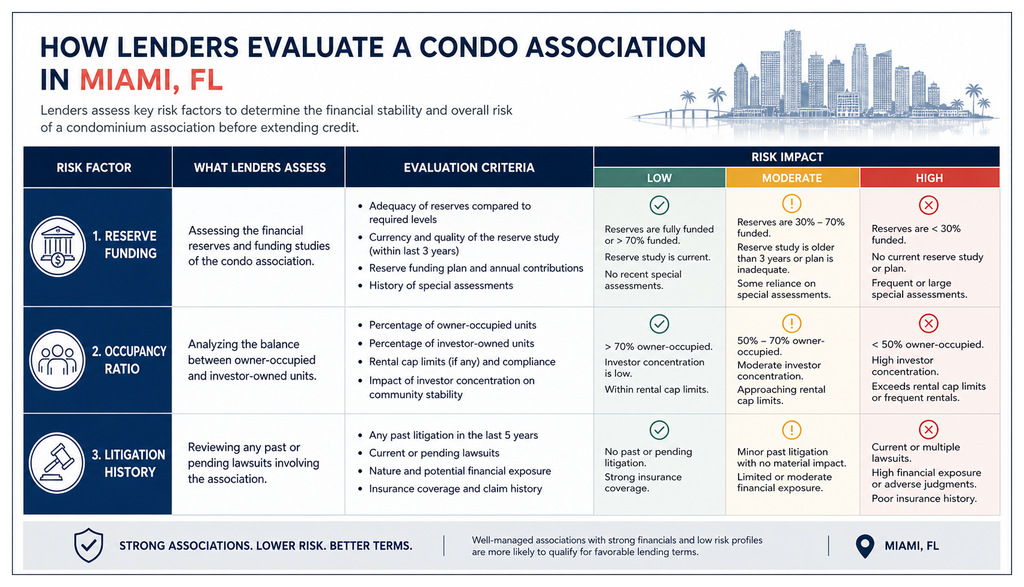
When you finance a single-family home, the lender evaluates you and the house. When you finance a condo, the lender adds a third file: the association itself. Reserve funding, delinquency rates, litigation history, and the ratio of owner-occupants to renters all get pulled and scored before your loan clears.
A buyer with a 780 credit score and a clean income history can still get a flat denial if the building's reserve study shows a funding gap, or if too many units in the complex are tenant-occupied. Buying a condo in Miami without checking this file first is like signing a lease on a business you have never audited. The unit is the smallest part of the risk.
This is also why two condos priced identically can move at completely different speeds. One clears underwriting in three weeks. The other sits for two months while the lender chases documents from an association that is slow to respond, or worse, ineligible altogether.
Owner-occupancy ratio is one of the quieter variables in this file. Most lenders want to see a majority of units occupied by their owners rather than tenants, since a building full of renters is treated as a higher default risk. A building running below that threshold can lose its FHA eligibility even if every other metric looks healthy, and that ratio shifts over time as owners move out and lease their units. A building that qualified two years ago is not guaranteed to qualify today, which is exactly why status needs to be confirmed fresh, not assumed from an old listing note or a friend's experience buying in the same complex last year.
How to Confirm FHA Approved Condos in Miami Before You Fall for a Unit
Not every condo building in Miami-Dade qualifies for FHA financing, and the gap is bigger than most buyers expect. Recent counts show only a small handful of buildings countywide, sometimes fewer than ten at any given time, carry current, unexpired approval. The rest either never applied, let their approval lapse, or were denied outright over reserve or litigation issues.
FHA approved condos Miami buyers can search for exist on a federal project list that your loan officer can check by building name before you write an offer. If the building is not on it, you have two options: pursue single-unit approval, which takes weeks and is not guaranteed, or shift to a conventional loan with a different down payment structure. Florida requires a 25 percent down payment on conventional financing when a building's reserves are not fully funded, compared to 10 percent in most other states, so this is not a minor detail to discover late.
I always tell buyers the same thing: ask about FHA approved condos Miami-wide before you schedule a second showing, not after you have already picked a favorite. A loan officer can usually confirm status same-day. Waiting until you are under contract to ask is the single most avoidable delay in this entire process. The Consumer Financial Protection Bureau's debt-to-income explainer is a useful primer if you want to understand how a lender weighs your file against the building's before you start touring.
What Miami Condo HOA Fees Really Cover, and Why Identical Units Can Differ by Hundreds a Month
Miami condo HOA fees are not a flat administrative charge. They fund three things: building insurance, reserve contributions for future repairs, and amenities. Since Florida tightened reserve funding requirements following the Surfside collapse, associations can no longer waive full reserve funding through a member vote, and older buildings are passing that cost through to owners immediately rather than deferring it.
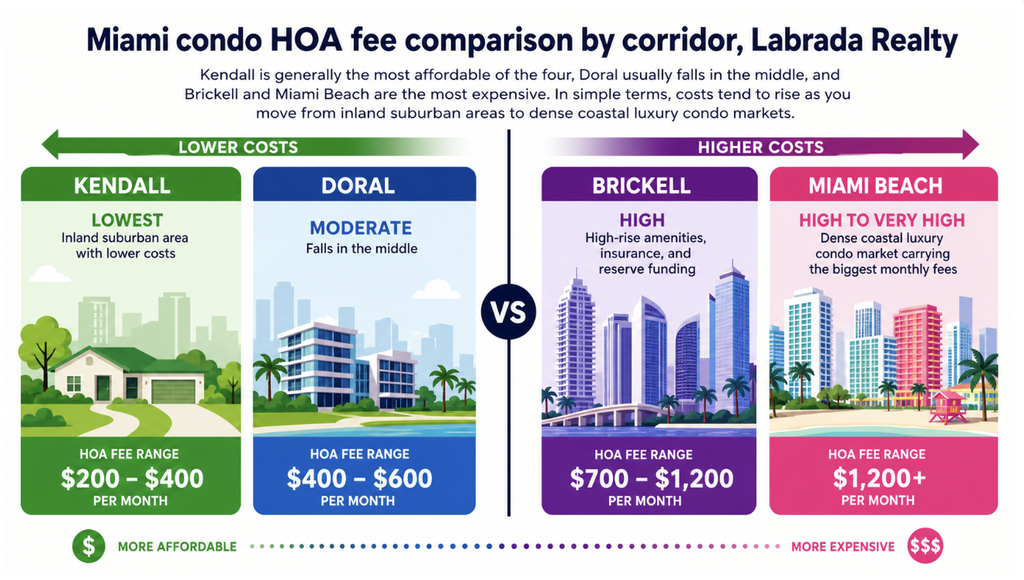
A coastal tower built before 2000 can carry Miami condo HOA fees of $1,200 to $2,500 a month on a standard two-bedroom, driven mostly by windstorm and flood insurance premiums. An inland building of similar size and age in a corridor like West Kendall or Doral often runs $350 to $600 a month for the same square footage, because the insurance exposure and building age profile are different.
Two units listed at the same price can carry a $700 monthly gap in fees purely because one building funded its reserves properly years ago and the other is now scrambling to catch up. A gap that size changes your real monthly cost by more than a full percentage point on your interest rate would.
The Real Math: How HOA Fees Change Your Odds When Buying a Condo in Miami
Here is where this stops being abstract. FHA lenders generally cap total debt-to-income ratio, including your mortgage, taxes, insurance, and HOA fee combined, at around 43 percent of gross monthly income, though some approvals stretch higher with strong compensating factors.
A buyer earning $6,200 a month, shopping near SW 137th Ave in West Kendall, was pre-approved based on a unit with an estimated $310 monthly HOA fee. The building she ultimately wanted to buy actually carried a $540 fee once the current budget was pulled, a detail the listing sheet had understated. The extra $230 a month pushed her back-end ratio from 41 percent to just over 45 percent, and the lender's automated underwriting flagged the file for manual review.
She did not lose the deal, but she lost eleven days waiting on a manual underwrite, and had to provide two additional months of bank statements to clear it. A buyer without that cushion of time, competing against a cash offer, would have lost the unit entirely. This is the exact reason I pull a building's current budget and questionnaire before a client makes an offer rather than after, since I hold my broker's license alongside my mortgage broker and title agent licenses and can move that verification in parallel instead of waiting on three separate parties to sequence it.
Miami-Specific Depth: Board Approval, Insurance, and HOA-Heavy Buildings
Board approval timelines vary enormously across Miami-Dade. Some associations run a one-page application processed in 48 hours. Others require an in-person board interview scheduled weeks out, and a handful still reserve the right to reject a buyer for reasons that have nothing to do with financing. Ask your agent for the building's approval process before you write an offer, since a slow board can blow a rate lock.
Insurance availability is now a financing variable, not just a cost variable. Buildings that failed their milestone inspection or carry deferred maintenance are increasingly difficult to insure at all, and some lenders will not close a loan until the association can show proof of a bindable policy. This single requirement has added weeks to closings that would have moved in days two years ago.
HOA-heavy buildings and non-HOA single-family homes behave completely differently at the underwriting stage. A single-family home's insurance and tax burden sits entirely with you, and a lender evaluates only your file. A condo splits that burden across an entire association, which means someone else's late assessment payment, someone else's lawsuit, or someone else's unfunded reserve can delay or kill your loan even though none of it involves you personally.
Micro-market differences compound all of this. A Brickell tower and a Kendall garden-style building can carry nearly identical unit prices and still produce completely different financing experiences. Brickell's high-rise stock skews toward buildings with heavier amenity packages, taller reserve requirements, and a larger share of foreign, cash-paying owners, which can actually make FHA approval harder to obtain since occupancy and rental restrictions come into play. Kendall and areas further west tend to have lower-rise, owner-occupant-heavy buildings where reserve funding is simpler to verify and approval, when it exists, tends to be more stable year over year. Hialeah's condo stock sits closer to Kendall's profile than Brickell's, with smaller associations and fewer amenity-driven cost swings, though inventory in that corridor is thinner and turns over less often. None of this means one corridor is right or wrong. It means the financing conversation has to start with the building's profile, not just the neighborhood's reputation.
The Mistake That Costs Condo Buyers the Most: Waiting Until Under Contract to Pull the Questionnaire
The most expensive mistake I see is a buyer who falls for a unit, writes an offer, and only then asks their lender to request the condo questionnaire from the association. Some associations take ten business days or longer to respond to that request, and if anything on it disqualifies the building, the buyer has burned two weeks of their inspection period for nothing.
A buyer who instead confirms FHA approved condos Miami status and pulls the current HOA budget before writing an offer walks into contract with a financing plan that already matches the building. This sequencing gap is often the entire reason one buyer closes in three weeks while another loses the unit to a competing offer that moved faster.
I saw this play out with a buyer targeting a unit near Dadeland who skipped the questionnaire request until after the offer was accepted. The association took thirteen business days to respond, well past the standard inspection window, and the delay forced the buyer to request an extension the seller was not obligated to grant. The seller had a backup offer waiting and took it. The original buyer had already paid for an appraisal and an inspection on a unit they never closed on, several hundred dollars spent for nothing, purely because the building verification happened in the wrong order.
Buying a condo in Miami rewards buyers who verify the building before they fall for the unit, not after. The financing questions belong at the top of your search, not somewhere near the end of it.
If you are comparing corridors before you settle on a building, the breakdown of Miami-Dade's condo submarkets covers how pricing and building age shift from Brickell to Kendall to Doral. And if you are still weighing the full cost of ownership beyond the condo fee itself, the guide to hidden costs of buying a home walks through what else to budget for before closing. For a step-by-step look at the closing timeline once you are under contract, the home buying process guide lays out what happens from offer to keys.
FAQ
Q: Are there FHA approved condos in Miami right now?
A: Yes, but the list is short. Only a small number of Miami-Dade buildings currently hold active FHA approval at any given time, and approvals expire and need renewal, so a building that qualified last year may not qualify today. Your loan officer can check current status by building name in minutes. If your target building is not on the list, single-unit approval or a conventional loan with a larger down payment are the realistic paths forward.
Q: What's considered a normal HOA fee for a Miami condo?
A: It depends heavily on corridor and building age. Coastal towers in areas like Brickell or Miami Beach commonly run $700 to $1,500 a month on a two-bedroom, sometimes higher in older buildings with heavy insurance exposure. Inland buildings in West Kendall, Doral, or similar corridors often land between $350 and $600 for comparable square footage. Anything well below that range on an older building is worth a closer look at whether reserves are actually funded.
Q: Can I still get an FHA loan if the building has a special assessment?
A: It depends on the size and status of the assessment. A fully disclosed, budgeted assessment with a clear payment plan is less disruptive than an emergency assessment tied to a failed inspection. Lenders will ask for the assessment amount, whether it has been voted on, and how it affects the building's reserve funding. A large, unresolved assessment is one of the fastest ways a building loses its approval standing, FHA or conventional.
Q: How long does FHA condo approval actually take once I'm under contract?
A: If the building already carries active approval, confirming it takes a day or two. If you need single-unit approval because the building itself is not approved, plan for three to six weeks, and understand it is not guaranteed even after that wait. This is exactly why checking status before you write an offer protects your timeline instead of gambling with it mid-contract.
Q: Does a low HOA fee always mean a better deal?
A: Not necessarily, and this catches buyers who are only comparing numbers on a listing sheet. A fee that looks unusually low for an older building can mean the association is underfunding reserves, which often leads to a large special assessment down the road. I would rather see a client pay $150 more a month into a fully funded reserve than save that money now and get hit with a five-figure assessment in three years.
If you want to know whether a specific building qualifies for FHA financing and what its real HOA cost looks like before you write an offer, start with the Buyers page and I will pull the building's questionnaire and reserve status for you before you fall for a unit that cannot close.
Check out this article next