

Most buyers searching for Miami Dade homes for sale open Zillow, type in a zip code, and start filtering by price. The problem is not the process. It is the data underneath it. Zillow's Miami-Dade inventory is routinely populated with homes already under contract, mislabeled as active, or priced using automated estimates that cannot account for the county's extreme micro-market variance. A buyer who anchors expectations to what they see on a portal is starting the search with a fundamentally distorted picture.
Miami-Dade is not one market. It is dozens of micro-markets stacked on top of each other, each with its own price dynamics, insurance cost profiles, HOA structures, and buyer competition levels. This guide breaks down what is actually happening across the county and what buyers who go beyond the aggregators tend to figure out first.
What the Miami Dade homes for sale Market Actually Looks Like Right Now
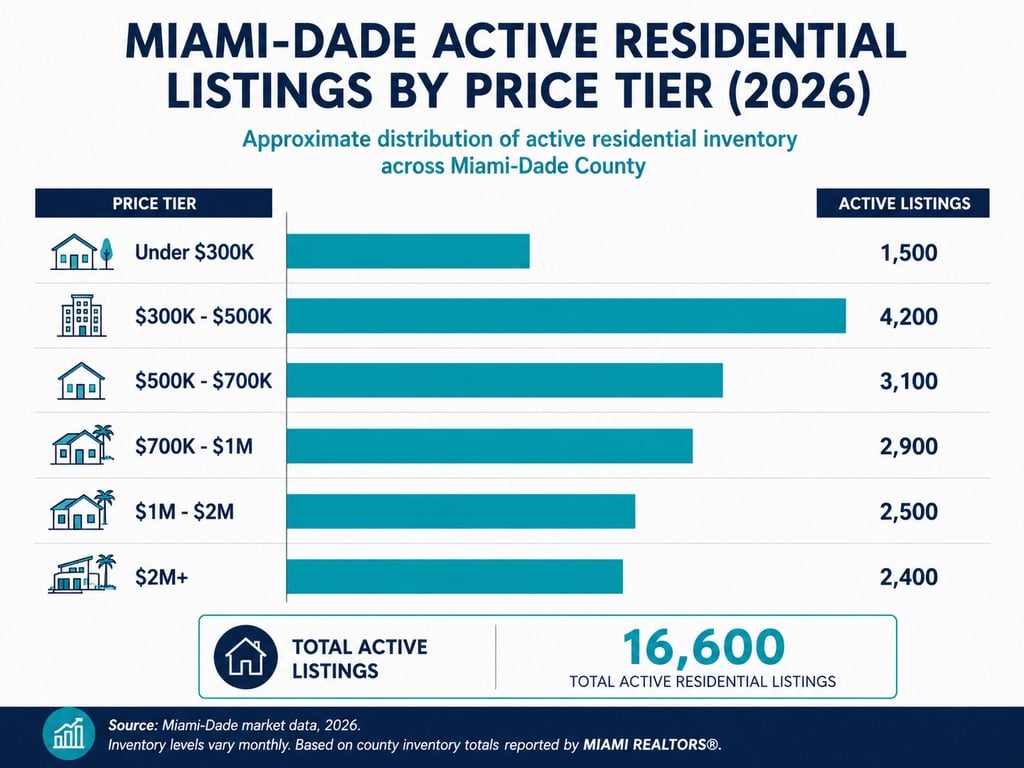
As of mid-2026, Miami-Dade County carries roughly 15,000 to 18,000 active residential listings at any given time. The total sounds significant until you break it down by area, price tier, and property type. Single-family homes in the $500K to $700K range, arguably the most competitive segment in the county, run the tightest supply and the shortest days on market. Condos tell a different story. Supply in the $300K to $500K tier is relatively elevated, but many of those units carry financing restrictions tied to building reserve status that shrink the eligible buyer pool considerably.
According to Florida Realtors market data, county-wide inventory has grown year-over-year in the upper price tiers while remaining constrained in the suburban single-family segment below $700K. The divergence between those tiers matters for how buyers should calibrate their expectations before they begin a search.
What buyers often miss is that the "available" count on any portal reflects a snapshot that may already be 24 to 72 hours stale. In a market where homes for sale Miami Dade county listings in areas like Kendall, Doral, and West Miami can go from active to under contract in under a week, that lag matters considerably. Buyers who rely on portal data alone regularly discover their saved homes have already accepted offers by the time they schedule a showing.
The shift worth noting in 2026 is that seller leverage has softened slightly at the upper end of the market, particularly for condos above $700K, while the suburban single-family segment continues to absorb demand faster than supply can replace it. Buyers in the $400K to $600K range are still facing multiple-offer situations in the most active corridors.
Why Aggregator Platforms Fail Buyers Searching Miami Dade Homes for Sale
The core problem with platforms like Zillow, Redfin, and Realtor.com is that they receive listing data through IDX feeds, syndicated from the MLS with a built-in delay. In Miami-Dade, that delay can run from several hours to a few days, depending on how quickly individual agents update their status. Active listings that go under contract often remain visible as "available" on third-party sites for days after the seller has already accepted an offer.
The Zestimate problem is equally significant in this county. Miami-Dade's price variance between adjacent areas can be dramatic. A home on one side of the Palmetto Expressway might be worth $80,000 to $100,000 more than a near-identical home on the other side, not because the structure is superior, but because the school zone, flood zone designation, or HOA structure differs. Automated valuation models cannot account for those distinctions. Buyers who use Zestimates as their pricing anchor consistently overpay in some areas and pass on genuine value in others.
Accessing real-time homes for sale Miami Dade County data requires a direct MLS pull from a licensed broker. Portals aggregate and delay that data by design. By the time a property populates a third-party feed, it has already been visible in the MLS to buyer-represented clients for at least a day, sometimes more. You can browse all available listings through a live MLS-connected portal, which eliminates the feed delay entirely.
The Price-Per-Square-Foot Reality Across Miami-Dade County
Miami-Dade's price-per-square-foot varies widely depending on which area you are targeting, and those differences are not intuitive.
Brickell and Miami Beach sit at the upper tier, where condos regularly trade at $700 to $1,200 per square foot and luxury single-family can push significantly beyond that. These markets carry a strong international demand component. Cash buyers from Venezuela, Colombia, Brazil, and Europe compete actively against financed buyers, which compresses days on market for well-positioned listings and creates a negotiating environment that differs considerably from the county's suburban segments.
The suburban single-family market along the Kendall Drive corridor, including The Hammocks and the 33186 and 33196 zip codes, typically trades at $280 to $420 per square foot. Demand here is school-district-driven and family-focused. Buyers relocating from the northeast or purchasing near schools like John A. Ferguson Senior High or Miami Sunset Senior High are the dominant profile in this segment. If you are targeting this corridor, the guide to homes for sale in Kendall breaks down what to expect block by block.
The Hialeah and Miami Gardens corridor along NW 27th Avenue represents a value tier that first-time buyers and investors often underestimate. Entry-level single-family homes here have historically traded at $220 to $320 per square foot, though sustained appreciation since 2020 has compressed that gap significantly. Further south, the US-1 corridor through Homestead still offers entry points below $400K for buyers willing to absorb the additional commute. For buyers considering homes for sale in Doral, that market sits closer to the Kendall range in price per square foot but carries a distinct new-construction component that changes the pricing conversation entirely.
Using "Miami-Dade" as a county-wide search boundary tells a buyer almost nothing about where they actually fit. Knowing the tier and the corridor before you start filtering saves weeks of misaligned searching.
What the Listing Price Does Not Tell You About homes for sale in Miami Dade
A listing price in Miami-Dade is a starting number. What a buyer actually pays to own the home is a materially different figure, and the gap in this county tends to be wider than buyers from other markets expect.
Insurance is the most consistent source of surprise. Florida's property insurance market has contracted significantly over the past several years, and Miami-Dade sits in the highest-risk tier for wind exposure. Homes built before 1994, when Miami-Dade adopted its post-Andrew hurricane construction code, frequently trigger a four-point inspection requirement before any insurer will bind coverage. If the roof exceeds 20 years, the electrical panel is outdated, or the plumbing is cast iron, a buyer may face immediate replacement demands or difficulty obtaining coverage altogether. According to the Florida Office of Insurance Regulation, the state's insurance market remains under significant stress, and buyers targeting older homes in Miami-Dade should budget accordingly. Annual premiums of $8,000 to $14,000 on a $600K home are not unusual, and those numbers directly affect loan qualification.
Condo buyers face an additional layer when evaluating homes for sale in Miami Dade. Following Florida's SB 4-D legislation after the 2021 Surfside collapse, buildings with three or more floors are now required to complete milestone structural inspections and fund SIRS reserves. Many buildings across the county have not yet completed that process or are working through significant special assessments to fund required repairs. When Fannie Mae flags a building on its condo project ineligibility list, buyers using conventional financing cannot purchase there. Reviewing the full picture of condos for sale in Miami-Dade County before making an offer is essential, not optional.
HOA dynamics add another dimension. Miami-Dade has a high concentration of HOA-governed communities, particularly in the western corridors from Kendall through Doral. Monthly fees ranging from $200 to $600 are common, and some communities carry rental restrictions that affect both lifestyle flexibility and future resale. Approval timelines in these communities can add two to four weeks to a closing if not anticipated early in the process.
First-time buyers especially should review the first-time home buyer tips for Miami guide before locking in a budget, since the full cost of ownership in Miami-Dade consistently runs higher than buyers from other markets expect. Running those numbers through a mortgage calculator that factors in estimated insurance, property taxes, and HOA fees gives a far more accurate monthly cost picture than any portal listing will.
The Seasonal Patterns That Shape Your Negotiating Power
Miami-Dade runs on a buyer demand cycle that most out-of-state buyers are unprepared for, and understanding it has a direct effect on what you pay and how much leverage you carry into a negotiation.
The high-demand window runs from approximately October through March. Northern buyers arrive, Latin American purchasers from Venezuela, Colombia, Argentina, and Brazil are most active, and European cash buyers are moving capital into South Florida real estate during this stretch. Inventory tightens, days on market compress, and sellers have considerably less incentive to negotiate on price or concessions. Buyers who enter the market during peak season expecting room to negotiate frequently find themselves in multiple-offer situations with no contingency flexibility.
The summer window, roughly June through August, reverses that dynamic. Families with school-age children are constrained until the academic year ends, fewer international buyers are touring actively, and listings that did not sell during peak season start accumulating. Sellers who have been on the market since winter are typically more flexible by July. Buyers who time their search for this window consistently find more room on price, more willingness from sellers to cover closing costs, and less direct competition on the same inventory.
This is not a reason to wait indefinitely. It is a framework for calibrating expectations. A buyer who enters the market in January expecting to negotiate 5% off asking in a tight pocket of Kendall or The Hammocks is going to be frustrated. A buyer who enters in July with a pre-approved loan and a clear target area walks in with genuine leverage.
What a County-Wide Local Broker Finds That You Cannot Search Alone
Searching houses for sale in Miami Dade County Florida independently is not the problem. The problem is the information gaps that surface after the search.
You will not see what is not publicly listed. You will not know which buildings have active Fannie Mae restrictions before you make an offer. You will not have the local negotiation context to know whether a $625,000 asking price in a specific pocket of Westchester near SW 8th Street reflects current comparable sales or a seller who has been sitting on outdated comps for six months.
Working with a broker who has closed deals from Homestead to North Miami Beach, across all price tiers, changes both what you see and how quickly you see it. The VIP Home Search at Labrada Realty connects buyers to listings before they reach the public portals. In a segment where competitive inventory moves in under 10 days, early access is not a minor advantage.
Here is a scenario that plays out regularly in this market: a buyer targeting homes for sale in miami dade between $550K and $650K spent two months using portal searches and consistently arrived to showings after offers had already been accepted. After switching to a direct MLS feed through a buyer's agent, she went under contract in 11 days on a home in the Westchester corridor that had not yet reached Zillow. The difference was not luck. It was 48 hours of information advantage.
The layer most buyers overlook is what happens after the offer is accepted. A Miami-Dade transaction involves the purchase agreement, the financing, and the title closing. When those three pieces run through separate companies, the timelines compound and the communication gaps multiply. Alberto Labrada holds a Florida real estate broker license, a mortgage broker license, and a title agent license. Having all three functions under one roof compresses the closing timeline and keeps the buyer informed at every stage, not just during offer and signing.
In competitive situations, a clean offer with a credible, fast financing timeline can be the deciding factor between two near-identical bids.
Buying a home in Miami-Dade County is genuinely more complicated than the popular search platforms communicate. The variance in price-per-square-foot across the county's micro-markets, the insurance constraints on older homes, the financing restrictions on condo buildings, and the seasonal demand shifts that shape your negotiating position all require context that goes beyond a listing filter.
When buyers approach Miami Dade homes for sale with a clear understanding of which tier they belong in, which building limitations to screen for, and which seasonal window gives them leverage, they close faster and at better terms. The buyers who skip that context and rely solely on portal results pay for it later, in overpayment, surprise costs after inspection, or missed opportunities that went under contract before they reached their saved searches.
If you are actively evaluating houses for sale in Miami Dade County Florida, the most practical first step is connecting with a broker who can give you a real-time picture of what is actually available in your price range and target area, not what a portal thinks is available three days later.
Frequently Asked Questions
Q: What is the average price of a home for sale in Miami-Dade County right now?
A: Pricing in Miami-Dade varies dramatically depending on area and property type. County-wide, single-family homes have been transacting across a broad range, from the low $400Ks in the Homestead and Florida City corridor to well above $1 million in Coral Gables, Coconut Grove, and Miami Beach. The most competitive middle-market segment, suburban single-family homes between $450K and $700K in Kendall, The Hammocks, and Westchester, has been running below 30 days on market consistently for well-priced listings, which tells you more about county demand than any average figure will.
Q: Can I search Miami Dade homes for sale without using Zillow or Redfin?
A: Yes, and for buyers serious about not missing opportunities, a direct MLS connection is the better starting point. Third-party portals receive their data through IDX syndication feeds with a built-in delay that can run from hours to several days. A buyer working with a licensed Miami-Dade broker gets access to listings as they enter the MLS, not after they have been filtered, delayed, and pushed through a third-party platform. The VIP Home Search at Labrada Realty sets up automated alerts tied directly to MLS criteria, so buyers see new listings before they hit the aggregators.
Q: Are houses for sale in Miami Dade County Florida actually overpriced in 2026, or does it depend on the area?
A: It depends almost entirely on the area and the property type. Miami-Dade's luxury condo segment, particularly above $800K in Brickell and Miami Beach, has seen price appreciation moderate slightly as inventory has grown in that tier. The suburban single-family middle market has remained stubborn on price because demand consistently outpaces supply. Entry-level buyers targeting Hialeah, Miami Gardens, or the Homestead corridor will find relative value compared to the national average, but even those areas have appreciated sharply since 2020 and carry far less discount potential than they did five years ago.
Q: What should buyers know about HOA fees and condo rules when looking at homes in Miami-Dade?
A: HOA fees in Miami-Dade range from under $100 a month in some single-family communities to $1,500 or more in high-rise buildings with full amenities. Beyond the monthly fee, buyers need to verify rental restrictions, which affect flexibility if you ever need to lease the property, and approval timelines, which in some communities add two to four weeks to a closing. In condo buildings specifically, the post-Surfside SB 4-D legislation means buyers should request the building's most recent structural inspection report and SIRS reserve funding study before making an offer. A building with an underfunded reserve is not just a negotiating issue; it may be a deal-killer if the lender pulls approval after reviewing the building's financials.
Q: How long does it take to close on a home in Miami-Dade County?
A: A cash transaction can close in as few as 10 to 15 business days once the contract is executed, assuming title search and required inspections move efficiently. A financed closing in Miami-Dade typically runs 30 to 45 days, though condo purchases in buildings requiring lender review can add another two to four weeks on top of that. Insurance binding is frequently the step that creates unexpected delays, particularly for older homes where a four-point inspection reveals deferred maintenance items. Working with a broker who also holds a mortgage license and a title license consolidates the coordination at every step and significantly reduces the risk of timeline slippage.
Stop losing homes to buyers who saw them first. Set up a VIP Home Search and get direct MLS alerts for Miami-Dade listings before they reach the portals.
Check out this article next