
If you want to sell house fast Miami has no shortage of buyers ready to move, but most sellers assume the only lever is a lower price. It isn't. Sellers who close in one to two weeks are rarely the ones who priced out of fear. They are the ones who priced accurately against what closed nearby last month, then let competing buyers do the rest of the work. Sellers who lose money and still don't sell fast are the ones who guessed at a number, sat on the market, and chased it down with cuts that read as distress instead of value. This guide covers what actually drives speed across Miami-Dade's submarkets, from Kendall to Doral to Coral Gables, and where a cash offer genuinely beats a listed sale, and where it doesn't.
Why Selling Fast in Miami Doesn't Mean Selling Cheap
The logic sellers default to goes like this: price low, attract buyers quickly, close and move on. Investor postcards and "we buy houses" text messages reinforce the idea, because that pitch only works if sellers believe speed requires sacrifice.
The market data across Miami-Dade doesn't support that belief. Homes priced correctly for their condition and area typically go under contract in seven to fourteen days, regardless of whether they sit in Kendall, Doral, or Coral Gables. Homes priced below market to force activity usually raise a different question in a buyer's mind: what does the seller know that the listing isn't showing.
Discount pricing without a strategic reason doesn't create urgency. It creates suspicion, and suspicious buyers negotiate harder, not faster.
Sellers who lose the most aren't the ones who priced fairly from day one. They're the ones who guessed high, sat for forty-five or sixty days, cut the price twice, and still closed below what an accurate opening price would have produced. Every reduction after day fourteen costs twice, once in the dollars cut and again in the leverage lost once buyers know the home has been sitting.
Days on market is public data, and buyer's agents check it before writing an offer. A listing sitting at forty days in a market where well-priced homes go under contract in under two weeks becomes the first negotiating point on the other side of the table. Homeowners searching for a way to sell my house fast Miami Fl often don't realize that the listing's own history is working against them by the time a serious offer finally arrives, which is exactly why the pricing decision on day one matters more than any adjustment made afterward.
Sell House Fast Miami: Pricing Is the Real Lever, Not Discounting
Here's the mechanism. In most Miami-Dade price bands, buyers are pre-approved before they start touring homes seriously. When a listing lands inside their lender's comfortable range at a price that will support appraisal, they act. When it sits above that range, sellers wait for a buyer profile that's harder to find.
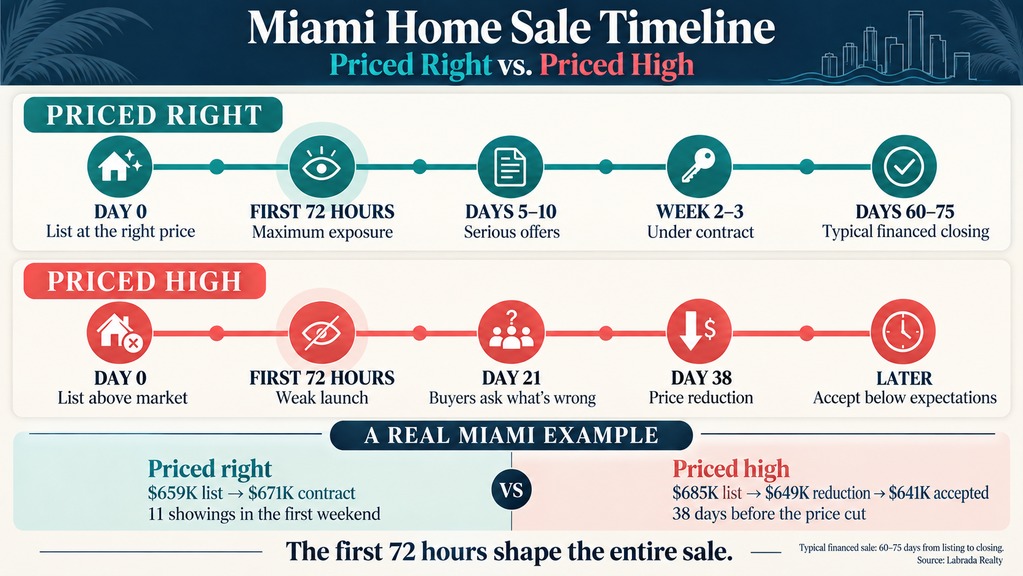
Pricing one to three percent below the top comparable closed sale in your condition category opens the door to competing offers. A home that draws four or more qualified showings in its first seventy two hours and generates two written offers hands the seller real leverage, something a home priced at the ceiling of its market rarely sees.
Near the US-1 and Dadeland Mall corridor in Kendall, that dynamic shows up clearly. Single-family inventory priced tight to recent closed comps in that stretch routinely draws multiple showings in the opening weekend, while similar homes priced at the top of the range sit through it with no activity at all. The buyer pool is watching the same comparable sales the seller should be pricing against, and it responds accordingly.
For sellers who want to verify their own numbers before listing, the Miami-Dade Property Appraiser's records let you pull closed comparable sales by zip code and square footage, the same data a buyer's agent will use to evaluate your price. Running it yourself before you commit to a number means fewer surprises once offers start arriving.
The First Two Weeks: What Actually Decides Your Timeline
The first fourteen days aren't just important, they're close to the whole outcome.
A property that launches with professional photography, a price inside the active buyer window, and same day showing response generates its strongest traffic in the opening week. Buyers who've already been searching for weeks have saved alerts and are ready to act, not casually browsing.
Ten or more showings in week one with zero offers usually means the price sits at the outer edge of what the market will bear, or the presentation is undercutting the value. Ten showings with two offers is where a seller wants to land. Fewer than five showings in the first week is a signal that the price needs an honest conversation before day ten.
Preparation before day one determines which of those outcomes you get. Buyers touring a home in the first week are comparing it directly against two or three other active listings in the same price band, often within the same afternoon. A home that's been deep cleaned, decluttered, and photographed professionally competes on value from the first click. A home launched as-is, with phone photos and visible clutter, gets mentally discounted before a buyer ever schedules a showing, regardless of how the price actually compares to the comps. First impression alone often explains why two similarly priced homes generate very different levels of week-one activity.
A real example makes the pattern concrete. A three bedroom, two bath single-family home near Costa Del Sol in Doral listed at $685,000 against closed comparables running $655,000 to $665,000. It drew two showings in the first week and no offers. The seller cut to $665,000 on day sixteen and finally closed on day thirty one at $652,000. An opening price of $660,000 would very likely have generated competing offers in week one and closed at or above asking, faster and for more money than the discounted path actually produced.
Cash Offer or Listed Sale: Choosing What Actually Closes Faster
Some Miami sellers have a legitimate case for a cash buyer: an estate with a fixed settlement date, a property needing more repair work than the retail-to-investor price gap justifies, or a tenant situation that makes showings difficult to schedule.
For those sellers, I've broken down how cash offers actually work in Miami-Dade, including who the buyers are and what the AS-IS contract requires. Read that before signing anything an investor sends you.
The speed assumption is worth challenging directly. Many sellers who want to sell my house fast Miami Fl assume a cash buyer automatically closes weeks faster than a listed sale. In practice the gap is narrower than most expect. A cash buyer in this market typically closes fourteen to twenty one days from contract. A listed sale with a pre-approved buyer closes twenty one to thirty days from an accepted offer. On a well-prepared home, that's often a gap of under two weeks.
The price difference is rarely small. On a standard single-family home in the $450,000 to $650,000 range across Miami-Dade, the spread between a cash offer and a retail sale price frequently runs $30,000 to $50,000. Before treating the closing date gap as the deciding factor, run your actual net in both scenarios, accounting for commission, pre-listing repairs, carrying costs, and closing cost allocation.
This is where the pieces of my license structure actually matter to a seller trying to sell my house fast Miami Florida on a real deadline. As a broker who's also a licensed mortgage loan originator and title agent, I coordinate the listing, the buyer's financing review, and the title work inside one team instead of three separate parties working on three separate timelines. Title issues that would normally surface as a surprise at week three get flagged and resolved in days, not weeks, because the same team is watching all three pieces of the transaction at once.
What Actually Speeds Up or Slows Down a Miami Sale
Three factors move the needle more than most sellers expect, and none of them show up in a generic listing checklist.
Florida's insurance market directly affects how fast a buyer's financing clears. Homes with an older roof or a lapsed four-point inspection can stall a buyer's lender at the underwriting stage while a new policy gets sourced, adding a week or more to closing even after the offer is accepted. Sellers who order a four-point inspection and roof certification before listing remove that delay before it ever reaches the buyer's side of the file.
Seasonal demand shifts the math too. Miami-Dade follows South Florida's typical curve: spring and early summer, roughly March through June, bring the deepest buyer pool. A listing that launches in that window compresses time to offer across nearly every price point. A listing that launches in August or September faces a thinner buyer pool and needs sharper pricing discipline to move at the same pace.
Micro-market behavior varies more than most sellers assume. Coral Gables, particularly near the Miracle Mile corridor, draws a buyer who moves deliberately and weighs architectural review requirements before writing an offer, which can add days to the offer stage even on a well-priced home. Doral moves faster on new-construction-adjacent inventory but slower on older product needing updates. Pinecrest is its own category entirely: single-family homes there sell in the $5 million to $8 million range, and speed at that tier depends less on pricing tactics and more on marketing reach to the right buyer pool, since the number of qualified buyers at that price is small to begin with.
Mistakes That Slow Down a Sell House Fast Miami Plan
Pricing from a neighbor's list price instead of closed comparables is the most common one. Active listings show what other sellers are hoping for. Closed sales show what buyers actually paid. If a comparable home on your block listed at $610,000 and closed at $580,000, your reference point is $580,000.
Launching with phone photos costs more than sellers realize. A meaningful share of Miami buyers begin their search on a phone screen, and dark or distorted images lose the click before a buyer ever requests a showing.
Slow response to showing requests is a silent deal killer. A buyer who asks for a Friday showing and doesn't hear back until Monday has often already toured, and sometimes offered on, another property by then.
Unresolved title complications are the most consistent source of unnecessary delay I see in Miami-Dade closings. A mortgage payoff, a second lien, or a HELOC balance needs to be understood before you go under contract, not discovered by a title company after a buyer has already signed. For sellers who want a plain-English breakdown of how liens affect a sale, Nolo's overview of property liens is a useful reference before you list.
Ignoring deferred maintenance until an inspection surfaces it is the other repeat offender. A homeowner trying to sell my house fast Miami Florida often assumes cosmetic condition is what matters most, when it's actually the mechanical and structural items, an aging water heater, roof wear, or active moisture intrusion, that stall a contract at the inspection stage. Buyers who find those issues during due diligence don't move faster to close the gap. They renegotiate the price, ask for repair credits that reopen the entire deal, or walk, and any of those three outcomes costs more time than addressing the item before the home ever went on the market.
Selling fast in Miami is a pricing and preparation decision, not a sacrifice. According to Florida Realtors market data, listings with professional photography consistently sell faster and at stronger price points across Florida markets, a pattern that holds whether you're in Kendall, Doral, Coral Gables, or Pinecrest. The homes that go under contract in seven to ten days aren't the cheapest ones on the market. They're the best-positioned ones, priced against real closed data and launched with a clear read on the buyer that area actually draws. If your goal is to sell house fast Miami wide, the process starts with an honest number, not a discount.
FAQ
How fast can I sell my house in Miami without dropping the price?
In most Miami-Dade submarkets, a well-priced single-family home in move-in condition attracts offers within seven to fourteen days of hitting the market, assuming professional photos and same day showing response. Homes priced one to three percent below the top closed comparable in their condition category see the most competing-offer activity. The variable that controls speed isn't the size of the buyer pool, it's how closely your list price tracks recent closed sales rather than nearby active listings.
Is it better to sell my house fast in Miami with a cash buyer or a realtor?
It depends on your property's condition, your actual required closing date, and whether the home can clear appraisal at a retail price. A cash buyer typically closes fourteen to twenty one days from contract, while a listed sale with a pre-approved buyer closes twenty one to thirty days from an accepted offer, often less than a two week gap. On a $500,000 Miami-Dade home, that gap in closing speed rarely justifies giving up $30,000 to $50,000 in net proceeds.
What's a realistic timeline to sell a house fast in Miami-Dade right now?
Spring through early summer, roughly March through June, brings the deepest buyer pool across Miami-Dade and compresses time to offer at nearly every price point. Listings launched in August or September face a thinner pool and need tighter pricing to move at the same pace. Regardless of season, homes generating four or more qualified showings in their first seventy two hours are the ones most likely to close inside thirty days.
Do I need to make repairs before I can sell my house fast in Miami?
Focus repair spending on what an inspector will flag, not on cosmetic upgrades. In Miami-Dade, an aging water heater, roof wear, or a lapsed four-point inspection are the items most likely to stall a buyer's financing or reopen a contract during due diligence. Deep cleaning and decluttering cost little and meaningfully improve first-week showing activity. Sellers who spend $500 to $1,500 on targeted pre-listing repairs and professional photography consistently close faster than sellers who list as-is.
If you want to know what your Miami home is actually worth, request a free VIP home valuation and get a real, agent-reviewed number back within 24 hours to build your pricing strategy from.
Check out this article next