

Cash offers come with a promise that sounds clean: no lender, no appraisal, no contingencies, fast close. For some sellers, that promise delivers exactly what they need. For others, signing a cash contract without understanding what is behind it turns a manageable situation into a costly one.
Wanting to sell my house for cash Miami is a decision most sellers arrive at for a real reason. An estate that needs to settle quickly. A property that needs more work than the owner wants to manage. A relocation deadline. A landlord who is done. The motivation is almost always legitimate. What rarely gets worked through before signing is whether the offer number actually reflects the market, whether the contract terms are as clean as the cash itself, and whether a traditional listing with the right strategy would have produced a meaningfully better net in the same window. This covers all of that.
Sell My House for Cash Miami: Who Is Actually Buying?
The phrase "cash buyer" covers at least four distinct types of purchasers in Miami-Dade, and they are not interchangeable.
Individual buyers with liquid funds
Some buyers in Miami purchase residential property outright because they are moving assets out of unstable currencies or simply prefer to avoid a U.S. lender. Venezuelan, Colombian, and Brazilian buyers are active in this category across Miami-Dade. These buyers may offer closer to market value because they are purchasing for personal use or long-term appreciation, not to flip or hit a yield target.
Local and regional investors
This is the type most sellers encounter first when looking for cash offers. They buy, renovate, and resell or hold as rentals. Their offer is below market because their model requires a margin to cover renovation cost, carrying cost, and profit. The gap between what they offer and what a retail buyer would pay is not negotiable from their side. It is their business model.
iBuyers
National platforms that generate algorithmic offers on homes meeting their criteria. Opendoor and similar companies operate in parts of Miami-Dade. Their offers tend to land in the 90 to 95 percent range of market value but carry service fees that erode the actual net further than the offer price alone suggests.
Institutional buyers
Less active in the sub-$600,000 range but present in specific corridors. They move quickly, make standardized offers, and in some cases assign the contract to a local operator after signing. Sellers who receive an offer from an out-of-state LLC with a rushed timeline should ask who the actual end buyer is before agreeing to anything.
Knowing which type of cash buyer is across the table changes how you respond, what proof of funds should actually look like, and how much negotiation room genuinely exists.
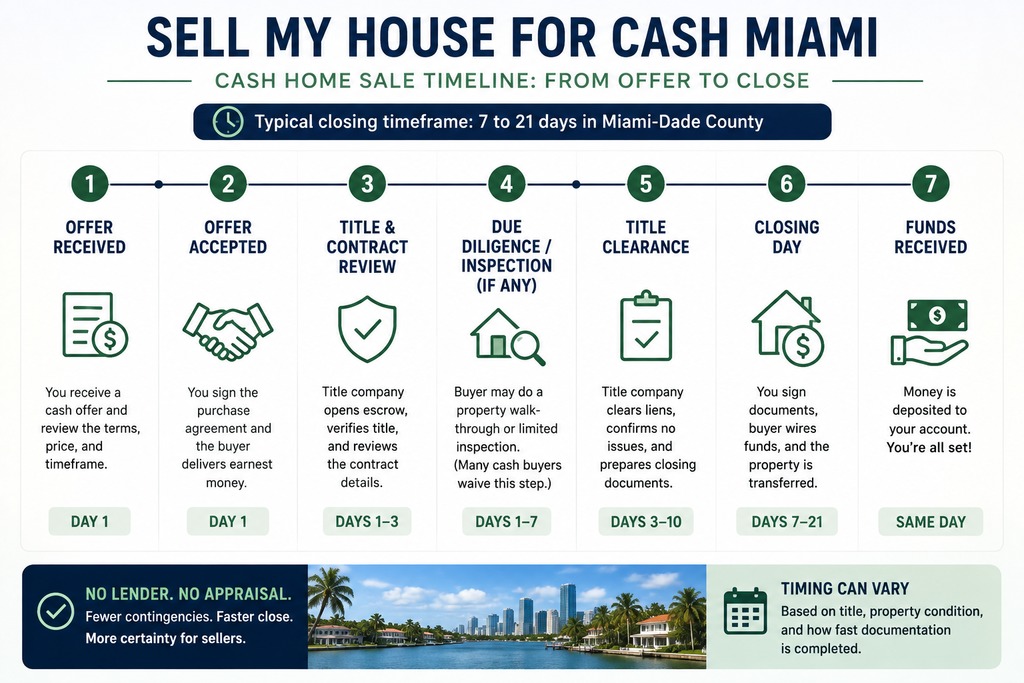
How a Cash Home Sale Works in Miami-Dade, Step by Step
The cash sale process is simpler than a financed sale in some ways and more hazardous in others. Simpler because there is no lender underwriting, no appraisal contingency, and no insurance binding deadline. More hazardous because sellers sometimes confuse the absence of those steps with the absence of risk.
Here is what the typical timeline looks like in practice.
Initial offer and proof of funds
A cash buyer presents an offer alongside proof of funds documentation. In Miami-Dade, this should be a bank statement or letter of funds dated within 30 days. Request it before engaging on the contract terms. Some buyers market themselves as cash buyers and intend to arrange private financing after going under contract.
Contract execution
The majority of cash investor transactions in Florida use the FAR/BAR AS-IS Contract, which Florida Realtors makes available as the standard form for residential transactions. AS-IS means the seller has no repair obligations. What sellers consistently misread is that the buyer still retains a full inspection period with the right to cancel for any reason within that window.
Inspection period
Cash buyers inspect. The AS-IS contract in Florida typically grants a 10 to 15 day inspection window. During this period, a buyer can cancel and recover their deposit in full for any reason, with no penalty to either party. Sellers who assume cash means no inspection are regularly caught off guard by renegotiation requests at day 12.
Title work
Even without a lender, a title search is required. HOA liens, unpaid property taxes, code enforcement violations, and open permits all surface here. A seller with an unresolved issue hits a delay at the title stage regardless of how quickly the buyer wants to close.
Close
A cash close in Miami-Dade can happen in as few as 10 days once title is clear. The realistic range for most investor cash transactions is 14 to 21 days from contract to close, assuming no title complications.
What Cash Buyers Actually Offer on Miami Homes, and Why
The search for cash for my house Miami is where most sellers start their research, and what they find first is usually a cluster of offers that look similar on the surface but reflect very different calculations underneath.
Investor cash buyers in Miami-Dade typically offer somewhere between 70 and 90 percent of after-repair value, minus their estimated renovation cost. The higher end applies to homes in excellent condition needing cosmetic work only. The lower end applies to properties with deferred maintenance, roof concerns, or structural issues.
On a home with a realistic retail sale value of $520,000 in its current condition, an investor cash offer might look like this: estimated retail value after light renovation of $545,000, renovation budget of $25,000, target margin of $45,000, resulting offer of $475,000. For the seller, that is roughly 91 percent of current market value before factoring in the absence of agent commission.
Two things sellers consistently miss. First, the question of cash for my house Miami is not only about the offer price. Every term in that contract matters: who pays closing costs, who covers transfer taxes, how much earnest money is at real risk if the buyer cancels. Second, the "we pay all closing costs" language common in investor offers often means the buyer absorbed those costs into a lower price, not that they added a genuine concession on top of their number.
A real offer is only as good as the net to seller after every line item is accounted for.
Sell My House for Cash Miami: Running the Net Proceeds Comparison
This is the section most sellers wish they had seen before signing anything. The math is not complicated, but the inputs are easy to overlook.
Consider a home in Miami Gardens worth $510,000 in retail-ready condition:
Traditional listing, sold at $510,000:
- Agent commission (5.5%): -$28,050
- Closing costs (title, transfer taxes, prorations): -$8,500
- Pre-listing repairs and staging: -$5,000
- Carrying costs (2.5 months of mortgage, insurance, taxes): -$4,200
- Net to seller: approximately $464,250
Cash investor offer at $450,000 (88% of market value):
- Agent commission (direct sale): $0
- Closing costs (buyer absorbs): $0
- Pre-listing repairs: $0
- Carrying costs (21-day close): $0
- Net to seller: approximately $450,000
The gap in this scenario is roughly $14,000. For some sellers, that figure is the deciding factor. For others, the time saving, the certainty of close, and the zero-repair obligation are worth far more than the difference.
Where sellers go wrong is assuming the gap always favors the traditional listing. If the property needs $30,000 in repairs to compete at retail, or if the seller cannot carry the property for two to three months, the cash sale may net more. The only way to know is to run the actual numbers for your specific property before accepting anything. The Florida seller net sheet covers every line item so you can model your real scenario with real numbers. Sellers who want to sell my house for cash miami fl and are also navigating a mortgage payoff or a tenant situation should also read selling your Miami home with a mortgage or tenants before finalizing any comparison.
This comparison is especially worth running for sellers who want to sell house for cash miami gardens or in the northwest Miami-Dade area, where investor activity makes the first offer rarely the best one available.
Miami-Specific Factors That Change the Cash Sale Calculus
Four dynamics in Miami-Dade make the cash sale decision different here than in most of the country.
Insurance market pressure on financed buyers
South Florida's insurance environment has tightened the buyer pool for financed transactions on older properties, homes with roofs past 15 years, and certain construction types. A seller with a 2001-era home in Biscayne Gardens trying to close with a conventional-loan buyer may watch the deal collapse in week 10 when the buyer cannot bind coverage at a monthly payment they can absorb. Cash removes that variable entirely. For sellers in older housing stock across the Biscayne Gardens area and North Miami Beach, the real risk of a late-stage deal failure with a financed buyer gives cash a practical advantage that does not always show up in the offer price comparison.
Investor activity in the northwest corridor
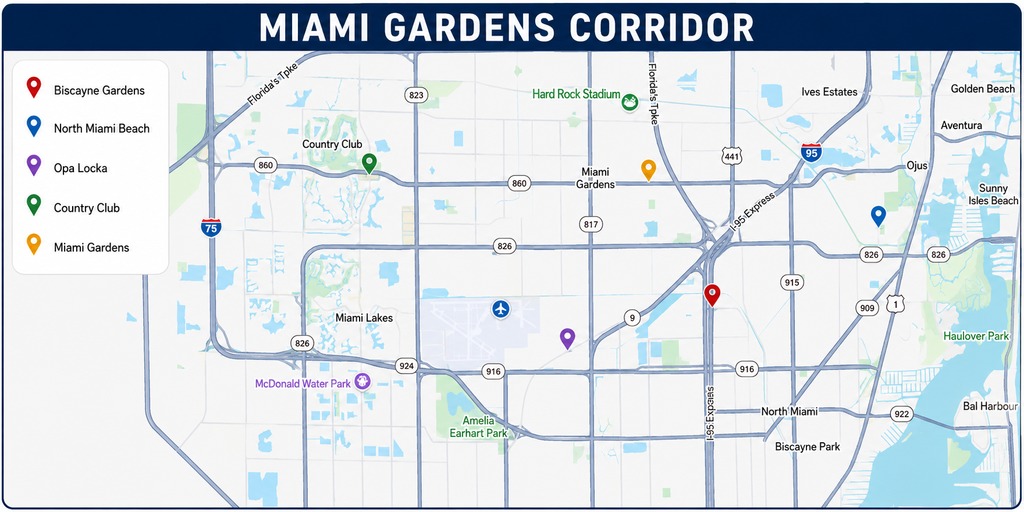
Anyone ready to sell house for cash Miami gardens and the surrounding northwest Miami-Dade areas should know that this corridor has one of the more active investor buyer pools in the county. Along Miami Gardens Drive from NW 27th Avenue west, and in communities adjacent to the I-95 Express ramps, investors both local and from out of state run ongoing acquisition campaigns. The competition among buyers is leverage, but only for a seller who uses it correctly. Approaching investors one at a time, rather than positioning for competing offers within the same window, is where sellers leave money that did not have to stay there.
HOA and condo approval timelines
Cash sales in Miami-Dade condos bypass the lender certification requirement for the building, but they do not bypass HOA approval. A cash buyer still needs association approval in most buildings, which adds 15 to 45 days to the timeline depending on the building's process. Sellers expecting a 10-day cash close on a condo should pull the building's current approval requirements before building that timeline into any plan.
Seller disclosure obligations under Florida law
Cash sales in Florida almost always use the AS-IS Contract, and sellers sometimes assume AS-IS means no disclosure is required. Under Chapter 689 of the Florida Statutes, sellers must disclose all known material defects in the property regardless of contract type. The AS-IS designation means the buyer cannot demand repairs after inspection. It does not exempt sellers from disclosing what they know. Sellers who conceal known defects in a cash transaction carry post-closing liability that an upfront disclosure would have eliminated.
How to Evaluate a Cash Offer Without Leaving Money Behind
The decision to sell my house for cash Miami Fl is the first step. Evaluating the offer correctly is where the outcome is actually determined.
Before signing anything, request proof of funds documentation dated within 30 days. A bank statement or letter from a financial institution should name the buyer entity and confirm liquid funds at or above the offer amount. In Miami-Dade, some buyers present letters from private lenders. Private lending is not cash. Ask directly whether any third-party financing is involved before the conversation goes further.
Read the inspection clause before focusing on the offer price. The AS-IS contract gives the buyer the right to cancel during the inspection period for any reason and recover their deposit in full. Some buyers negotiate windows of 20 to 30 days under the label of "due diligence." An extended inspection period on a low earnest money deposit is a tool buyers use to control a property while continuing to evaluate alternatives. A serious cash buyer in Miami-Dade puts down at least 3 percent of the purchase price as earnest money. Anything below that tells you more about their commitment than their proof of funds letter does.
Working through a licensed broker changes the leverage dynamic even on a direct cash transaction. Buyers know that a represented seller is reviewing the contract with someone who understands it. At Labrada Realty, the triple-license structure (real estate broker, mortgage broker, and title agent) means the entire transaction, including title coordination and closing, runs in one place. For sellers comparing a cash offer against a potential listing, I run both scenarios against current market data so the comparison is based on actual numbers, not assumptions.
For a look at what a traditional Miami listing involves from the same starting point, how a traditional Miami listing works is worth reading before a final call is made.
Knowing when to sell my house for cash Miami makes sense and knowing when it does not requires the same starting input: what your home is actually worth right now, what your timeline costs you, and what any specific cash offer is genuinely worth after all the terms are on the table. Sellers who answer all three questions before signing consistently outperform sellers who decide on the offer number alone. Getting that clarity before you commit is the entire difference between a clean outcome and a regret.
FAQ
How much below market value should I expect when I sell my house for cash in Miami?
A: In Miami-Dade, investor cash buyers typically offer between 70 and 90 percent of a home's retail value, though most standard single-family homes in decent condition draw offers in the 83 to 90 percent range. The exact number depends on condition, location, and how much renovation the buyer is budgeting. On a home worth $500,000 at retail, cash offers from investors tend to land between $415,000 and $450,000. iBuyer platforms generally offer closer to market value but add a service fee that reduces the actual net below what the headline offer implies. The only way to know whether any specific offer is legitimate or a lowball is to have a current market valuation before reviewing anything. Without that reference point, you are negotiating without knowing what you are negotiating from.
Do I still need a real estate agent if I want to sell my house for cash in Miami Fl?
A: Legally, there is no requirement. Practically, the math almost always says yes. When you want to sell my house for cash Miami Fl without representation, you review the contract alone and negotiate against a buyer who has purchased dozens of properties in Miami-Dade. In a single negotiating cycle, a licensed broker can often recover the equivalent of the commission by pushing on earnest money, inspection period length, closing cost allocation, and the offer price itself. Beyond price, a broker provides a current market analysis that tells you whether the cash offer on the table is competitive against what a 30-day retail listing might realistically produce. Sellers typically skip that comparison entirely, and it is often the most consequential number in the entire decision.
How fast can I realistically close when I sell my house for cash in Miami?
A: The timeline depends primarily on two variables: who the buyer is and whether any title issues exist on the property. A true institutional cash buyer in Miami-Dade can close in 10 to 14 days once a contract is signed, assuming a clean title search comes back. Most investor transactions realistically run 14 to 21 days. If the property is a condo, factor in the association's approval timeline, which in many Miami-Dade buildings adds 15 to 30 days regardless of the buyer's urgency. Open permits, unpaid liens, or code enforcement violations add time at the title stage. Ask any cash buyer for a target closing date in writing before signing and verify that the number is based on their actual process, not a figure chosen to make the offer look more attractive.
What contract terms should I watch for in a Miami-Dade cash offer?
A: Three terms matter more than the offer price in most Miami-Dade cash contracts. First, the inspection period length and the buyer's cancellation rights during it. Under the AS-IS contract standard in Florida, a buyer can cancel for any reason during the inspection window and receive their full deposit back. An inspection period of 20 or more days is a red flag, not a standard request. Second, the earnest money deposit amount. Anything under 2 percent of the purchase price signals low commitment from the buyer. Third, who pays the documentary stamp tax and transfer costs at closing. Florida's documentary stamp tax on deed transfers is set by the Florida Department of Revenue and is traditionally a seller expense. Some cash buyers use language claiming to pay all closing costs that is already reflected in a reduced offer price, not a genuine added concession on top of their number.
Is selling for cash a good move in Miami Gardens and northwest Miami-Dade?
A: For certain sellers and certain properties, it is a genuinely strong option in this corridor. The northwest Miami-Dade investor buyer pool along Miami Gardens Drive and the I-95 Express corridor is active enough that a seller who generates multiple competing cash offers, rather than accepting the first inbound inquiry, can meaningfully close the gap between the investor price and retail value. Sellers who want to sell house for cash Miami Gardens specifically should also know that the adjacent areas from Biscayne Gardens through North Miami Beach draw their own investor demand, which expands the buyer pool further. The core question is whether the property needs repairs that a retail listing would require but the seller cannot fund upfront. When that cost is real, the cash sale math frequently favors accepting the discount over investing in a retail-ready preparation.
Before you accept a cash offer or sign anything, it helps to know what your home is actually worth right now. A free VIP home valuation takes about 60 seconds and gives you a real market number to work from before any decision is made.
Check out this article next