

Cost of Living in Miami: What You'll Actually Pay in 2026
Most people who research the cost of living in Miami focus on rent. They find a number, compare it to what they pay now, and decide Miami is either affordable or not. That's the wrong way to think about it.
Miami's actual monthly cost isn't just rent plus groceries. It includes home insurance that has tripled in parts of Miami-Dade over the past four years, car insurance rates that rank among the highest in the country, tolls on nearly every major route, and a dining culture where eating out is practically a lifestyle requirement. Those costs add up fast, and most calculators don't capture them.
If you've been searching for what is the cost of living in Miami Florida before making a relocation decision, the honest answer is that it depends heavily on where you live and what kind of lifestyle you're building here. This breakdown gives you real numbers across both, covering housing, daily expenses, insurance, transportation, and how Miami stacks up against other major cities.
Miami Is Cheaper Than You Think — Until the Bills Arrive
Florida has no state income tax. No estate tax. No tax on retirement income. For someone moving from New York, California, or Illinois, the tax savings alone can be substantial, sometimes $15,000 to $30,000 or more per year depending on income.
Add to that no snow removal costs, lower heating bills, and year-round use of outdoor space, and Miami looks very affordable on paper.
The problem is that those savings don't always survive contact with the actual monthly budget.
Florida's insurance market has gone through a genuine crisis over the past several years. Carriers have exited the state, policies have been dropped, and premiums in Miami-Dade have climbed sharply. A homeowner who paid $3,500 a year for coverage in 2020 might be paying $7,000 to $10,000 or more today, depending on location, age of the home, and flood zone designation.
Renters don't entirely escape this either. Landlords who absorbed those insurance increases often passed them through in lease renewals.
Car insurance in Florida regularly ranks in the top three most expensive states nationally. A driver with a clean record moving to Miami from the Midwest should expect their premium to roughly double.
None of this means Miami is unaffordable. Plenty of people live very well here across a range of incomes. But the people who thrive financially in Miami tend to understand these dynamics before they move, not after they receive their first set of bills.
What Housing Actually Costs in Miami Right Now
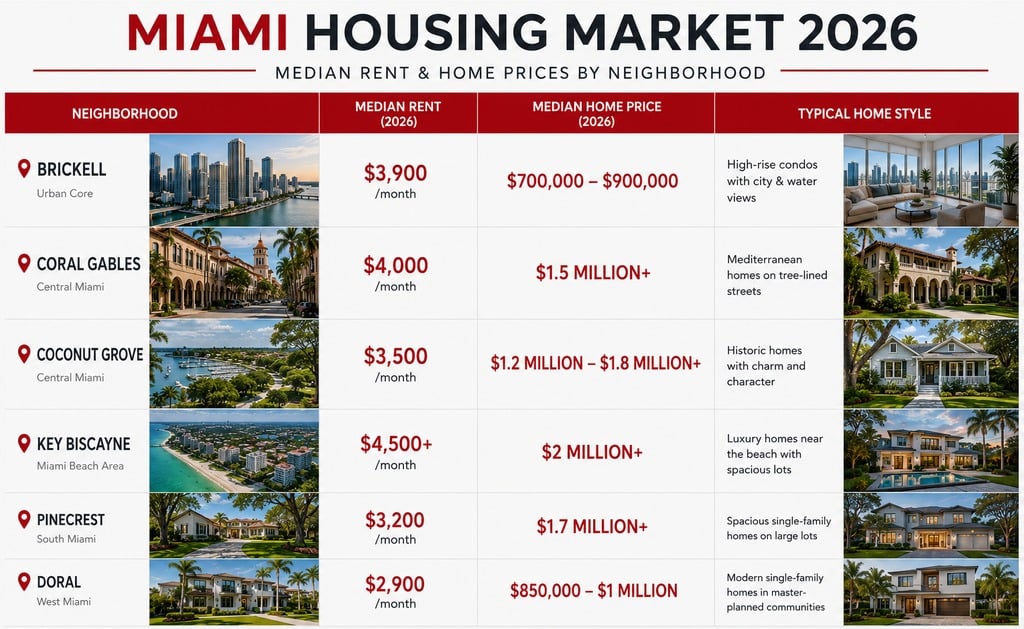
Miami-Dade is not one housing market. It is a collection of micro-markets with dramatically different price points, lifestyle profiles, and practical trade-offs. Where you live will shape your monthly budget more than almost any other single decision.
Here is a realistic snapshot of what housing costs across key parts of Miami-Dade in 2026:
Brickell and Downtown Miami
One-bedroom rentals in Brickell typically run $2,400 to $3,200 per month. Two-bedrooms range from $3,200 to $4,500. These are condo buildings with amenities, and HOA fees are baked into the rental price. Buyers purchasing a condo here should expect HOA fees of $800 to $1,400 per month on top of their mortgage, which changes the math on ownership considerably.
Coral Gables and Coconut Grove
Single-family homes dominate these areas. A three-bedroom home in Coral Gables sells in the $1.1 million to $2 million range. Rentals for comparable homes run $4,500 to $7,000 per month. These are established, tree-lined neighborhoods with strong schools and some of Miami's most walkable commercial streets. The price reflects that.
Kendall and West Kendall
For families prioritizing space and value, Kendall is where Miami-Dade still offers meaningful affordability. Three-bedroom single-family homes sell in the $550,000 to $750,000 range, with some pockets under $500,000. Rentals for a three-bedroom run $2,600 to $3,400. HOA fees in many Kendall communities are $150 to $400 per month, far more manageable than downtown condo fees.
Doral
Doral sits in a middle tier, with a mix of townhomes and single-family homes. A three-bedroom purchase price typically runs $550,000 to $800,000. It has excellent schools, proximity to Miami International Airport, and a large Venezuelan and Colombian community that makes it feel like a city within a city. It is a strong value option for families who don't need to be near the beach.
Hialeah
Hialeah offers the lowest entry points in the county for buyers, with some single-family homes still available under $450,000. Rentals for a three-bedroom range from $2,200 to $2,800. The trade-off is longer commute times to Brickell or Coconut Grove and fewer walkable amenities.
One nuance that matters: Miami has a huge condo inventory compared to other Sun Belt cities. Condo ownership in Miami comes with HOA fees, condo association rules, approval processes for buyers, and in many older buildings, pending special assessments for structural repairs or roof replacement. Buyers in the $400,000 to $700,000 range who are looking at condos should always review the financials of the association before making an offer, not after.
The Costs Most People Don't Budget For
This is where Miami surprises people.
Home and Renters Insurance
Homeowner's insurance in Miami-Dade is expensive and getting more so. Flood insurance adds another layer for homes in FEMA-designated flood zones, which covers a significant portion of the county. Flood policies through the National Flood Insurance Program can run $1,500 to $3,500 per year. Private flood insurance is sometimes cheaper but not always available. For renters, renters insurance is relatively affordable at $200 to $400 per year, but it does not cover flood damage by default.
Car Insurance
Miami's car insurance rates are driven by a combination of high accident frequency, fraud history in the market, and dense traffic. Expect to pay $250 to $400 per month for a single driver with a clean record and a mid-range vehicle. Two-car households can easily spend $500 to $700 per month.
Tolls
If you commute anywhere outside your immediate area, tolls are unavoidable. The Florida Turnpike, the Palmetto Expressway, the Dolphin Expressway, and I-395 all carry tolls. A daily commute from Kendall to Brickell on toll roads can run $80 to $120 per month, more if you're doing it five days a week.
Utilities
Air conditioning in Miami is not optional. Summer electric bills for a 1,500-square-foot home can run $200 to $350 per month, sometimes higher in older homes with inefficient systems. Water bills, depending on lot size and irrigation, can add another $80 to $150. Total utilities for a family in a single-family home often run $350 to $500 per month in the summer months.
Hurricane Preparedness
This is a real line item. Impact windows or shutters protect your home and often lower your insurance premium, but they cost money upfront. A generator for a medium-sized home runs $3,000 to $8,000 installed. Stocking supplies before hurricane season costs a few hundred dollars per year. Residents who have been through a significant storm take this seriously.
Daily Life — Groceries, Transportation, and Eating Out
Miami is a car city. Public transit exists, but it is limited and not a realistic option for most daily commutes outside of specific corridors like the Metrorail line that runs through Brickell, Coconut Grove, and South Miami. If you are moving here expecting to live without a car, you need to select your neighborhood very carefully and likely limit yourself to Brickell, Wynwood, or areas immediately adjacent to Metrorail stations.
Groceries in Miami run slightly above the national average. A week of groceries for two people at Publix, the dominant chain, typically runs $180 to $240 depending on diet and preferences. Whole Foods and Trader Joe's are available in wealthier areas and run 15 to 25% higher. Sedano's, Bravo, and local Latin grocery stores often offer better prices on produce and proteins, and they are part of the cultural fabric of the city.
Dining out is where Miami spending diverges most from other cities. Miami has a dining culture. Going out to dinner is a social expectation in a way that doesn't exist everywhere. A casual dinner for two at a sit-down restaurant runs $60 to $90. A mid-range spot with a bottle of wine is $120 to $180. Fine dining starts at $200 per person. Families who eat out frequently should budget $800 to $1,500 per month for dining and entertainment, possibly more.
Coffee, gym memberships, weekend plans, Miami's lifestyle costs are real. This isn't a complaint; it's one of the things people love about living here. Budget honestly before you arrive.
Cost of Living in Miami vs. New York: What the Numbers Show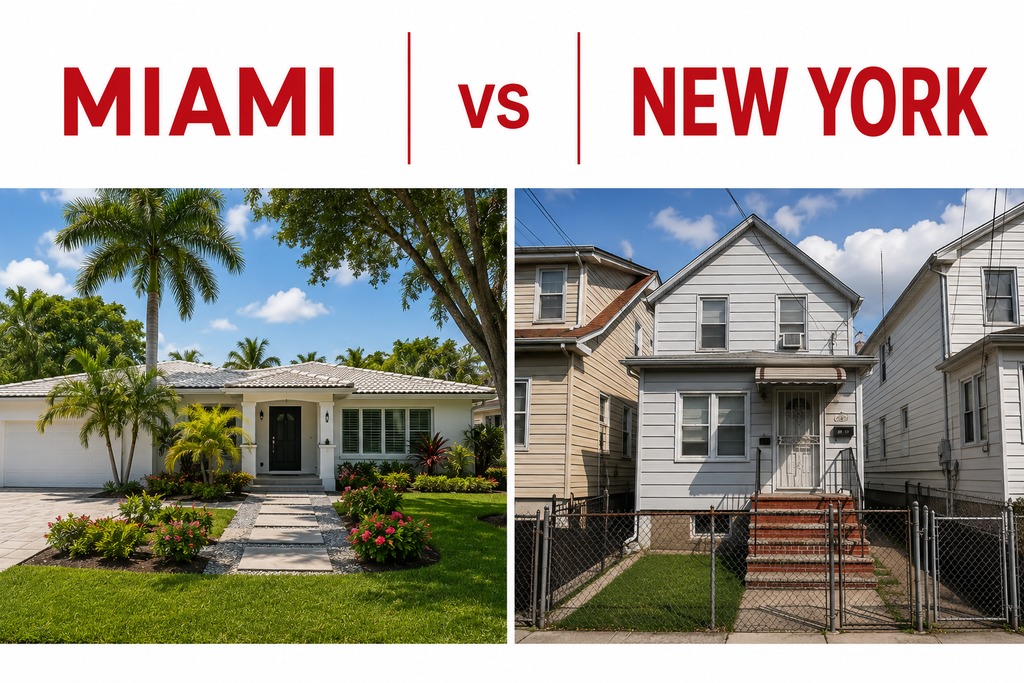
The most common comparison for people considering Miami is New York City, and it deserves a direct look. The cost of living in Miami vs. New York shows meaningful differences, but not in every category.
Housing
A one-bedroom in Manhattan averages $4,200 to $5,500 per month. The same in Brickell runs $2,400 to $3,200. For renters, Miami offers a genuine advantage. For buyers, Manhattan prices are so elevated that Miami looks affordable almost everywhere by comparison.
Taxes
New York City residents pay federal income tax, New York state income tax, and New York City income tax. A single earner making $200,000 in New York City pays roughly $60,000 to $70,000 in combined federal, state, and city taxes. In Miami, the same earner pays federal tax only. The savings range from $15,000 to $25,000 per year depending on the specifics. This is the most powerful financial argument for Miami and one that drives a significant share of Northeast relocations.
Transportation
New York is genuinely walkable with a functional subway. Miami requires a car. A Manhattan resident who doesn't own a car might spend $150 per month on transit. A Miami resident who does own a car might spend $400 to $600 per month on car payment, insurance, gas, and tolls. Miami wins on housing costs but loses on transportation costs for car-free New Yorkers making the switch.
Groceries and Dining
Broadly comparable. Miami has slightly lower grocery prices; New York has more delivery options and more competition keeping prices down in some areas. Dining costs are similar at mid-range and above.
Overall Monthly Budget
A single professional living well in Manhattan typically needs $7,000 to $10,000 per month after taxes. In Miami, the same lifestyle in Brickell or Coconut Grove runs $5,000 to $7,500 per month. The savings are real, but Miami is not dramatically cheap. It is more affordable than New York in the ways that matter most: housing and taxes.
How to Actually Afford Miami — Where Smart People Start
The residents of Miami who seem to have figured it out tend to share a few patterns.
First, they chose their neighborhood based on actual priorities rather than prestige. A family that moved to Kendall instead of Brickell might be saving $1,500 to $2,500 per month on housing while living in a larger home with a backyard. A young professional who chose a studio in Edgewater over a one-bedroom in South Beach is paying $600 to $900 less per month and still within reach of the bay.
Second, they did not rush into buying. People who rent for 12 to 18 months before buying in Miami almost always make better purchase decisions. They learn which zip code actually fits their life, where the traffic is genuinely brutal, which buildings have HOA issues, and which areas are appreciating. Miami rewards local knowledge.
If you are already weighing that decision, the comparison at should I rent or buy in Miami walks through the actual financial considerations for this market.
Third, they budgeted for insurance before they budgeted for the mortgage. In Miami-Dade, a home that costs $650,000 might carry a mortgage payment of $3,800, property taxes of $650, HOA of $300, and insurance of $700 to $1,000 per month. The all-in carrying cost is $5,450 to $5,750, not $3,800. Buyers who model the full cost before making an offer avoid surprises later.
For buyers ready to start looking seriously, explore Miami's areas by neighborhood to compare price ranges, lifestyle, and what different parts of Miami-Dade actually feel like to live in day to day.
A Realistic Monthly Budget for Living in Miami
People who search for what is the cost of living in Miami Florida often land on a single average figure that flattens a lot of variation. Below are realistic monthly budget estimates across three household profiles, based on Miami-Dade pricing in 2026. These are illustrative, not guaranteed, and vary significantly by neighborhood and lifestyle.
Single professional, renting a one-bedroom in Brickell
Rent: $2,700 / Car (payment, insurance, gas, tolls): $750 / Groceries: $400 / Dining and entertainment: $600 / Utilities and renters insurance: $200 / Health insurance (if self-employed): $400 / Total: approximately $5,050 per month
Couple, renting a two-bedroom in Doral
Rent: $2,900 / Two cars: $1,100 / Groceries: $600 / Dining and entertainment: $700 / Utilities and insurance: $280 / Total: approximately $5,580 per month
Family of four, owning a three-bedroom home in Kendall
Mortgage, taxes, HOA, insurance (all-in): $4,800 / Two cars: $1,100 / Groceries: $900 / Dining and entertainment: $800 / Utilities: $450 / Total: approximately $8,050 per month
These numbers explain why income in the range of $80,000 to $120,000 per year after taxes is commonly cited as where most individuals start to feel comfortable in Miami. Households earning above $150,000 combined have significantly more flexibility.
FAQ
Q: What is the average cost of living in Miami for a single person per month?
A: A single person living in Miami in 2026 can expect to spend between $3,800 and $5,500 per month, depending on where they live and how they spend. Renting a modest one-bedroom in an area like Doral or Kendall puts you closer to the lower end of that range. Living in Brickell or Midtown and eating out several times a week pushes you toward the top. The biggest variables are housing and car costs — those two line items alone account for roughly 60% of a single person's monthly budget in Miami.
Q: Is Miami more expensive than New York City?
A: For most households, no, but the gap is smaller than people expect. Housing and taxes are where Miami wins clearly. A renter paying $4,500 in Manhattan might pay $2,800 for a comparable unit in Miami, and they save on state and city income tax on top of that. Where Miami catches up is transportation: without a functioning transit system, a car is almost always necessary, and car ownership in Florida is expensive. A car-free New Yorker who moves to Miami will add $600 to $900 per month in car-related costs that didn't exist before. Account for that before assuming Miami is dramatically cheaper.
Q: How much do you need to earn to live comfortably in Miami?
A: For a single person, comfortable living in Miami typically requires a take-home income of $6,000 to $7,500 per month, roughly $90,000 to $110,000 in gross annual income depending on your situation. For a couple without children, $10,000 per month combined take-home is where most people start to feel financially stable rather than stretched. Families with children should also budget for private school if they prefer alternatives to public school in their area. Monthly tuition at Miami-Dade private schools ranges from $800 to $2,500 per child, which changes the family budget meaningfully.
Q: What are the hidden costs of living in Miami that calculators don't show?
A: The three that catch people most off guard: home insurance (which has roughly doubled or tripled for many properties in Miami-Dade since 2020), car insurance (Florida ranks near the top nationally and Miami specifically drives those numbers up), and the lifestyle cost of eating out. Miami is a social city and dining out is embedded in the culture. A couple who eats out three or four times per week will spend $800 to $1,200 per month on that alone, which most cost-of-living calculators don't capture. Hurricane preparedness is also a genuine annual expense, not a one-time cost.
Q: Which areas of Miami have the lowest cost of living without sacrificing quality of life?
A: Kendall and West Kendall consistently offer the best value per square foot in Miami-Dade for families. You get single-family homes with yards, good schools, and lower HOA fees compared to urban condo buildings. Doral is similarly positioned and appeals especially to families who want newer construction and proximity to the airport corridor. Hialeah offers the lowest price points in the county but involves a longer commute to employment centers. South Miami and Palmetto Bay sit in a middle tier — more expensive than Kendall but significantly less than Coral Gables or Coconut Grove, with excellent schools and a quieter residential feel.
If you're trying to figure out whether buying in Miami makes financial sense for your situation right now, a free home valuation gives you a real number to work with in under 60 seconds. It's a useful starting point whether you're six months out from a decision or actively looking.
Check out this article next