
Where to Live in Miami: The Honest Neighborhood-by-Neighborhood Breakdown
Most people searching for where to live in Miami start with the wrong question. They ask "Which neighborhood is the best?" — as if Miami has one answer for everyone. It doesn't. Miami-Dade County contains 34 separate municipalities. Each one has its own price floor, school rating, HOA structure, commute reality, and lifestyle identity. A buyer who is perfect for Brickell would be miserable in Kendall, and vice versa.
The people who end up in the wrong area usually get there by chasing a vibe they saw online, choosing based on price alone, or picking wherever a friend happened to land. This guide exists to help you avoid that. If you want to explore Miami's neighborhoods by area with listings attached, that's available once you know which direction to look. But first, let's get you oriented.
Miami Is Not One Market. It's a Collection of Distinct Towns.
People who have never lived here tend to imagine Miami as one continuous city. It's not. Brickell and Homestead are both "Miami" by loose definition, but they share almost nothing in terms of price, density, lifestyle, or culture. Coral Gables has its own city government, its own permitting office, and its own architectural standards. Key Biscayne is a separate island municipality connected to the mainland by a toll bridge.
Understanding this matters for buyers because what's available in one zip code, the type of home, the school feeding into, the insurance exposure, the HOA obligations, has almost no relationship to what's available in the next one over.
The best areas in Miami to live are not ranked universally, and anyone searching for the best areas to live Miami will quickly realize the answer shifts depending on commute, school zone, and budget. They are ranked relative to what the buyer actually needs. That's the only framework worth using.
If You Want Walkability and Energy: Brickell and Coconut Grove
These two areas are often mentioned in the same breath, but they attract very different buyers.
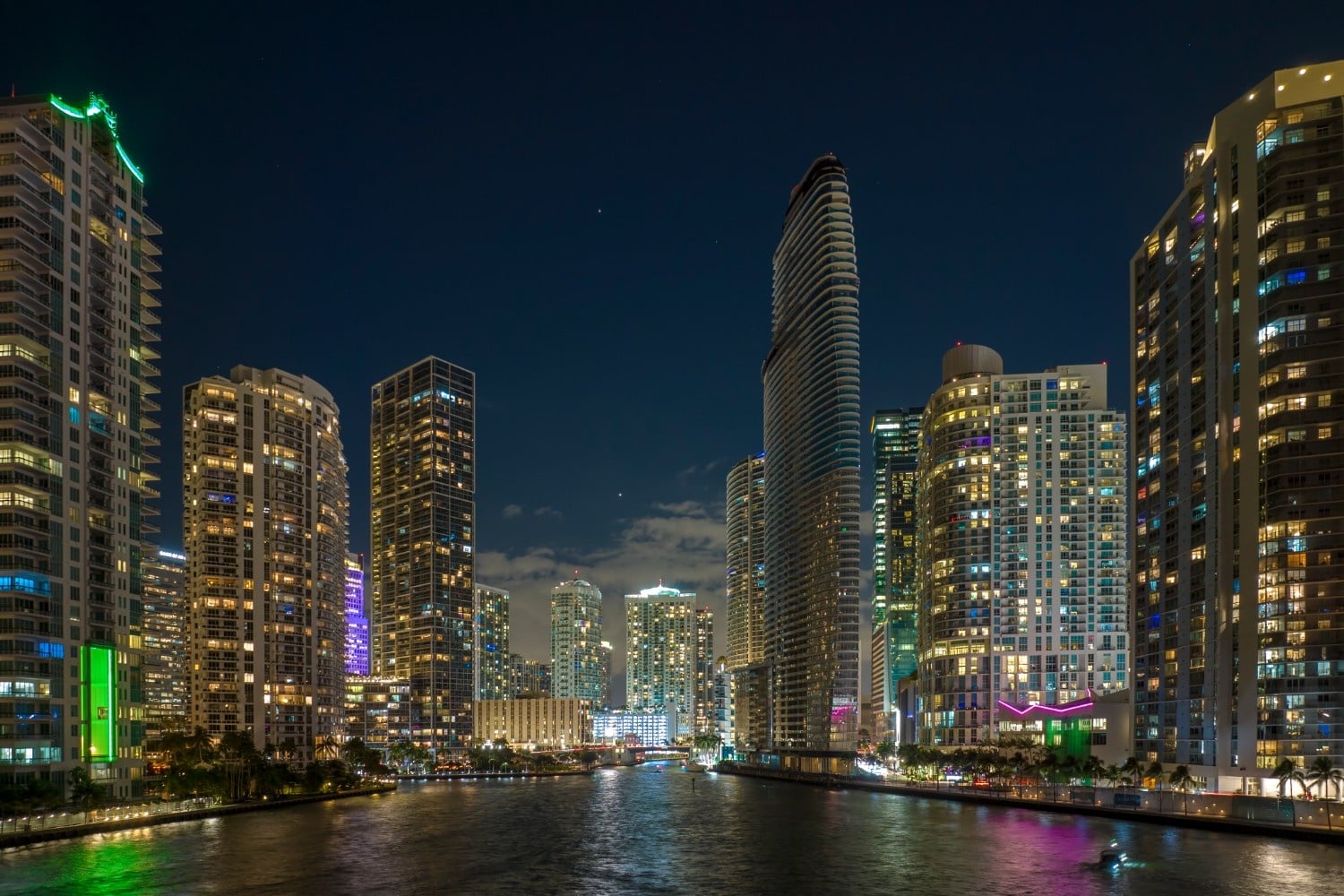
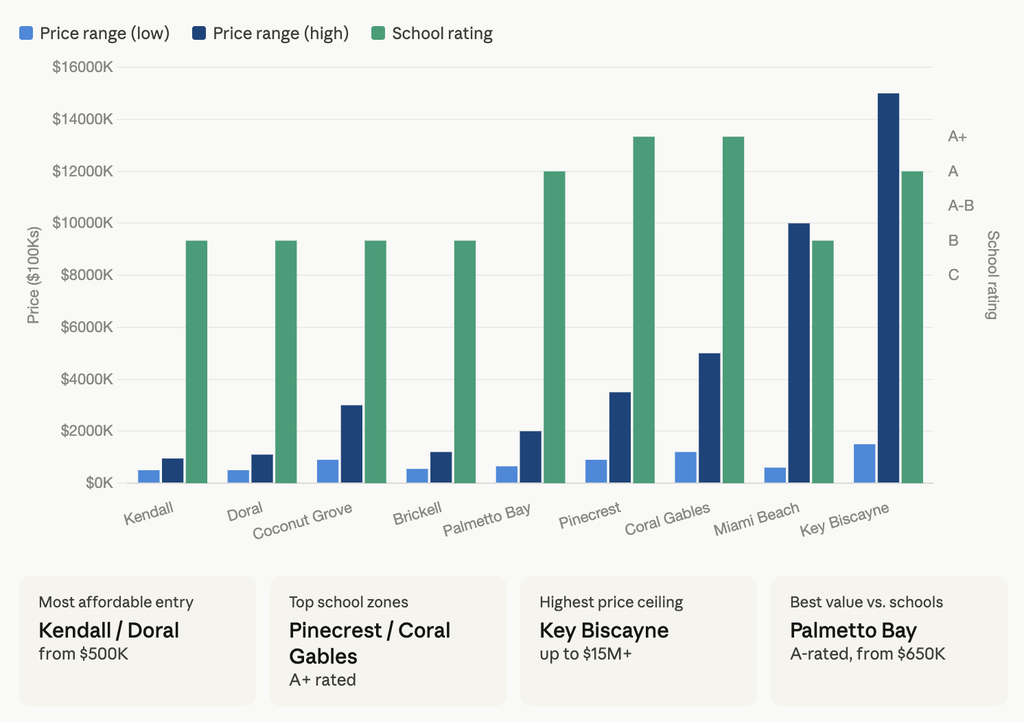
Brickell is Miami's financial district. The housing stock is almost entirely condos, glass towers with doormen, gyms, rooftop pools, and monthly maintenance fees that can run $800 to $1,400. A 1-bedroom in a newer Brickell building lands between $550,000 and $750,000. A 2-bedroom with bay views crosses $1M without much negotiating room. Price per square foot runs $580–$720 depending on the building and floor.
What you get in return is genuine walkability. Brickell City Centre is a six-minute walk from most buildings. The Metrorail connects to Coconut Grove and Coral Gables. For buyers coming from dense cities like New York or Chicago, Brickell real estate tends to feel the most familiar.
One thing to factor in: condo association approval timelines in Brickell average 30–60 days for financed buyers. Some buildings require board interviews. If you're working with a deadline, this matters.
Coconut Grove has the personality Brickell doesn't. Tree-canopied streets, independent restaurants, art galleries, and a marina that actually gets used. The housing mix is more varied here, you'll find condos, older single-family homes, and some newer construction scattered in. Prices range from $900,000 for a modest 3-bedroom to well over $3M for anything with a waterfront view.
Coconut Grove homes attract buyers who want a walkable lifestyle but with character and a slower pace. The trade-off is that older inventory sometimes comes with maintenance surprises, and the bayfront premium is real — expect to pay significantly more per square foot for any home with direct water access.
If Schools and Stability Are the Priority: Coral Gables, Pinecrest, and South Miami
This corridor is where families relocating from out of state almost always end up. The public schools in this part of Miami-Dade consistently rate A or A+. George Washington Carver Middle, Coral Gables Senior High, and Pinecrest Elementary are among the most sought-after school feeds in the county.
Coral Gables is the anchor of this zone. It's one of the few Miami areas with genuine architectural cohesion, Mediterranean Revival homes, banyan-lined streets, and a city government that enforces that aesthetic with strict permitting. For buyers, that means higher prices ($1.2M to $5M+ for most single-family homes) and longer renovation timelines if you buy something that needs work. The City of Coral Gables runs its own permits separately from Miami-Dade, and approvals routinely take longer than buyers expect.
What you're paying for in Coral Gables real estate is a combination of school access, neighborhood stability, and a home that holds value through market cycles. It has. Even during the 2008 downturn, Coral Gables recovered faster than most of the county.
Pinecrest sits directly south and offers something increasingly rare in Miami-Dade: large private lots with minimal HOA involvement. Most Pinecrest properties sit on a quarter-acre or more. There are no high-rises. No commercial corridors cutting through residential streets. Prices run $900K to $3.5M, with price per square foot in the $450–$750 range depending on the lot and condition.
The school access in Pinecrest homes and schools is the primary driver of demand. Buyers who move here for a specific school zone typically stay for years. That stability keeps inventory tight, which keeps prices from softening much even when the broader market cools.
A common mistake buyers make in this corridor is assuming school zone and school quality are the same thing across all listings. They're not. In Pinecrest, the school feed can change by a single block. Verifying the exact school zone for any property you're serious about is non-negotiable.
If Budget Is the Starting Point: Kendall, Doral, and West Kendall
This is where most of the real volume happens in Miami-Dade real estate. Kendall and Doral account for a significant share of home sales in the county every year, and for good reason.
Kendall is an established suburban area with larger lots, older homes, and a community that has been here long enough to have genuine roots. Single-family homes in Kendall range from $500K to $950K, with price per square foot in the $280–$420 range. HOA fees are moderate compared to condo buildings, typically $200–$600 per month in communities that have them.
One thing buyers overlook about Kendall area homes is the lot size differential relative to the rest of Miami-Dade. For the same price as a 1,200 sq ft condo in Brickell, a buyer in Kendall can get a 2,200 sq ft single-family home with a two-car garage and a yard. That trade-off is exactly why so many young families leaving Miami Beach or Brickell end up here.
Doral plays a different game. The housing stock skews newer, the density is higher (more townhomes, more gated communities), and the international buyer base is one of the most concentrated in all of Miami-Dade. Venezuelan and Colombian buyers make up a substantial share of Doral transactions, and many purchase with cash or large down payments. That affects negotiating dynamics, sellers in Doral are used to clean offers and move quickly.
Doral real estate prices range from $500K to over $1.1M, with most activity in the $550K–$750K band. Days on market run 20–30 days for well-priced inventory. If you're slow to act on a home that checks your boxes in Doral, it's usually gone.
The best area to live in Miami for budget-conscious buyers isn't always the cheapest area. Kendall and Doral both offer strong school ratings, reasonable HOA structures, and neighborhoods that are genuinely livable, not just affordable.
If You Want Waterfront or the Miami Lifestyle People See From the Outside: Miami Beach, Key Biscayne, and Palmetto Bay
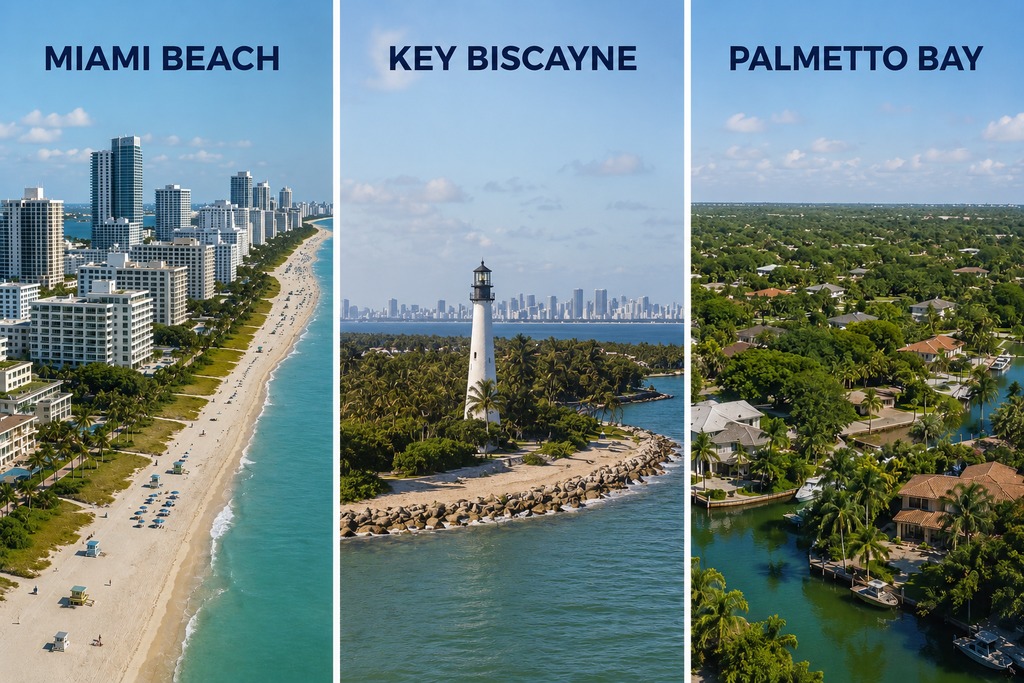
Waterfront living in Miami-Dade spans three very different price points and three very different lifestyles.
Miami Beach is the version of Miami most people outside Florida imagine. The reality is more complicated. The housing stock is almost entirely condos, and HOA fees in Miami Beach buildings routinely run $1,000–$3,500 per month. Insurance costs have climbed sharply due to flood zone exposure, and some buildings require reserve contributions on top of regular maintenance fees. Financing a condo purchase in Miami Beach takes longer than on the mainland because lenders scrutinize building reserves and litigation history before approving loans.
That said, the demand for Miami Beach condos is genuinely global. International buyers from Latin America, Europe, and the Middle East consistently target this market, and cash transactions are common. If you're paying cash and want the lifestyle, the trade-offs are manageable. If you're financing, work with a broker who knows which buildings are lendable before you fall in love with a unit.
Key Biscayne is a different product entirely. It's a barrier island municipality with limited inventory, outstanding public schools, and a community that doesn't turn over often. Prices start around $1.5M for condos and climb past $15M for waterfront single-family homes. What buyers get is an island lifestyle with virtually no commercial noise, outdoor access in every direction, and one of the strongest long-term appreciation histories in Miami-Dade. The trade-off is the bridge. Key Biscayne homes sit behind the Rickenbacker Causeway, and rush-hour traffic heading to the mainland is a daily reality for anyone who commutes.
Palmetto Bay is the most underrated area on this list. It offers waterfront access, A-rated schools, and large single-family lots — all at a price point that is meaningfully lower than Pinecrest or Coral Gables. Homes in Palmetto Bay real estate range from $650K to $2M, with most move-in-ready inventory trading between $800K and $1.3M. HOA fees are minimal in most parts of the area, which keeps the monthly cost of ownership considerably lower than comparable condo living anywhere on the coast.
Buyers who look at Palmetto Bay and Pinecrest side by side often choose Palmetto Bay once they realize they can get more square footage, more land, and the same school quality for 10–15% less.
How to Decide: Match Your Priorities Before You Start a Home Search
The most common mistake buyers make when figuring out where to live in Miami isn't choosing the wrong neighborhood. It's starting the home search before they've answered the right questions.
A buyer once came to me focused entirely on Coral Gables because a colleague lived there. After one conversation, it came out that she worked in Doral, had no children, and her real priority was a newer home with minimal maintenance. Coral Gables was the wrong fit on every axis. She ended up in a newer townhome in Doral and closed in six weeks.
Before you look at a single listing, work through these:
- Commute tolerance. Miami traffic is real. Where you work determines which areas are actually viable, and driving 45 minutes each way changes how you feel about a neighborhood fast.
- School timeline. If school access matters now, the zone is non-negotiable. If it matters in three to four years, you have flexibility — but buying in the right zone before you need it is usually smarter than trying to move once enrollment becomes urgent.
- HOA appetite. High HOA fees in a condo building are not inherently bad, but they affect what you can afford and what your monthly obligation looks like after purchase. Buyers who underestimate HOA costs get squeezed.
- Cash vs. financing. Certain Miami Beach buildings have financing restrictions. Certain Brickell towers are not FHA-approved. Knowing your financing profile before you fall for a unit saves a lot of wasted time.
If you're relocating to Miami and want to start a focused search tied to specific areas, the VIP Home Search gives you access to listings before they hit public portals, which in tight markets like Kendall and Doral often means the difference between getting to see a home or missing it entirely. And if you're still deciding whether to rent first, Should I Rent or Buy a Home? walks through that decision in the context of the Miami market specifically.
The best areas in miami to live are different for every buyer. Spend time on the decision before you spend time on listings, figuring out the best areas to live miami for your specific situation is the work that makes every other part of the process faster and cleaner.
FAQ
Q: What is the best area to live in Miami for families with young children?
A: Coral Gables, Pinecrest, and Palmetto Bay are consistently where family buyers land when school quality is the driving factor. All three feed into A-rated public schools in Miami-Dade County, and all three have predominantly single-family housing stock with meaningful lot sizes. Pinecrest tends to offer the most private land per dollar, Coral Gables carries a prestige premium, and Palmetto Bay gives the most square footage relative to price. One thing to verify before writing an offer: the school zone for each individual address, not just the general area. Zone lines in Miami-Dade can shift block by block, and the difference between an A and B school feed sometimes comes down to a single street.
Q: Which Miami neighborhoods are most affordable for first-time buyers in 2025?
A: Kendall and West Kendall are still the most accessible entry points for buyers who want a single-family home rather than a condo. Inventory under $650K in move-in condition moves fast, typically going under contract within 2–3 weeks of listing, but it exists. Doral is a close second, though prices there have risen sharply since 2020, and the townhome-heavy inventory means less land for the money. Hialeah is worth mentioning for buyers open to older housing stock; prices per square foot remain lower than Kendall, though resale liquidity is more variable. Budget-conscious buyers should get pre-approved before searching — in sub-$700K price points, sellers do not wait for conditional buyers.
Q: Is it better to live in Miami Beach or on the mainland for someone relocating for work?
A: Depends entirely on where the job is. If the office is in Brickell or Downtown, Miami Beach is closer than it appears on a map, but the MacArthur Causeway adds meaningful commute time during peak hours. More importantly, the cost of living in Miami Beach is substantially higher when you factor in HOA fees, insurance, and parking. Most professionals relocating for work who want a reasonable commute and manageable monthly costs end up on the mainland, either in Brickell itself or in Coconut Grove. Miami Beach works best for buyers who are specifically drawn to the island lifestyle and can absorb the associated costs without strain.
Q: How much do home prices vary between the best areas in Miami to live?
A: The range is wider than most people expect. In Kendall, a 3-bedroom single-family home trades between $500K and $750K in most cases. In Coral Gables, a comparable home in terms of bedrooms starts around $1.2M and climbs from there. On Key Biscayne, $1.5M is closer to the floor than the ceiling. Price per square foot tells a more consistent story: Kendall and Doral run $280–$450, Coral Gables and Pinecrest run $450–$800, and coastal areas like Miami Beach and Key Biscayne reach $700–$2,000+ depending on the view and building quality. The spread reflects not just location but also HOA structure, insurance exposure, and school zone premium.
Q: What should I know about HOAs and condo rules before choosing where to live in Miami?
A: HOA rules in Miami-Dade vary more than people realize, and they affect the purchase process as much as the ongoing ownership experience. In condo buildings, the association's financial health matters to your lender. Buildings with pending litigation, underfunded reserves, or deferred maintenance can be unlendable, meaning if you're financing, you may not be able to get a mortgage on a specific unit even if your credit is strong. In HOA-governed single-family communities, rental restrictions are common; many associations in Kendall and Doral limit how soon after purchase a buyer can rent the home. If you're buying as an investment or know you may need flexibility in a few years, reviewing the association docs before going under contract is not optional.
If you've narrowed it down to two or three areas and want to see what's actually available at your budget right now, the VIP Home Search gets you access to off-market and pre-market listings across Miami-Dade before they hit Zillow or Realtor.com. Takes two minutes to set up, and in markets like Kendall and Doral where good inventory disappears in days, being first matters.
Check out this article next