
Home Updates That Add Value Before You List in Miami
Most sellers come into a listing conversation with a renovation budget and a long list of ideas. A new kitchen. Maybe a pool. Fresh flooring throughout. And almost every time, the conversation has to slow down before it can move forward.
Because the question is not "what would make my home nicer?" The real question is "what will a buyer in this zip code actually pay more for at closing?"
Those are two very different questions, and confusing them is one of the most expensive mistakes a Miami-Dade seller can make. This article walks you through the home updates that add value in a way that shows up on the closing statement, not just on an Instagram post.
Not Every Upgrade Pays You Back
Here is something the home improvement industry would rather you not think about too hard: a beautiful renovation and a high-ROI renovation are not the same thing.
A $40,000 kitchen gut renovation in Kendall may return $28,000 in sale price. Sellers feel good about it because the kitchen looks great. But they left $12,000 on the table by over-improving for the price ceiling in that micro-market.
The best ROI home improvement decisions are not emotional. They are strategic. And strategy starts with understanding how buyers in your specific area are evaluating properties right now.
In Miami-Dade, three forces shape buyer behavior more than anywhere else in the country: insurance costs, HOA restrictions, and the presence of foreign cash buyers who weigh upgrades differently than a first-time domestic buyer using an FHA loan. More on each of those below.
The Short List of Highest ROI Home Improvements in Miami
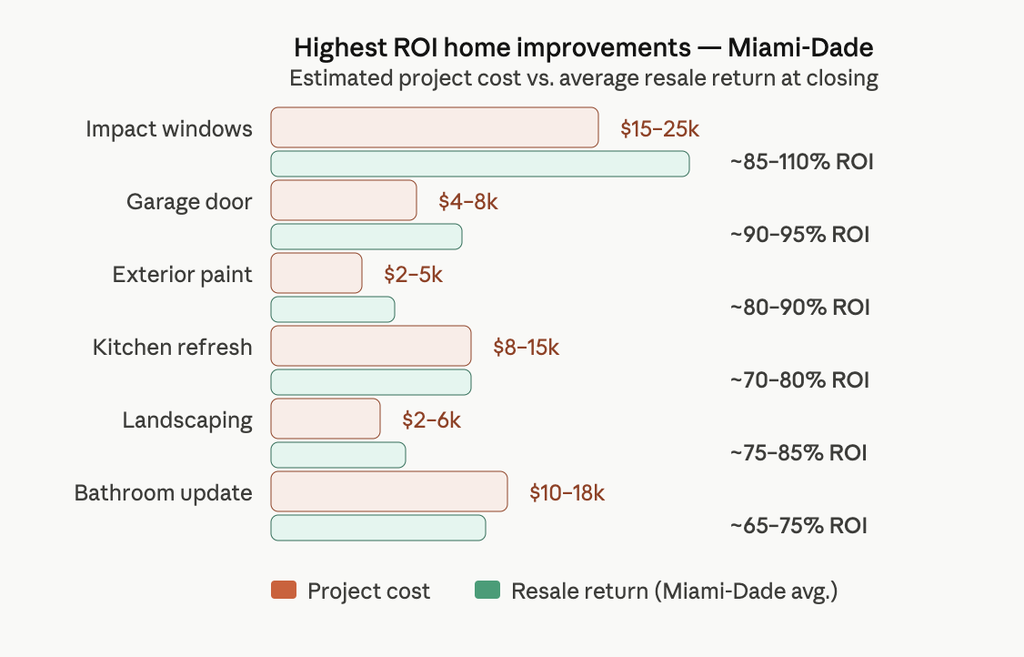
The projects below consistently deliver the strongest returns in Miami-Dade based on resale data. The returns are not guarantees. They are ranges based on what buyers in this market have shown they will pay for.
Impact windows and doors are the single highest ROI home improvement category in South Florida. A full-home impact window and door package typically costs $15,000 to $25,000 depending on the number of openings and the glass grade. At resale, well-priced homes with this upgrade command a $20,000 to $30,000 premium over comparable homes without it. The ROI is strong on its own. But the real advantage is the insurance discount: buyers who are financing need to show lenders an insurable property at a reasonable rate, and impact windows reduce annual premiums by $2,000 to $6,000 in many parts of Miami-Dade. That savings figure directly affects a buyer's ability to qualify and their monthly payment. Sellers with impact windows face less resistance at the appraisal stage and attract more qualified buyers.
Garage door replacement is consistently one of the highest ROI home improvements in the country, and in Miami it skews even higher. A steel hurricane-rated garage door costs $4,000 to $8,000 installed. It returns nearly its full cost at closing and meaningfully boosts curb appeal in the first 30 seconds of a showing.
Exterior paint is cheap relative to its impact. In a market where buyers often do drive-bys before they schedule a showing, a fresh exterior in a current neutral color can be the difference between getting a viewing and getting skipped. Budget $2,000 to $5,000 for a single-family home. Few home updates that add value this quickly for this little.
Minor kitchen refresh (not a gut renovation) means new cabinet hardware, updated fixtures, resurfaced or repainted cabinet fronts, and a modern faucet. Budget $8,000 to $15,000. Buyers respond to a kitchen that looks clean and current. They do not need a custom kitchen to make an offer. A full gut renovation at $40,000 to $60,000 rarely returns its full cost in the mid-range Miami market.
Landscaping and curb appeal return 75 to 85 percent of their cost at closing, and more importantly they affect showing count. Homes that generate more showings in the first weekend close faster and above asking more often. A $3,000 to $6,000 landscaping investment that gets you five more showings in week one often earns far more than the landscaping itself cost.
Bathroom updates sit in the middle of the ROI range. A full gut renovation is generally not worth it. A refresh, meaning new vanity, updated lighting, reglazing the tub if needed, and fresh tile grout, returns better on a per-dollar basis.
How to Increase Home Value by $50,000 Without a Full Renovation
This is a question many sellers approach as a single project question. "What one thing can I do to raise my value by $50,000?"
The answer is almost never a single project. Figuring out how to increase home value by $50,000 is a sequencing problem.
Here is a real example. A three-bedroom home in The Hammocks listed in 2023 was priced at $540,000 based on comps. The seller spent $22,000 across four targeted upgrades: impact windows on the main living areas ($12,000), exterior paint ($3,500), landscaping ($2,500), and a minor kitchen refresh ($4,000). The home sold at $598,000 after four days on market with two competing offers. The $58,000 price premium came from a $22,000 investment — and from listing in move-in condition during peak season, which was not an accident.
None of those four projects was a full renovation. All four together repositioned the home in the buyer's mind from "needs work" to "move-in ready." Move-in ready commands a premium in Miami because buyers are absorbing high mortgage rates, high insurance, and high property taxes simultaneously. Anything that reduces their post-closing burden is worth paying for.
For more detail on which upgrades have the strongest track record, this breakdown of 10 top renovations that will up the sale price of your home covers the full list with costs and expected returns.
What Looks Good but Rarely Moves the Needle
The projects that feel like upgrades but often hurt your net proceeds deserve equal attention.
Pools are the classic Miami seller trap. Adding a pool before listing costs $50,000 to $80,000. In most Miami-Dade zip codes below the $700,000 price point, the pool adds $15,000 to $25,000 in perceived value, if anything. Buyers in certain price points see pools as a maintenance liability, not a luxury. Insurance in flood-prone zip codes adds another layer of complexity. If the home already has a pool, maintain it well. If it does not, do not add one to sell.
Full kitchen gut renovations were addressed above, but the pattern is worth reinforcing. Sellers who spend $50,000 on a kitchen in a market where the ceiling price for that street is $620,000 are not improving their position. They are spending equity they already have.
Luxury finishes in mid-range markets follow the same logic. Porcelain slab countertops, custom cabinetry, and designer tile in a Hialeah home priced at $480,000 will not return their cost. Buyers at that price point are not expecting luxury. They are expecting clean, updated, and functional. Spending $30,000 to deliver luxury in a market that will pay for "updated" is one of the fastest ways to lose money on a home sale.
Over-improving for the zip code is the umbrella mistake. Before committing to any renovation, the right question is: what is the highest comparable sale on this street in the last six months? Your renovation budget should be calibrated to reach that ceiling, not exceed it.
Miami-Specific Factors That Change the ROI Equation
This section is where generic home improvement advice breaks down. Miami is not a normal market, and sellers who use national ROI averages as their planning tool will make miscalculated decisions.
Insurance costs are reshaping buyer behavior in ways that make certain upgrades more valuable here than anywhere else in the country. A buyer financing a $600,000 home in Miami-Dade may be paying $8,000 to $14,000 per year in homeowners insurance. When a home with impact windows and a newer roof can reduce that number to $5,000 to $6,000 annually, the best roi home improvement decision becomes obvious: target the upgrades that move the insurance needle. Buyers talk to their insurance agent before they make offers. Sellers who make their home easy to insure at a reasonable rate attract more qualified, motivated buyers.
HOA restrictions change what is even possible on exterior updates. In HOA-heavy communities like Doral or parts of Coral Gables, exterior paint colors, fence styles, and landscaping choices are subject to architectural review. Sellers who make exterior changes without HOA approval can face fines and be required to revert the work before closing. Confirm the scope of restrictions before spending any money on exterior improvements.
Foreign cash buyers evaluate upgrades differently than financed domestic buyers. A Venezuelan or Colombian buyer paying cash in Doral or Brickell is not constrained by lender insurance requirements. They often place higher subjective value on visual upgrades like kitchen finishes and flooring than a financed buyer who is already stretched on rate and insurance. If your home sits in a corridor with high international buyer traffic, the calculus on cosmetic upgrades shifts slightly.
Seasonal demand patterns by price point affect how renovation timing interacts with your list date. In Miami-Dade, the strongest buyer activity for homes priced between $500,000 and $900,000 runs from late October through April. Sellers who complete their upgrades and list during this window see faster absorption and more competitive offers. A renovation finished in June in that price band may sit. The same home listed in November often does not. Knowing how to increase home value by $50,000 is only half the equation; knowing when to present that home to the market is the other half.
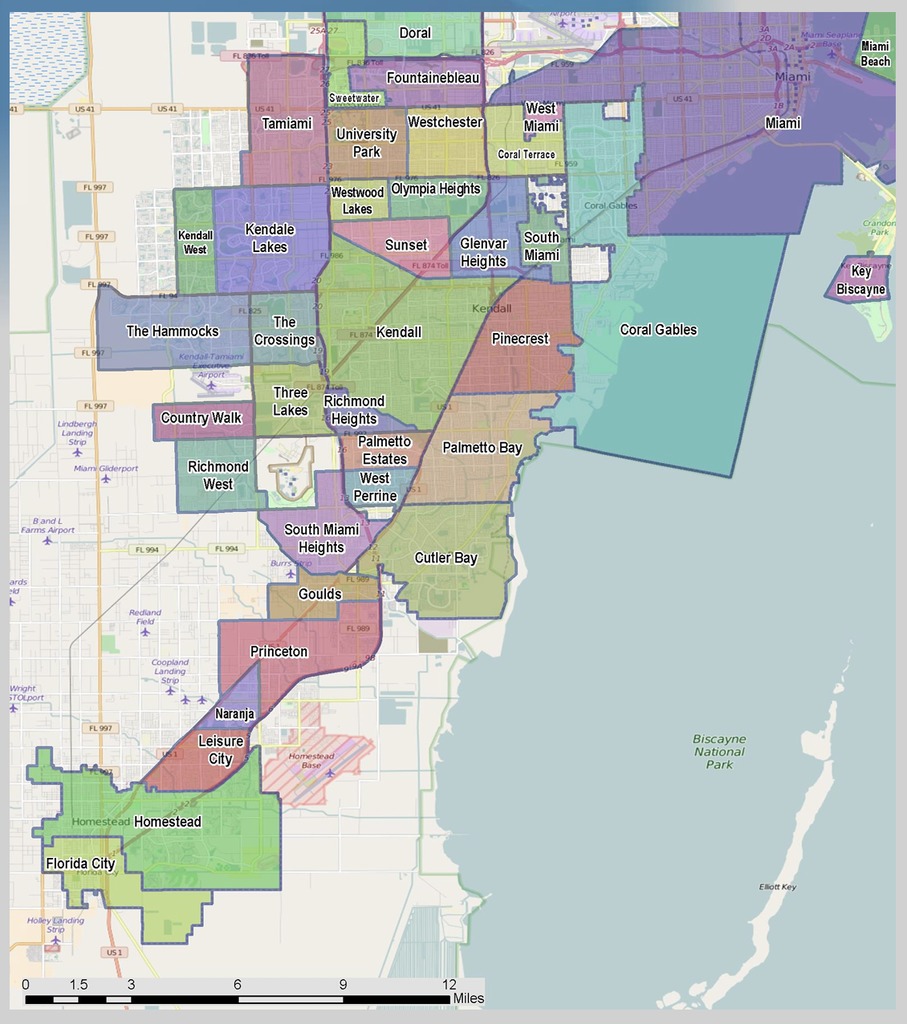
Micro-market price ceilings vary sharply across Miami-Dade. A $30,000 renovation budget in Pinecrest, where median sale prices run $1.2M to $1.8M, has a different return profile than the same budget in Homestead, where the ceiling is $450,000. Renovation decisions cannot be made in a vacuum. They require a clear picture of what the market ceiling is in your specific area and how far below that ceiling your current condition puts you.
How to Sequence Your Updates Before You List
The framework that consistently produces the best results for Miami sellers follows three stages.
Fix first. Address anything a buyer or inspector will flag: roof condition, HVAC age, water intrusion, electrical panels. These are not upgrades. They are table stakes. A buyer who finds a deficiency in the inspection will either ask for a credit that exceeds what a repair would have cost, or they will walk. Deferred maintenance items cost sellers more at closing than they cost to fix before listing.
Refresh second. Paint, landscaping, fixtures, cleaning, and staging. These are the home updates that add value most efficiently because they are visible, they are low cost, and they directly affect the emotional response a buyer has in the first ten minutes of a showing.
Upgrade only if the numbers justify it. This means running a quick analysis: what will this upgrade cost, what is the realistic return in this specific zip code based on recent comps, and how does that return compare to leaving the money in your pocket and adjusting price accordingly? Sometimes the right answer is a $5,000 discount on list price rather than a $12,000 bathroom renovation.
For a broader view of how strategic pre-listing decisions affect your final number, this guide on unlocking maximum value from your home sale walks through the full process.
What Labrada Realty Does Before the Sign Goes Up
The conversation most sellers need to have before they spend a dollar on renovations is a pre-listing strategy session, not a trip to the home improvement store.
At Labrada Realty, the pre-listing process starts with a market analysis that identifies the price ceiling for your specific street, the condition gap between your home and recent comparable sales, and which upgrades, if any, will move your net proceeds at closing.
Some sellers are told to renovate when they should not spend a dollar. Others are told to list as-is when a $10,000 targeted investment would net $30,000 more at closing. The difference between those two outcomes is having someone who has studied the local market run the numbers with you before you commit.
FAQ
Q: Which home improvements have the highest ROI before selling in Miami?
A: In Miami-Dade, impact windows consistently deliver the strongest return of any single upgrade category, often returning 85 to 110 percent of the project cost at closing. After that, garage door replacement, exterior paint, and minor kitchen refreshes perform well across most price points. The ranking shifts based on your specific zip code. A $3,500 paint job in a neighborhood where curb appeal drives showing count can generate more net return than a $15,000 kitchen update in a market where buyers are more focused on condition than finish level. The highest roi home improvements in your home's case depend on where you start relative to comparable sales on your street.
Q: How much value does a kitchen remodel add to a home in Miami-Dade?
A: A minor kitchen refresh, updated cabinet fronts, new hardware, modern faucet, fresh lighting, typically adds $10,000 to $18,000 in perceived value in the $450,000 to $750,000 price range. A full gut renovation at $40,000 to $60,000 in the same price band rarely returns more than $30,000 to $35,000 at closing. The gap between what it costs and what buyers will pay for it tends to widen as price points drop. In Brickell condos or Coral Gables single-family homes above $1M, the calculus shifts, and higher-end finishes can perform better. But in mid-range Miami-Dade markets, a targeted refresh consistently outperforms a full remodel on a per-dollar basis.
Q: Do impact windows increase home value in Miami?
A: Yes, and they do it in two ways. Directly, homes with full-home impact windows sell for a measurable premium over comparable homes without them, typically in the $20,000 to $30,000 range in the $500,000 to $800,000 price band. Indirectly, impact windows reduce annual insurance premiums significantly, which affects buyer qualification and their monthly cost of ownership. A buyer who is stretched on rate and insurance may not qualify for a home with a $10,000 annual insurance bill but can qualify once that number drops to $5,500 because of impact protection. That expanded buyer pool translates into faster sales and more competitive offer environments. Of all the home updates that add value in South Florida, impact windows are the most consistently cited reason for a buyer choosing one home over another in the same price range.
Q: Is it worth renovating a bathroom before selling in Miami?
A: A full gut renovation rarely pencils out before a sale. A targeted refresh usually does. Reglazing a dated tub rather than replacing it, updating the vanity and lighting, recaulking the tile — these changes cost $3,000 to $6,000 and meaningfully shift how a buyer perceives the condition of the home. Where sellers lose money is by spending $18,000 to $25,000 on a full primary bathroom renovation in a market where comparable homes with updated but not luxury bathrooms are selling at the same price ceiling. Before committing, ask: will this renovation push me above the best comparable sale on my street, or just bring me up to it? If it brings you up to market condition, do it. If it pushes you past the ceiling, scale it back.
Q: How do I know if I am over-improving my home for the market?
A: Pull the six most recent comparable sales within a half-mile of your property and find the highest one. Add the cost of your planned renovation to your current estimated value. If the result exceeds the highest comparable sale by more than 10 to 15 percent, you are likely over-improving. Miami-Dade buyers will not pay above market ceiling regardless of how beautiful the renovation is. Appraisers will not support a number that comparable sales do not justify, which creates appraisal gaps that kill deals or force price reductions. The ceiling is the ceiling. The smarter move is to hit it efficiently rather than exceed it expensively.
If you want to know exactly which updates will move the needle for your home and which ones are not worth the spend, get a free home valuation that gives you a real number to work with and a clear picture of where your home stands against the current market.
Check out this article next