
Most people researching brickell real estate come in with the same assumption: this is Miami's luxury high-rise corridor, prices are high, and if you can afford a unit, you're done thinking. Buy it, enjoy it, done.
The buyers who get hurt are exactly the ones who stop there.
Brickell operates under a specific set of market conditions. Inventory levels, condo association rules, insurance underwriting quirks, and financing constraints do not apply the same way anywhere else in Miami-Dade. A $650,000 condo here is not the same transaction as a $650,000 townhouse in Kendall. The variables that determine your real cost of ownership, your ability to get financed, and your long-term resale position are different enough that buying without understanding them is a real risk.
This guide covers what the market looks like right now, what questions to ask before you make an offer, and where buyers most often leave money on the table or walk into problems they didn't see coming. If you're also weighing whether to buy at all, our rent-vs-buy breakdown for Miami buyers is a useful first read.
What Brickell Actually Is, and Why It Behaves Differently
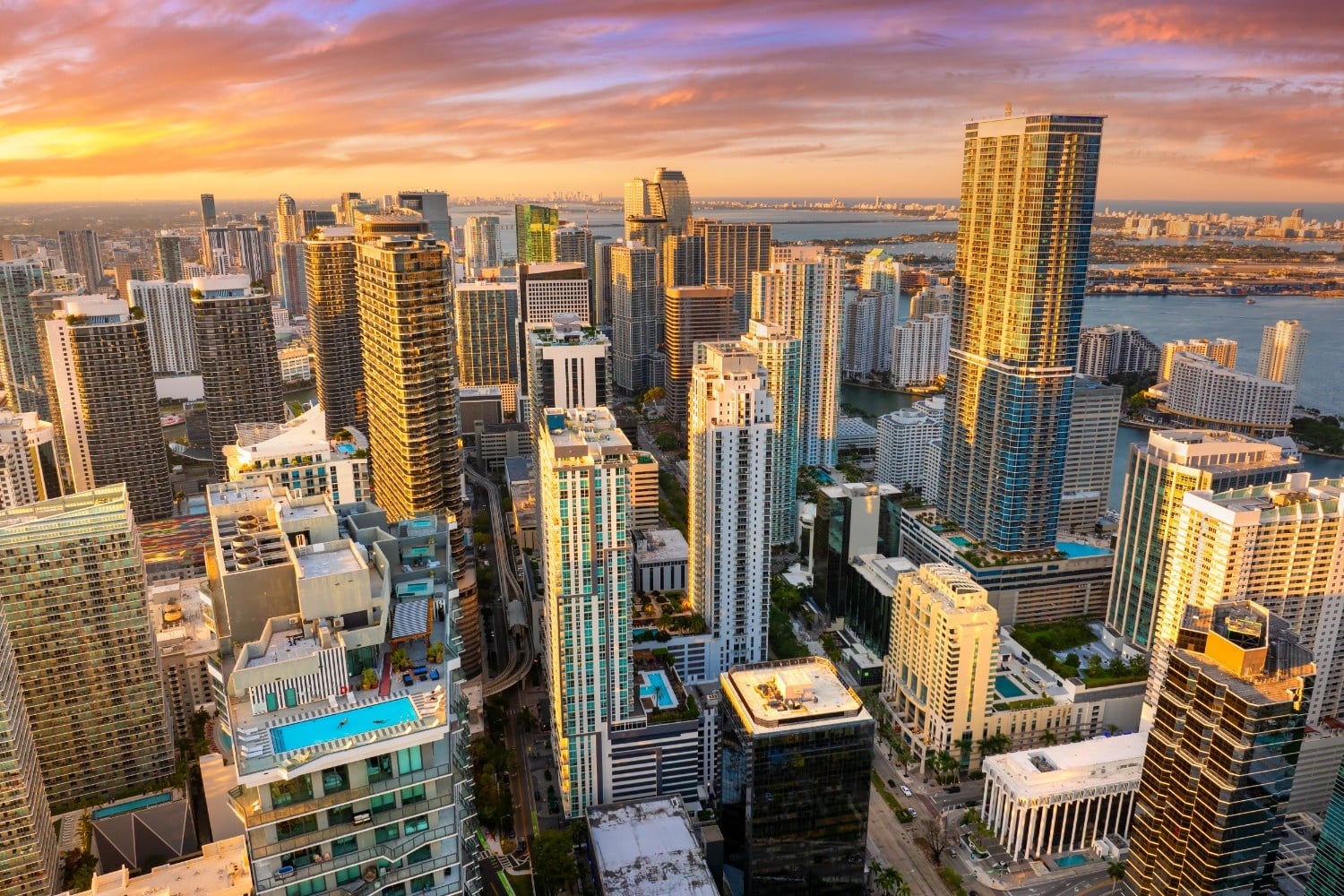
Brickell is Miami's financial district. That sounds like a descriptor, but it's actually the explanation for almost everything that makes this market behave the way it does.
The neighborhood spans roughly zip codes 33131 and 33129, bounded by Biscayne Bay to the east, the Miami River to the north, and I-95 to the west. Those physical constraints matter because they mean there is almost no undeveloped land remaining. Every new unit delivered here comes from a high-rise project on a site that was already built on. Supply is structurally limited in a way that suburban Miami-Dade simply is not.
The buyer pool is also different. Brickell attracts three overlapping groups: financial-sector professionals who live five minutes from their office, international buyers from Latin America who want a foothold in what has become the financial capital of the region, and domestic buyers relocating from New York, Chicago, or Los Angeles who are trading a higher cost of living for no state income tax and year-round weather. These buyers don't move on the same seasonal cycles as the broader Miami market. They move when corporate relocation happens, when a lease expires, or when currency and tax considerations align.
Walk Score of 90. Free Metromover service running through the heart of the neighborhood. Brickell City Centre and Mary Brickell Village within walking distance of most towers. An estimated 40,000 residents, growing steadily. None of that is marketing language. It's why end-users are willing to pay Brickell prices rather than getting more square footage somewhere else in the county.
Understanding all of that is the foundation for understanding why Brickell Miami real estate prices are what they are, and why the negotiating environment right now is more nuanced than the headline numbers suggest. Buyers who treat this as a generic condo market tend to overpay or underprepare. Buyers who understand the specific dynamics of Brickell Miami real estate close with more confidence and fewer surprises.
Where Brickell Condo Prices Stand Right Now
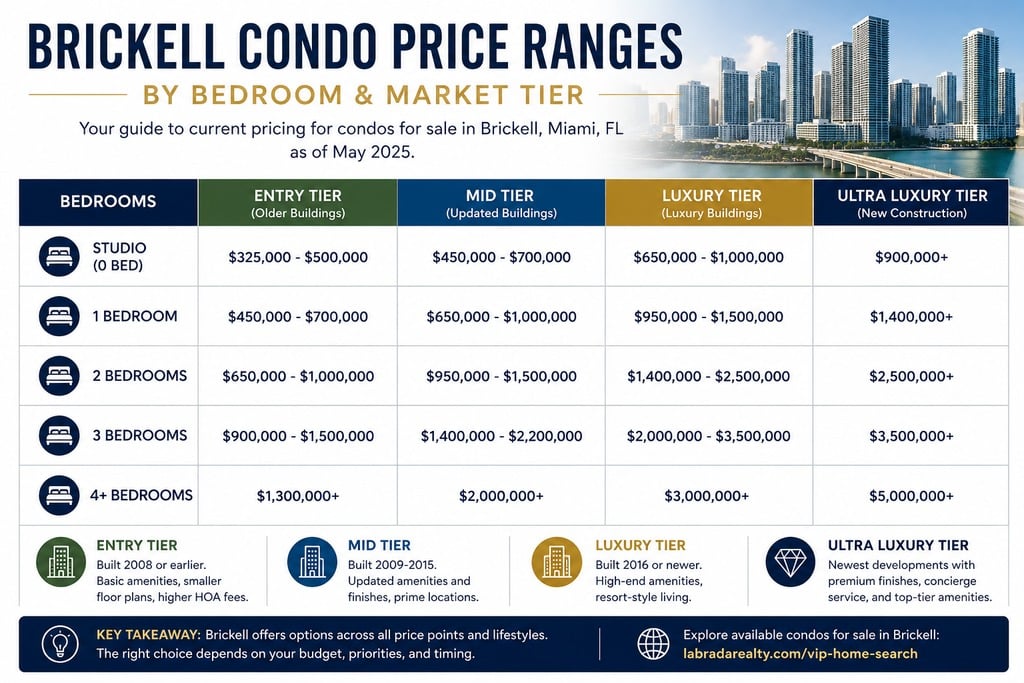
The median condo sale price in Brickell sat at approximately $660,000 based on Q4 2025 closings. On a per-square-foot basis, buyers closed at around $648/sq ft in Q1 2026, a figure that reflects the broader resale market across building tiers.
Entry-level one-bedroom units in established resale buildings typically land between $325,000 and $500,000. Two-bedroom units run $500,000 to $1,000,000 depending on the building, floor, and finish level. The $1M to $3M range has the largest share of inventory and transactions right now, with the luxury tier above that operating in its own segment where price per square foot can push past $900.
The more consequential data point for buyers right now is inventory. As of early 2026, months of supply in Brickell is approximately 17 months, more than twice the 6-month threshold that defines a balanced market. Average days on market for Brickell condos sits around 113 days. Both numbers tell the same story: sellers are competing for a smaller pool of qualified buyers, and the leverage balance has shifted.
What that means practically: buyers who come in with clean financing, a realistic price expectation, and a solid understanding of the building they're targeting have real negotiating room. Not unlimited room. Well-priced units in well-funded buildings still move. But the environment today is meaningfully different from 2021-2022, when anything decent went fast and over asking.
One nuance worth knowing: the price softening is not uniform. Buildings with strong financials, healthy reserves, and low owner-to-renter ratios are holding value better than comparable towers with deferred maintenance or pending special assessments. Price per square foot is your most reliable comparison tool, but only once you account for what's sitting underneath that number in the building's financials.
For condos for sale in Brickell Miami Fl in the sub-$700K range, there's meaningful inventory available from buildings that were delivered between 2010 and 2018. These units often require more scrutiny of association documents, which brings us to the section most buyers skip.
The HOA Reality Nobody Explains Before You Make an Offer
Monthly HOA fees in Brickell range from roughly $0.65 per square foot for non-waterfront mid-tier buildings to over $1.05 per square foot for newer full-service towers. On an 800-square-foot one-bedroom, that's $520 to $840 per month before your mortgage, taxes, and individual unit insurance. On a 1,200-square-foot two-bedroom, you're at $780 to $1,260.
Those are the numbers most buyers notice. The number that matters more is the one they don't ask about.
Reserve funding is the percentage of a building's expected future repair costs that the association has actually set aside. A building with reserves funded at 70% or above is in solid shape. Below 50%, you are buying into a building that is likely to pass major repair costs on to owners through special assessments, meaning one-time charges that can range from a few thousand dollars to tens of thousands, with little advance notice and limited ability to opt out.
This is not a theoretical concern. In 2025, owners at 1060 Brickell faced a $21 million special assessment, with individual unit owners receiving bills exceeding $40,000. The trigger was a structural integrity reserve study required under Florida's updated condo safety laws, passed in the wake of the Surfside Champlain Towers collapse in 2021. Every building in Florida that is three stories or taller must now complete a Structural Integrity Reserve Study and cannot waive full reserve funding going forward. For buyers shopping condos for sale in Brickell Miami Fl that were built before 2015, this is not a background detail. It is one of the first things to evaluate.
Before you make an offer on any Brickell unit, request these documents from the listing agent:
- The most recent reserve study and reserve funding percentage
- The last two to three years of audited financial statements
- The meeting minutes from the last 12 months of board meetings
- Any pending or recently approved special assessments
- The building's master insurance policy declarations page
A well-funded building with a boring financial history is worth more than a building with a lower asking price and a reserve fund running on fumes. That gap shows up in your carrying costs, in your future resale, and in your ability to get financed. That path leads directly to the next variable most buyers underestimate.
New Construction vs. Resale: The Decision Every Brickell Buyer Faces
The Brickell development pipeline in 2026 is extraordinary. Branded residences from Dolce & Gabbana (888 Brickell), Cipriani, St. Regis, Mandarin Oriental, and others are under development or in pre-sale. Average pre-construction pricing across the neighborhood runs approximately $1,650 per square foot, but ultra-luxury branded towers can push $2,500 to $3,000 or more.
Pre-construction carries a specific risk-reward profile that resale does not. You are committing deposits, typically 20 to 50% of the purchase price held over a two-to-four-year construction timeline, based on floor plans and renderings rather than a physical unit you can walk through. The building's HOA financials don't exist yet, because the building doesn't exist yet. And the market you're delivering into in 2028 or 2029 may look different from the one you're buying into today.
That is not an argument against pre-construction. For buyers who want the newest product, brand cachet, lower assessment risk in early years, and the potential for appreciation during the construction period, it is a legitimate play. But it requires a longer time horizon, a high cash reserve, and a clear understanding of the deposit structure and developer's track record.
Resale is where the current leverage sits. With 17 months of inventory and an average DOM of 113 days, buyers shopping the resale market, especially the $500K to $1M range for Miami Brickell condos for sale, are in the strongest position they've been in several years. Sellers who have been sitting on the market are more willing to negotiate on price, closing costs, and credits. If you're buying to live in the unit in the near term, resale gives you the ability to inspect, review financials, and close in a conventional 45-to-60-day window rather than waiting years.
The right answer depends on your timeline, your risk tolerance, and how you plan to use the property. But walking into a Brickell showing without knowing which market you're actually shopping is one of the most common ways buyers misallocate their time.
The Financing and Insurance Variables That Can Kill a Deal
Florida's property insurance market has changed the calculus for condo buyers across Miami-Dade, and Brickell is no exception. Individual HO-6 policies for condo interiors have increased significantly over the past several years. On top of that, the building's master insurance policy, which covers the structure and common areas, is one of the largest line items in most HOA budgets, often representing 10 to 30% of operating costs. When that premium rises, monthly HOA fees rise with it. Buyers who model their monthly payment using current HOA fees without accounting for insurance-driven increases can find their cost of ownership climbing faster than expected.
The second issue is lender eligibility. Not every Brickell building is financeable with a conventional loan. Fannie Mae and Freddie Mac have specific condo project approval requirements, and buildings can fall out of eligibility for reasons that have nothing to do with the unit itself. A building with pending litigation, a low owner-occupancy ratio (many investors renting out units), or reserve funding below required thresholds can be flagged as a non-warrantable condo. When that happens, your conventional financing options disappear and you're looking at portfolio loans, higher rates, or a cash-only transaction.
This is one of the most practical reasons to work with someone who handles both real estate and financing under one roof. At Labrada Realty, Alberto Labrada is a licensed real estate broker, mortgage broker, and title agent. That means before you spend two weeks pursuing a unit, we can pull the building's financials and tell you upfront whether conventional financing is likely to work, rather than finding out at the underwriting stage after you've gone under contract. You can browse Brickell listings and area details and reach out directly to discuss a specific building before you tour anything.
The insurance check, the reserve review, and the financing qualification all need to happen before you submit an offer, not after. That sequence is what separates buyers who close efficiently from buyers who lose deals at the last mile.
Brickell vs. the Rest of Miami-Dade: When It's the Right Fit
Brickell is the right choice for a specific type of buyer. It is not the right choice for everyone, and pretending otherwise doesn't serve you.
If you want a walkable urban lifestyle, proximity to Miami's financial and professional core, a high-rise with resort-style amenities, and a property that attracts strong rental demand when you travel, Brickell is hard to beat in Miami-Dade. The Metromover, the restaurant density, and the ease of access to the airport and port make it genuinely functional in a way few Miami neighborhoods are at this price point.
If you want a yard, a single-family home, top-rated public schools within walking distance, and quiet streets, Brickell is not your answer. Coral Gables delivers that at a premium. Pinecrest delivers it at slightly lower entry points. Kendall gives you the most space per dollar in Miami-Dade. Those are different products for different lives.
For international buyers, Brickell has historically been the default Miami choice, and for good reason. The concentration of Latin American banks, the bilingual professional community, and the mix of primary residences and investment properties makes it familiar and liquid. But even for that buyer profile, the due diligence requirements around building financials and financing eligibility are the same. Currency doesn't bypass the reserve study.
The honest summary: if your life and your search align with what Brickell offers, right now is a better time to buy than it has been in several years. If the lifestyle is more aspirational than practical for how you actually live, the carrying costs and the condo-specific risks make more sense in a building that matches your real usage patterns.
FAQ
Q: What is the average price per square foot for condos for sale in brickell miami fl right now?
A: Across the general resale market, buyers in early 2026 are closing at approximately $648 per square foot. That number shifts considerably by building tier. Resale units in older, non-luxury towers can come in below $500/sq ft, while mid-tier buildings from the 2015-2020 delivery period often run $600 to $800. The luxury segment, brand-name buildings on high floors with premium finishes, regularly clears $900/sq ft and beyond. Pre-construction for Miami Brickell condos for sale averages around $1,650/sq ft across all branded and non-branded projects currently in development. Use price per square foot as your comparison baseline, but always layer in HOA fees, reserve health, and floor position before drawing conclusions between buildings.
Q: How long does it typically take to close on miami brickell condos for sale?
A: For resale condos in Brickell, a conventional financed transaction typically runs 45 to 60 days from executed contract to closing. Cash deals can close in 21 to 30 days if the seller is motivated and the title process moves efficiently. Two variables add time in Brickell specifically: condo association approval (some buildings require board review of the buyer, which can add 10 to 20 business days) and lender review of the building's financials for loan eligibility. Buildings with pending litigation or reserve shortfalls can slow or stop the lender side entirely. If you're working with a buyer's agent who also has a mortgage relationship, these eligibility checks can happen in parallel with your search rather than after you're already under contract.
Q: Can I get conventional financing on a Brickell condo, or do I need cash?
A: Conventional financing is available on most Brickell buildings, but not all of them. The building, not just the unit, has to meet Fannie Mae and Freddie Mac project approval standards. Buildings can fall out of eligibility for low owner-occupancy rates (too many investor-rented units), pending litigation against the association, or reserve funding below required thresholds. When a building is flagged as non-warrantable, conventional loan options disappear and buyers face higher-rate portfolio loans or all-cash requirements. In Brickell's current market, with a meaningful number of older buildings now undergoing structural reserve studies and some facing assessments, building eligibility is more variable than it was five years ago. Check the building before you fall in love with the unit.
Q: What should I check in an HOA before buying in Brickell?
A: Request the reserve study and current funding percentage, the last two years of audited financial statements, recent board meeting minutes, and any disclosed pending or approved special assessments. In Florida, post-Surfside legislation now requires buildings of three stories or more to complete a Structural Integrity Reserve Study on a regular cycle and prohibits associations from waiving full reserve funding. That law change has accelerated assessments in buildings that previously underfunded reserves. A building with reserves funded at 70% or above carries low assessment risk. One sitting at 30 to 40% is a building you should price accordingly, or avoid if you can't absorb an unexpected five-figure bill within the first few years of ownership.
Q: Is Brickell a good place to buy if I plan to rent it out later?
A: Brickell has one of the strongest rental demand profiles in Miami-Dade, driven by corporate relocations, international renters who prefer urban living, and a high-income professional base that cycles through the neighborhood as jobs and leases turn over. Cap rates in the area run approximately 4 to 6% as of Q1 2026. Two things to verify before counting on rental income: first, check the building's rental restrictions, since some HOAs cap the percentage of units that can be rented at any time, and short-term rental rules vary significantly by building. Second, factor HOA fees, insurance, and property management into your net yield calculation. Gross rent looks very different from net return once carrying costs are properly modeled.
Ready to Run the Real Numbers?
If you want to know what a specific Brickell unit actually costs to own, not just the list price but the monthly carrying costs, the financing options, and whether the building's financials hold up. Talk through your search before you tour anything. Alberto Labrada handles real estate, mortgage, and title in-house, which means you get one conversation that covers all three instead of chasing three separate professionals who don't talk to each other. You can also run your real numbers with our mortgage calculator to get a baseline before we connect.
Check out this article next