


Most first-time buyers assume confusion about the home buying process steps is a personal problem, something they should have figured out by now. It isn't. Recent research shows 59% of Americans admit they don't fully understand how buying a home actually works, and among first-timers specifically, that number climbs to 64%. Another 22% either underestimated or simply weren't sure how their credit score would affect their mortgage rate. This isn't a knowledge gap buyers created. It's a timeline gap the industry never fixed. Nobody hands a buyer a clock and says, here's what happens, and here's how long each piece really takes. This guide fixes that, stage by stage, using how the process actually plays out in Miami-Dade.
Home Buying Process Steps, Stage One: Pre-Approval (Week 1)
Pre-qualification and pre-approval get treated like synonyms. They aren't. Pre-qualification is a lender's rough guess based on numbers you provide over the phone. Pre-approval is an underwriter actually pulling your credit, verifying income documents, and confirming what you can borrow in writing.
In a market where competitive Miami-Dade listings can generate multiple offers within days, a buyer holding only a pre-qualification letter is functionally unarmed. Sellers and their agents know the difference, and they weight offers accordingly.
Budget five to seven business days for full pre-approval if your documents are organized. Buyers who show up with tax returns, pay stubs, and bank statements already gathered routinely finish in three days. Buyers who scramble to find documents after the lender asks routinely stretch this to two weeks, which pushes every later stage back with it.
One local detail buyers miss constantly: insurance costs get folded into your debt-to-income calculation from day one. On a $500,000 home in Miami-Dade, annual premiums can run from $5,000 to over $12,000 depending on roof age and flood zone proximity. This shifts your real qualifying amount before you've toured a single house.
This confusion around credit carries a real cost. A twenty-point swing in your FICO score can shift your mortgage rate by a quarter point or more, and on a $450,000 loan, that difference adds up to thousands of dollars over the life of the loan. Miami-Dade lenders typically reserve their best pricing for scores above 740, with rate adjustments kicking in below 700 and again below 660. Buyers are often surprised at pre-approval because the score a lender pulls, using a mortgage-specific scoring model, rarely matches the number a free credit app displays. Knowing where you actually stand before you apply gives you time to pay down a card balance or dispute an error, either of which can move your rate before you ever make an offer.
If your finances feel complicated, you don't need a separate counselor and a separate lender to sort it out. I'm a licensed Florida mortgage broker in addition to being a real estate broker, so the same conversation where I look at where your credit and income actually stand becomes your pre-approval conversation, with no handoff to a second office and no waiting on a second appointment. Before you start touring anything, pull together your document list: two years of tax returns, thirty days of pay stubs, two months of bank statements, and any gift-letter documentation if part of your down payment is coming from family. Buyers who assemble this folder before their first lender conversation routinely move through the entire home buying process timeline faster than buyers who hand documents over one request at a time. Run a few payment scenarios through the mortgage calculator at Labrada Realty before you commit to a search range, and include taxes, insurance, and HOA fees as separate line items rather than folding them into a single guess.
For a deeper look at how financing, insurance, and neighborhood choice interact before you make a move, first time home buyer tips and advice for Miami covers the budgeting side of this decision in more depth than a stage-by-stage timeline can.
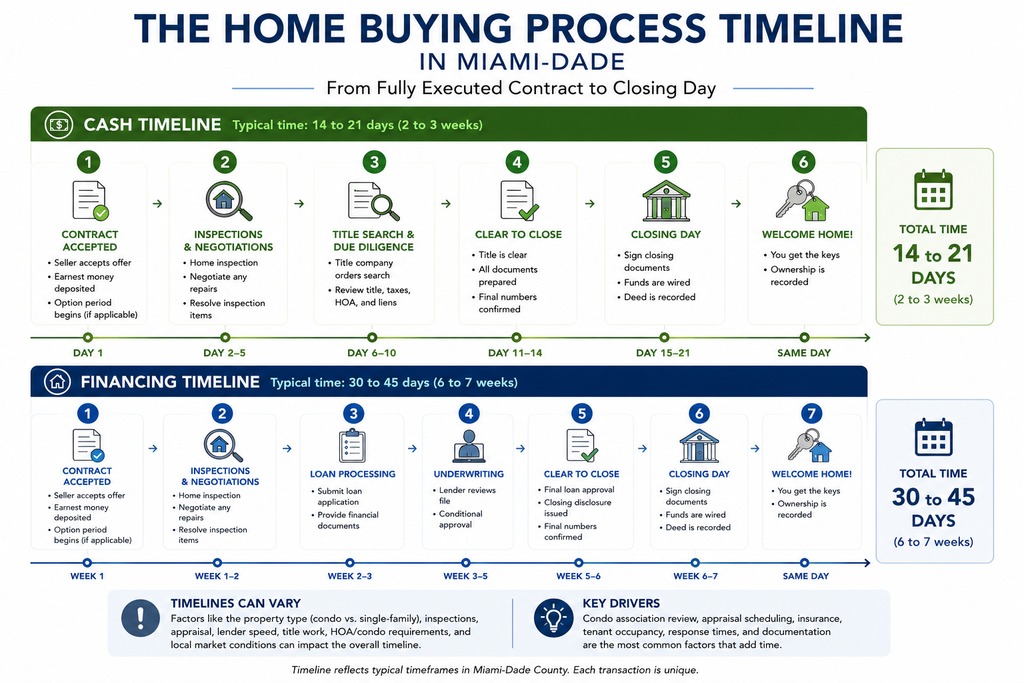
Step 2: The Search and the Offer (Weeks 2 Through 4, Highly Variable)
This is the stage with the widest range, and it's the one most guides gloss over. In Miami-Dade's current market, well-priced entry-level homes under $500,000 in areas like Kendall or Homestead often go under contract within two to three weeks of listing. Higher price points, particularly waterfront or luxury inventory, can sit for two to three months before the right buyer appears.
I worked with a buyer targeting a $460,000 townhome in West Kendall who toured eleven properties across eighteen days before writing an offer, a pace typical for that price band and one worth knowing if you're asking how long is the home buying process before an offer even gets written. The home she chose had been listed for 41 days, well past the initial rush of showings. Because average days on market countywide has climbed to around 96 days, I recognized the seller's leverage had softened. Her offer came in $12,000 under asking with a 21-day close, and the seller accepted within 48 hours. A buyer chasing a three-day-old listing at that same price point would have had none of that room.
How long is the home buying process at this stage depends almost entirely on price point and buyer flexibility, not on paperwork. Buyers who insist on a narrow list of must-haves in a tight inventory band wait longer than buyers who identify the two or three features that actually matter and stay open on the rest.
Writing a strong offer is a separate skill from finding a home, and it's where strategies buyers can learn from real estate investors apply directly. Investors rarely lead with price alone. They ask how long a property has sat, what the seller's next move depends on, and whether a faster closing date or a rent-back period matters more to that particular seller than an extra five thousand dollars. First-time buyers who borrow that habit, reading the seller's situation instead of only comparing list prices, shorten their own search inside the broader home buying process timeline.
Step 3: Under Contract, Inspection, Appraisal, and Underwriting (Days 1 Through 30)
Once an offer is accepted, three processes run at roughly the same time: inspection, appraisal, and underwriting. Buyers who think of these as sequential steps consistently misjudge their own timeline.
The inspection period in a standard Florida contract typically runs 10 to 15 days. This is where the most expensive mistakes in the entire home buying process steps sequence happen. A buyer who waives inspection contingencies to look more competitive on a multiple-offer property in South Florida is gambling on roof age, wind mitigation status, aluminum wiring in older homes, and, near the coast, foundation moisture. I had a buyer in Homestead who skipped inspection to beat a competing cash offer, only to discover a 22-year-old roof that Citizens Property Insurance flagged as ineligible for standard coverage. The replacement cost, $18,000, came entirely out of pocket because there was no contingency left to renegotiate against.
Appraisal typically follows seven to ten days after inspection clears, and underwriting runs concurrently once the appraisal report lands. A clean file with no appraisal gap and no last-minute credit changes moves through underwriting in about two weeks. A file where the buyer opens a new credit card, finances a car, or co-signs a loan in this window can get flagged during the final credit pull days before closing, sometimes resulting in a denied loan or a required cash increase to close the gap. For a fuller list of the errors that trip up buyers at every stage, first home buyer mistakes that cost you the most breaks down the patterns that repeat most often in Miami-Dade contracts.
Earnest money deposits, typically 1% to 3% of the purchase price in Miami-Dade, sit in escrow during this entire window. Buyers sometimes assume that money is simply at risk once they sign. It isn't, as long as contingency deadlines are tracked correctly. A buyer who lets the inspection contingency deadline pass without requesting repairs or a price adjustment loses the right to renegotiate on those grounds, even if a serious issue turns up later. Calendar every contingency deadline the day the contract is signed, not the week it's due.
Step 4: Clear to Close and the Closing Table (Final 3 to 7 Days)
Clear to close means underwriting has signed off completely and your loan is funded pending final signatures. This triggers the closing disclosure, which by federal law must be delivered at least three business days before closing, giving buyers a fixed window to review final numbers against what they expected.
The final walkthrough happens 24 to 48 hours before closing, confirming the property's condition matches the contract terms. At the closing table itself, buyers sign loan documents, the seller signs the deed, and funds get disbursed through the title company. The deed then gets recorded with the Miami-Dade County Clerk of Courts recording office downtown, the step that actually transfers ownership on public record. Buyers are often surprised to learn that recording, not the signing itself, is the legal moment the property changes hands.
Wire fraud targeting real estate closings has increased across South Florida in recent years. Never wire funds based on emailed instructions alone. Call your title company using a phone number you already have on file, not one from the email, before sending a single dollar.
Miami-Specific Realities That Change the Timeline
A generic home buying process steps article written for a national audience misses the variables that actually move Miami-Dade timelines.
Condo association approval adds real time that single-family purchases don't face. Beyond the lender approving the building, most associations require a separate buyer approval, sometimes including a board interview. This can add two to four weeks to closing, and buildings not on an FHA-approved list eliminate that financing path entirely.
Insurance underwriting speed now directly affects closing dates. Several major carriers have exited Florida, and many properties route through Citizens Property Insurance, the state-backed insurer of last resort. A roof older than 15 years can trigger a separate wind mitigation inspection that adds days the buyer didn't budget for.
Seasonal demand patterns shift differently here than in northern markets. Miami-Dade stays active through late fall as relocating buyers arrive with flexible schedules, while entry-level activity under $500,000 tends to slow slightly in summer, giving buyers at that price point more negotiating room from July through September.
HOA-heavy communities versus non-HOA single-family homes move through underwriting differently. HOA fees count against a buyer's debt-to-income ratio, and lenders often request HOA financial statements and reserve study documentation, adding a review step that non-HOA properties skip entirely.
Why the Team Behind Your Timeline Matters as Much as the Timeline Itself
Every delay described above happens at a handoff point, the moment one vendor finishes their piece and passes the file to another. Inspection results have to reach the lender. Insurance quotes have to reach underwriting. Title work has to reach closing. Each handoff is where files sit in someone's queue.
When the same person handling your offer also manages your financing and your title work, those handoffs disappear. A question about a wind mitigation report doesn't wait for an email reply between three separate companies, it gets resolved in the same conversation. I hold licenses as a Florida real estate broker, mortgage broker, and title agent, which means the stages that typically stretch a Miami-Dade closing from 45 days to 60 get compressed instead of extended.
For a first-time buyer already managing the confusion the buyer-education stats describe, that structural difference is worth more than another checklist. It's the difference between chasing three companies for updates and getting one straight answer from me.
What the Home Buying Process Steps Mean for Your Own Timeline
Understanding the home buying process steps in sequence removes most of the anxiety first-time buyers describe. The stages are predictable. What varies is how prepared you are walking into each one, and how quickly the people managing your file can move once you're under contract.
A buyer who gets fully pre-approved before searching, stays realistic about days on market, keeps credit steady through underwriting, and works with a coordinated team instead of three disconnected ones will consistently close faster than the 45-to-60-day range that surprises unprepared buyers. The process itself hasn't changed. What changes is whether you're navigating it blind or with a real map.
Frequently Asked Questions
How long does the home buying process take from start to finish in Miami-Dade?
A: Most financed purchases in Miami-Dade run 45 to 60 days from a signed contract to closing day, though the search period before that can add anywhere from two weeks to several months depending on price point and inventory. Condo purchases requiring association approval often add two to four weeks on top of a standard financed timeline. Buyers who are fully pre-approved before writing an offer and who keep their credit unchanged through underwriting tend to land at the faster end of that range.
What is the very first step in buying a house, before I even look at listings?
A: Full mortgage pre-approval, not pre-qualification, is the real first step. A lender needs to pull your credit, verify income documents, and confirm your actual borrowing power in writing before you start touring homes. In Miami-Dade's competitive price bands, sellers and listing agents routinely disregard offers backed only by a pre-qualification letter, so skipping this step can cost you the home you actually want.
Can the home buying process be faster than 30 days in Florida?
A: It's possible with an all-cash purchase and a cooperative seller, sometimes closing in 14 to 21 days, but a financed purchase rarely closes under 30 days once appraisal and underwriting are factored in. Even a well-organized file needs roughly two weeks for appraisal and underwriting to run their course after inspection clears, and rushing past those steps to hit an artificial deadline is where costly mistakes happen.
What causes the most delays in the closing timeline for first-time buyers?
A: New credit activity during underwriting is the single most common cause, financing furniture, opening a store card, or co-signing a family member's loan can all trigger a final credit pull that changes your debt-to-income ratio. Condo association approval and insurance underwriting on older roofs are the next most frequent causes, both of which can add two to four weeks that buyers rarely plan for in advance.
Do I need a real estate agent for every step of the process?
A: You aren't required to have one, but attempting the home buying process steps without representation in Miami-Dade means coordinating your own inspection, appraisal, insurance, and title timelines with no single point of accountability. Buyer's agent commissions are typically paid by the seller, so the cost of representation rarely falls on the buyer directly, which makes going without one a risk with little financial upside.
If you want to know exactly where you'd stand in this timeline right now, start with Labrada Realty's buyer resources and get pre-approval, financing, and title guidance from one team instead of three.
Check out this article next