


Most first-time buyers and sellers think a realtor's job is to unlock doors and write one contract. This assumption is exactly why so many first-timers hire the wrong person, then find out too late what they actually needed help with. A realtor's real job starts weeks before a showing and doesn't end until weeks after closing, and most of the value happens in the parts nobody sees on a listing photo tour. If you don't know what does a realtor do behind the scenes, you can't evaluate whether the person you're about to hire is any good at it. Here's what the role actually covers, and how to pick someone who does it well.
What Does a Realtor Do? From First Call to Closing Day
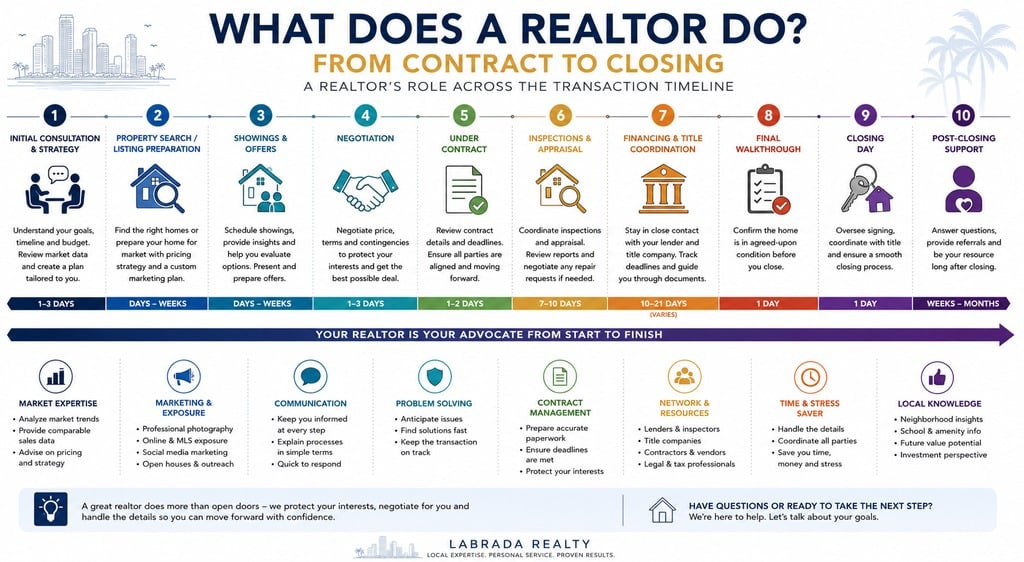
The job breaks into phases most first-timers never see coming.
Before a single showing happens, a realtor working with a buyer is supposed to be doing homework: pulling comparable sales, understanding financing pre-approval limits, and narrowing a search area based on budget and lifestyle instead of just running a portal search the client could do alone. On the seller side, the work starts with pricing strategy built from real comparable data, not a Zestimate, plus a plan for how the home gets positioned in its first weekend on the market.
Once a property is identified or a listing goes live, the realtor's role shifts into negotiation and paperwork. Every offer, counteroffer, inspection request, and repair negotiation runs through this person. A well-run negotiation protects thousands of dollars in either direction, and a poorly managed one leaves money on the table without either side realizing it happened.
After a contract is signed, the job becomes coordination. A realtor is tracking the inspection period, staying in contact with the lender on financing timelines, following up with the title company on document requests, and flagging anything that threatens the closing date. This is the stretch where deals quietly fall apart when nobody is managing the moving pieces, and it's also the stretch a first-timer has the least visibility into because it happens mostly by phone and email, not in person.
Closing day itself is usually the easy part. By the time paperwork is signed at the table, a good realtor has already resolved the problems that would have blown up the deal two weeks earlier.
Realtor vs. Real Estate Agent vs. Broker: Why the Words Don't Mean the Same Thing
These terms get used interchangeably, and that's part of why first-timers struggle to evaluate who they're hiring.
Every state requires a real estate license to legally represent a buyer or seller, and the exact coursework and exam requirements vary by state. In Florida, that means completing pre-licensing education and passing a state exam before someone can call themselves a licensed sales associate.
A "realtor" is a specific designation. It refers to a licensed agent who is also a member of the National Association of Realtors and has agreed to follow its code of ethics, which goes beyond baseline state licensing requirements. Not every licensed agent chooses to join, which means not every agent is technically a realtor, even though the terms get used as if they're identical in everyday conversation.
A broker sits a level above both. Becoming a broker requires additional experience hours and a separate exam beyond the standard sales associate license, and a broker can operate independently or supervise other agents under their license. When you're evaluating who to hire, the license type someone holds tells you how much additional training and accountability sits behind their name, and it's one of the first things worth asking about before you sign anything.
What Does a Realtor Do for a Buyer vs. a Seller?
The title is the same, but the day-to-day job looks different depending on which side of the transaction you're on.
For a buyer, the realtor's core job is protecting your offer and your leverage. In practice, this includes writing a competitive but not reckless offer, reading the comparable sales correctly, and managing the inspection period so you know exactly what you're walking into. Consider a real example: a first-time buyer in Kendall submitted an offer $12,000 below a comparable sale two doors down because their realtor pulled the wrong comp set. The seller went with a competing offer that used accurate numbers, and the buyer lost the house and spent another two months searching. The realtor's homework, or lack of it, was the entire difference.
For a seller, the job centers on pricing correctly the first time and managing exposure in the first two weeks on market. A home priced too high sits, picks up stale-listing stigma, and eventually sells for less than it would have at the right price from day one. A home priced correctly and marketed well can generate multiple offers in the first weekend, which is where a seller's realtor earns the fee, not by writing the listing description.
If your depth angle covers both sides at once, here's the connection: seller strategy directly shapes buyer behavior. A well-priced, well-prepared listing draws serious offers fast, which means buyers working with a sharp realtor need to move decisively instead of waiting to negotiate down a price that was never inflated in the first place.

The Mistake First-Timers Make When Choosing an Agent
The most common mistake is hiring based on referral or friendliness alone, without checking actual transaction history.
A friend's recommendation tells you the agent was pleasant to work with. It doesn't tell you whether they've closed deals in your price range, your area, or your property type in the last twelve months. First-timers who skip this check often end up with an agent who is generally competent but has never actually negotiated a multiple-offer situation or navigated a condo association approval, and they find out only when their own deal hits that exact problem.
The cost of this mistake shows up in specific ways: extra days on market because pricing was off, a lower final sale price because negotiation leverage wasn't managed correctly, or a blown closing date because nobody was tracking the financing timeline closely enough. None of these mistakes are visible until they've already cost you money or the deal itself.
Before you commit to anyone, ask to see actual closed transactions in your specific area and price range, not overall production numbers. It's also worth running a quick license verification through the state's online lookup, which takes under a minute and shows active status, license type, and any disciplinary history on file. Most first-timers never think to check this before signing a representation agreement, even though it's public information available to anyone.
If you want the full breakdown of what separates strong local expertise from generalist volume, the deeper guide to finding a top real estate agent in Miami walks through the exact metrics worth checking before you sign anything. It goes further into the specific vetting questions worth asking once you've narrowed your list to two or three candidates, a natural next step once you understand the basics covered here.
Questions to Ask a Realtor Before You Sign Anything
A short list of questions to ask a realtor separates a solid first conversation from a wasted one.
Start with: how many transactions have you closed in this specific area or price range in the last year? Vague answers here are a warning sign. Follow with: what's the current average time on market for a home like mine, and can you explain your pricing or offer strategy in plain terms rather than jargon?
For buyers, it's worth asking how the realtor handles multiple-offer situations, since the answer reveals whether they know how to write a competitive offer or default to the highest number and hope. For sellers, ask specifically how they plan to generate exposure in the first weekend on market, since that window drives most of a listing's final outcome.
One question first-timers rarely think to ask: does this realtor hold any licenses beyond a standard real estate license? An agent who also holds a mortgage license can catch financing problems before they become contract failures, and one with a title background can spot title issues early instead of at the closing table. Buyers exploring their first purchase benefit the most from this question, since financing snags are the most common reason a first-timer's deal stalls.
The Consumer Financial Protection Bureau's guidance on finding the right home makes a point worth repeating here: check your state's licensing agency for disciplinary history before signing with anyone, even a friend or family referral. It's a step first-timers skip more often than any other, usually because they assume a referral has already been vetted. It hasn't. A referral tells you the agent was likeable. It doesn't tell you they've closed a deal like yours.
How to Choose a Listing Agent vs. a Buyer's Agent
Knowing how to choose a listing agent means looking for a different skill set than you'd look for in a buyer's agent, even though both roles carry the realtor title.
A strong listing agent prices accurately from real comparable data, has a plan for generating serious offers in the first two weeks, and knows how to manage multiple offers without leaving money behind. When you're learning how to choose a listing agent, ask to see their list-price-to-sale-price ratio on recent closings. An agent who consistently sells close to asking price is pricing correctly the first time, which saves you the stress and cost of a mid-listing price drop.
A strong buyer's agent, by contrast, is judged on how well they protect your offer and your inspection period. Ask how they've handled financing contingencies and repair negotiations on past deals, since those are the moments where a buyer's agent either protects you or lets a problem slide through.
If you're preparing to sell, the seller resources at Labrada Realty walk through what a strong listing strategy looks like from pricing through closing, and a free home valuation gives you a real number to start that conversation with.
Where Licensing Depth Changes the Outcome
This is the part most generic guides skip, and it's where Miami-Dade transactions in particular can go sideways.
Insurance and financing speed
Florida's property insurance market has tightened considerably, and lenders now scrutinize insurability earlier in the process than they used to. A realtor who doesn't flag insurance exposure before an offer goes in can leave a buyer pre-approved on paper but unable to close once the real premium comes back. This isn't unique to Florida. Anywhere insurance costs are climbing, the same financing risk applies, which is why asking about it matters no matter where you're buying.
Condo association approval timelines
In buildings across Brickell, Miami Beach, and other high-rise submarkets, board approval can take 30 to 60 days after a contract is signed, and some buildings require interviews or impose rental restrictions. A realtor unfamiliar with a specific building's process can hand you a closing date that was never realistic.
Foreign buyer negotiation patterns
A significant share of Miami-Dade transactions involve buyers from Latin America, Europe, and Canada, who often pay cash and negotiate on a different timeline than domestic buyers. A realtor who misreads that dynamic can misprice leverage on either side of a deal.
License breadth changes how many of these risks get caught early instead of at the closing table. Alberto Labrada holds a Florida real estate broker license, a mortgage broker license, and a title agent license, which means financing exposure, title risk, and pricing strategy all run through one point of contact instead of three separate professionals who may never speak to each other directly.
FAQ
Q: Do I have to pay a realtor out of pocket as a buyer?
A: In most transactions, the seller pays the commission that gets split between the listing agent and the buyer's agent, so a buyer typically doesn't pay their realtor directly out of pocket. That said, commission structures have shifted since 2024 industry-wide settlement changes, and buyer representation agreements are now more common upfront. Ask any realtor you're considering to explain exactly how they get paid and whether you'll be asked to sign a buyer's agreement before you tour homes together.
Q: What's the difference between a real estate agent and a realtor?
A: Every realtor is a licensed real estate agent, but not every licensed agent is a realtor. The realtor designation specifically means the agent is a member of the National Association of Realtors and has agreed to follow its code of ethics, which adds a layer of accountability beyond baseline state licensing. In Florida, licensed agents complete pre-licensing coursework and pass a state exam, while brokers complete additional experience requirements and a separate exam.
Q: How do I know if a realtor is actually licensed and in good standing?
A: You can verify any Florida real estate license in under a minute through the state's licensing lookup at myfloridalicense.com. Search by name or license number to confirm active status, license type, and whether any disciplinary actions are on file. In a market where a meaningful share of buyers are relocating from out of state or from another country, this check matters more than most people realize, and it takes less time than reading a single online review.
Q: Can one realtor represent both the buyer and the seller in the same deal?
A: In Florida, this is legally possible under specific disclosed arrangements, most commonly as a transaction broker who facilitates the deal without full fiduciary duty to either side. Some buyers and sellers prefer single-agent representation instead, which carries a full fiduciary obligation to one party only. Ask any realtor you're interviewing which representation model they're offering before you sign anything, since the answer changes what they're legally obligated to do for you.
Q: How long does it typically take a realtor to sell a home?
A: In Miami-Dade, a well-priced home in good condition typically attracts serious offers within 10 to 20 days of listing when marketed correctly, though this shifts by price point and area. Homes priced too aggressively often sit past 45 days and require a price adjustment before they generate real interest. The realtor's pricing accuracy in the first week, more than any single marketing tactic, tends to be the biggest driver of how quickly a home actually sells.
Once you know what does a realtor do at every stage of a deal, the next step is talking to one who can show you real numbers instead of promises. If you're weighing your options, get a free home valuation takes about 60 seconds and gives you a real starting point for the conversation.
Check out this article next