

Most people assume that figuring out how to sell a house during a divorce is a normal home sale with two signatures instead of one. It is not. When a marriage ends, the house stops being only an asset and becomes the largest number in a negotiation that is already emotional, often adversarial, and running on a legal clock that has nothing to do with the market. Two people who may not want to share a room now have to agree on an agent, a price, a repair list, and how the money gets divided. Get that wrong and the home sits, equity erodes, and both sides lose. Here is what actually happens, in the order it happens, across Miami.
How to Sell a House During a Divorce Is Not a Normal Sale
In a standard listing, one owner makes every call. In a divorce, two owners with opposing interests each hold a veto, and the market does not pause while they fight it out.
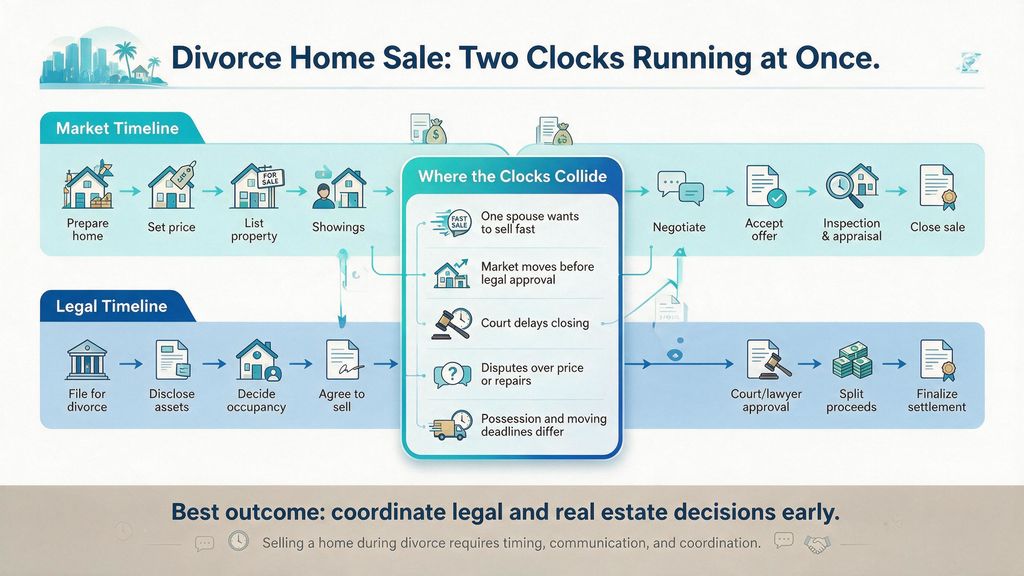
Learning how to sell a house during a divorce means accepting that the transaction now has two timelines stacked on top of each other. The market timeline rewards speed, clean preparation, and a strong first week. The legal timeline runs on filings, disclosures, and sometimes a judge's calendar. When those two clocks disagree, the house is the thing that suffers.
The second complication is motivation. One spouse may want out fast and will take the first reasonable offer. The other may want to stall, either for leverage or because leaving the home feels like losing. A buyer's agent reads that tension in about one showing. Once the market senses a divided seller, offers get sharper and lower, because the buyer assumes someone across the table needs the deal more than the home is worth.
Sell House Before or After Divorce: The Timing Call That Shapes Everything
Deciding whether to sell house before or after divorce is usually the first real financial decision a divorcing couple makes about their home, and it drives almost everything downstream.
Selling while still legally married keeps things simpler on paper. Both names are on the deed, both sign the listing agreement and the closing documents, and the proceeds get held and split according to the marital settlement. Selling after the decree means the ownership question is already resolved, so one person may be selling alone, or one may have bought the other out first.
The money side deserves its own look. A married couple filing jointly can generally shield up to $500,000 of gain from federal capital gains tax on a primary residence, while a single filer is limited to $250,000. For a long-held Miami home that has appreciated hard since 2015, the difference between closing before or after the divorce is final can be real money. I walk clients through this against the numbers in the guide on capital gains on a Florida home sale, and we map what each spouse actually pockets using a seller net sheet that shows what you keep after closing. The question of whether to sell house before or after divorce is as much a tax question as an emotional one.
I am a licensed Florida real estate broker, not a CPA or a family-law attorney. Timing decisions with tax and legal weight should be confirmed with your accountant and your attorney before you act.
Who Gets the House in a Divorce, and the Three Paths It Creates
Figuring out who gets the house in a divorce is rarely as simple as whose name is on the mortgage. Florida is an equitable distribution state, which means marital property is divided fairly, not always equally, and the home is usually the biggest piece on the table.
The court's approach to who gets the house in a divorce weighs how the property was acquired, each spouse's financial position, and whether children need to stay in a school zone. In practice, that produces three paths.
Buyout
One spouse keeps the home and refinances to pay the other their share of the equity. This works only if the keeping spouse can qualify for the new loan alone, which in today's rate environment is harder than most people expect.
Sell now and split
Both agree to list, sell, and divide the net proceeds. This is the cleanest path when neither party wants the ongoing cost or when neither can carry the home alone.
Deferred sale
The couple agrees to hold the home for a set period, often until a child finishes school, then sells and splits later. This carries risk, because two former spouses stay financially tied to one asset and one insurance policy for years.
I am a licensed Florida real estate broker and not an attorney. How your specific home is classified and divided is a legal determination for your family-law counsel, not something an agent decides.
How to Sell a House During a Divorce: The Step-by-Step in Miami-Dade
Once the decision to sell is made, the process has a specific order, and skipping steps is where divorce sales fall apart.
Step one, agree on the agent
Both spouses should be comfortable with a single, neutral listing agent. Hiring two agents, or letting each spouse lobby for their own, turns every decision into a proxy fight.
Step two, agree on the price with real data.
Price is where divorcing sellers dig in hardest, because each side reads the number as either a win or a surrender. A market analysis grounded in recent closed sales, not opinion, takes the argument off the personal level.
Step three, both signatures on the listing agreement.
In Florida, both owners on the deed must sign to list marital property. One spouse cannot list the home alone without authority.
Step four, set the showing and repair protocol in writing.
Who approves showings, who handles access, and who pays for pre-list repairs should be settled before the sign goes in the yard.
Step five, route the proceeds to escrow.
The net proceeds are typically held by the title company or attorney and split per the settlement, not handed to either spouse at the table.
This is the point where a neutral broker earns their keep. When I take a divorce listing, I set one rule early: I communicate with both parties equally and in writing, and I never carry a message that helps one spouse gain leverage over the other. I had a Kendall listing near Kendall Drive where the two owners had not spoken in months. I ran every update by email to both of them at the same time, kept the pricing tied to closed comparables rather than either person's opinion, and we closed in 41 days with a full-price offer neither expected. My triple licensure as a Florida real estate broker, mortgage broker, and title agent also means I can see the financing and title moving parts in one view, which matters when a buyout refinance and a sale are being weighed against each other. Labrada Realty exists to be the calm, neutral center of a transaction that has none of its own.
Where Divorce Home Sales Go Wrong
The most expensive mistakes in a divorce sale are not about the market. They are about one spouse using the house as a weapon.
The classic failure is sabotage pricing. One spouse insists on listing high, either to delay the sale or to punish the other, and the home launches above what the data supports. In Miami-Dade, an overpriced home burns its best window in the first 72 hours and then sits. A house that lingers past three weeks starts drawing lowball offers, because buyers and their agents smell a stalled situation. The consequence of selling house during divorce with a poisoned price is measured in days on market and lost leverage, and both spouses pay for it out of the same shared proceeds.
The second failure is blocking access. One spouse refuses showings, cancels appointments, or leaves the home in poor condition. Every missed showing in a hot week is an offer that never gets written.
Here is what the numbers look like. A four-bedroom home off Kendall Drive listed at $760,000 during a contested divorce because one spouse would not agree to anything lower. It sat 47 days, drew two lowball offers, and finally closed at $684,000. A nearly identical home two streets over, sold by cooperating owners at a data-driven $699,000, went under contract in nine days at $711,000 with competing offers. The gap of roughly $27,000 came straight out of the shared equity, and it was entirely self-inflicted. The lesson of divorce and selling home in Miami is that the fight over price almost always costs more than the price ever could. Anyone facing divorce and selling home at the same time should treat the launch as the one thing they cannot afford to get wrong.
The Miami-Dade Factors That Complicate a Divorce Sale
Selling here adds variables that do not exist the same way in other markets, and a divorce magnifies each one.
Insurance and financing speed.
Since South Florida's insurance market tightened, homeowners insurance has become one of the most common late-stage deal-killers on financed purchases. A buyer who cannot bind affordable coverage on an older roof can lose the loan in the final two weeks. In a divorce sale, a collapsed deal is worse than usual, because it reopens every argument the couple thought they had settled. Having roof and permit documentation ready before listing protects both spouses.
Condo association approval.
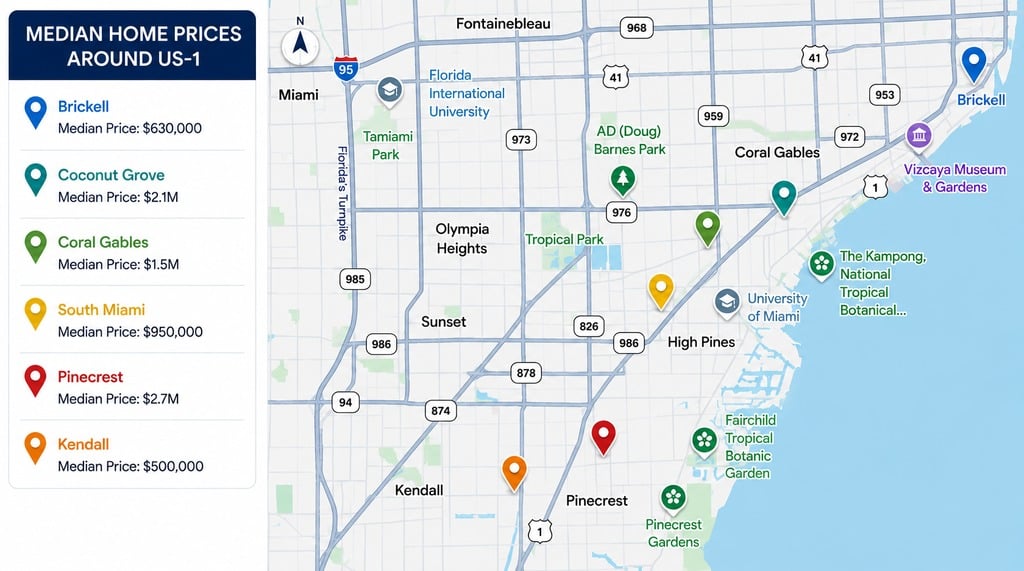
For couples selling a unit along the US-1 corridor or in a Brickell tower, the building's approval process can add 30 to 45 days through board review, interviews, and document checks. This extra window has to be built into the settlement timeline, or one spouse ends up blaming the other for a delay the building caused. Every ordinary rule of a Miami sale still applies on top of the divorce layer, and I cover those fundamentals in the mechanics of a Miami home sale. Handling selling house during divorce well means managing both the marital layer and the market layer at once, and neither forgives a slow start.
Cash-buyer negotiation.
Miami has a heavy concentration of cash buyers, and they negotiate harder because their certainty of closing is their leverage. Near Calle Ocho and across many single-family areas, cash offers often open 5 to 8 percent under asking. A divided seller who looks desperate invites exactly that. A neutral broker keeping both parties aligned removes the weakness a sharp buyer would otherwise exploit.
Knowing how to sell a house during a divorce in Miami-Dade comes down to one idea. The market does not care about the marriage, and it punishes indecision fast. Agree on a neutral agent, price to the data instead of the grievance, put the protocol in writing, and let a title company hold the proceeds. Do that, and the house becomes the one clean part of an otherwise hard chapter. Fight over it, and it becomes the most expensive part.
I am a licensed Florida real estate broker, not a CPA, tax advisor, or attorney. The tax and legal points above are general and should be confirmed with your own accountant and family-law attorney before you make decisions about your home.
FAQ
Q: Can I sell the house before the divorce is final in Florida?
A: Yes, and many couples do. If both spouses are on the deed and both agree, you can list and close while the divorce is still pending, with the net proceeds held in escrow and split later per your settlement. Selling before the decree can also preserve the $500,000 joint capital gains exclusion, which a single filer cannot claim after the split. The catch is that both owners must sign the listing agreement and the closing documents, so cooperation is required. If one spouse refuses, a Miami-Dade judge can be asked to compel the sale, though that path adds months.
Q: What happens to the sale proceeds when you sell a house during a divorce?
A: The net proceeds do not go to either spouse directly at closing. In a Florida divorce sale, the title company or closing attorney holds the funds and disburses them according to the marital settlement agreement or the court's order. If the split has not been finalized, the money often sits in escrow until the divorce is resolved. In Miami-Dade, where cash sales and quick closings are common, couples are sometimes surprised that a fast close still does not mean fast access to the money. Plan for that gap so neither spouse counts on funds that are still legally tied up.
Q: Can one spouse force the sale of the house in a Florida divorce?
A: In many cases, yes. When spouses cannot agree, a Florida family court can order the home sold as part of dividing marital property, especially when neither can afford to keep it alone or a buyout is not realistic. A judge can appoint terms for the listing and even name the agent if the parties stay deadlocked. Forcing a sale through the court is slower and costlier than agreeing to list, so it is usually the last resort. Most cooperating couples in Miami-Dade reach a listing agreement long before a judge has to step in.
Q: Do both spouses have to agree on the listing price and the agent?
A: When both names are on the deed, both generally have to sign the listing agreement, which means both effectively have a say in the agent and the price. Disagreement here is the most common reason divorce sales stall. The practical fix is a neutral agent who prices to recent closed comparables rather than to either spouse's opinion, which takes the number off the personal battlefield. If the two sides remain locked, the court can set the price and terms, but reaching agreement on a data-backed number is almost always faster and nets both people more.
Q: Is it better to sell before or after the divorce for tax reasons?
A: It depends on your gain. A married couple selling a primary residence can generally exclude up to $500,000 of capital gain from federal tax, while a single filer is capped at $250,000. For a Miami home bought years ago that has appreciated sharply, closing while still married and filing jointly can protect far more of the profit. For a modest gain, timing may not move the needle at all. Because the answer turns on your specific numbers, confirm it with a CPA before you decide. I can model the sale side, but the tax call belongs to your accountant.
If you and your spouse need one honest number to build the whole decision around, a VIP home valuation gives you a real, data-backed figure both of you can trust before you list, refinance, or negotiate a buyout.
Check out this article next