


Most people who inherit a home in Miami brace for a tax bill that never comes. They have heard horror stories from relatives up north, and they assume Florida works the same way. It does not. There is no Florida inheritance tax, and there has not been one in this state's modern history. The people who actually lose money here are rarely the ones worried about a state death tax. They are the heirs who sit on an inherited property too long, let the insurance lapse, and never document what the home was worth on the day they inherited it. Skip that step and a tax-free inheritance can turn into a real capital gains bill down the road. This article walks through what you owe, what you do not, and where the real money is won or lost.
Does Florida Have an Inheritance Tax? The Answer Most Heirs Get Half-Right
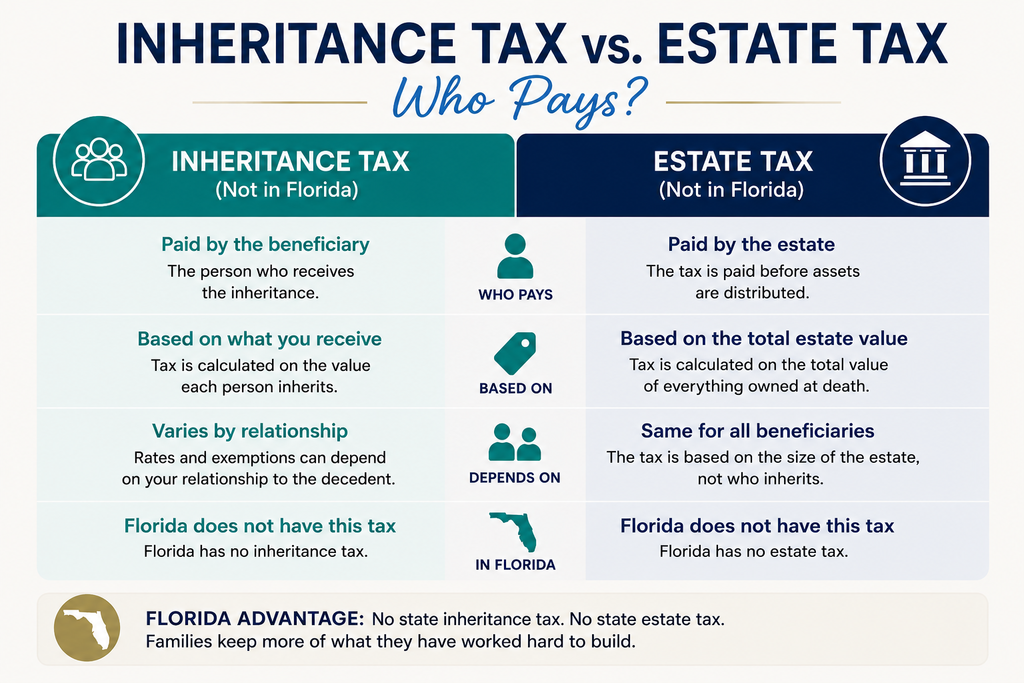
The question I hear most from families in Miami is blunt: does Florida have an inheritance tax on the house I just inherited? The short answer is no. Florida has no inheritance tax and no estate tax, and the ban sits in the state constitution, so the legislature cannot simply add one. A beneficiary who receives a home, a bank account, or a brokerage account from a Florida estate owes the state nothing, no matter how large the inheritance is.
Here is the half that people miss. Does Florida have an inheritance tax? No. Does that make the entire inheritance tax-free forever? Not necessarily. Two federal layers can still apply. The estate itself may owe federal estate tax if it is very large, and any income the inherited property later produces, whether rent, dividends, or a gain when you sell, is still taxable under federal law. The State of Florida stays out of it. Washington does not.
Florida Inheritance Tax vs. Florida Estate Tax: Not the Same Thing
People use the two terms interchangeably, and that is where the Florida inheritance tax confusion starts. They are different taxes with different payers. An inheritance tax is charged to the person who receives the assets, based on what they get. An estate tax is charged to the estate itself, before anything is distributed, based on the total value of everything the person owned at death.
Florida imposes neither. The Florida estate tax that once existed was a pickup tax, a mechanism that let the state capture a slice of what the estate already owed the federal government. When a federal change removed the credit that funded it, the Florida estate tax ended for anyone who passed after December 31, 2004. Personal representatives no longer even file the old no-tax-due affidavits, per the Florida Department of Revenue.
The federal estate tax still exists, but it reaches only very large estates. For 2026, the federal exemption sits at $15 million per person, or $30 million for a married couple, with a top rate of 40%, according to the IRS estate tax rules. A family home in Hialeah or a condo off Sunset Drive is nowhere near that line. Well over 99% of Florida estates owe zero federal estate tax.
The Stepped-Up Basis Rule That Quietly Saves Heirs the Most
The tax that heirs should actually care about is not a death tax at all. It is capital gains, and it turns on a rule called stepped-up basis. When you inherit a property, your cost basis is not what the original owner paid. It resets to the fair market value on the date of death.
Walk through a real Westchester example. A mother buys a home near Coral Way in 1994 for $110,000. She lives there for three decades and passes in 2026, when the home is worth $560,000. Her son inherits it. His basis is not $110,000. It steps up to $560,000. If he turns around and sells for $575,000, his taxable gain is roughly $15,000 before selling costs, and after commission and closing costs it lands close to zero.
Compare that to what happens if the mother had signed the house over to him while she was alive. A lifetime gift carries over her original basis. His gain would be measured from $110,000, exposing more than $450,000 in appreciation. Stepped-up basis is the single biggest reason inheriting a property beats being handed one during life. The IRS explains the basis of inherited property directly. How that gain is actually taxed at sale, including the rates, the primary-residence exclusion, and how foreign sellers are treated, is covered in depth in our guide to capital gains tax on a Florida home sale.
What You Owe When You Sell an Inherited Home in Miami-Dade
So you decide to sell. What do you actually owe? On the state side, nothing changes by selling, because there is no inheritance tax Florida charges at any stage of the transaction. Federally, you owe capital gains only on the appreciation that happens after the date of death, measured against that stepped-up basis. In a flat market, the number is often small. In a fast-rising corridor, it grows the longer you hold.
A lot of the confusion around inheritance tax Florida questions surfaces right here, at the closing table, because heirs expect a state tax that does not exist and overlook the federal gain that sometimes does. If the home has to pass through probate before it can be sold, that adds process and timing you need to plan around. Our walkthrough on selling a house in probate in Miami covers how the court timeline shapes your listing.
The other figure that surprises heirs is what actually lands in their pocket after commission, title, and any liens are cleared. An inherited home may carry an unpaid mortgage, a reverse mortgage balance, or a code lien nobody knew about. Our breakdown of what you keep after closing shows how those line items stack up against the sale price.
One more wrinkle drives more inherited sales off the rails than any tax: multiple heirs. When two or three siblings inherit a single house together, each owns an undivided share, and a sale generally needs all of them to agree on price, timing, and terms. I have watched a clean listing near Bird Road stall for months because one sibling wanted to sell immediately and another wanted to rent it out. When heirs cannot agree, the fallback is a partition action in court, which is slow, expensive, and almost always nets everyone less than a coordinated sale would. Getting the heirs aligned on a number before the home hits the market is worth more than any staging dollar.
This section covers tax topics in general terms. Alberto Labrada is a licensed Florida real estate broker, not a CPA or tax attorney. Confirm your specific situation with a qualified tax professional.
Miami-Dade Realities: Foreign Heirs, Condo Approvals, and the Insurance Clock
Three Miami-specific dynamics can turn a simple inheritance into a complicated one, and none of them show up in a generic online guide.
Foreign heirs and the estate side
Miami-Dade holds one of the largest foreign-owner bases in the country. If the person who died was a non-resident alien, the federal estate tax exemption on their U.S. property is not $15 million. It is $60,000. A single condo in Brickell owned by a foreign decedent can trigger a federal estate tax filing that a U.S. citizen's estate would never face, and heirs often cannot clear title to sell until that filing is resolved, which can stall a sale for months.
Condo and HOA approvals
Inheriting a unit inside a condo or an HOA community adds an approval layer. The association issues an estoppel letter listing unpaid dues, fines, and pending special assessments, and in many South Florida buildings those post-Surfside structural assessments run from a few thousand dollars to well over $50,000 per unit. A pending assessment attaches to the unit, so it becomes the heir's problem, and it can delay a buyer's financing while the lender confirms the building's reserves.
The insurance clock on a vacant home
This is the one that quietly costs the most. Once an inherited home sits empty, the existing homeowners policy is often at risk. Most Florida carriers will not renew a standard policy on a dwelling vacant for 30 to 60 days, and a lapse leaves the property exposed during hurricane season. Add an aging roof, common in the older Hialeah and Westchester housing stock, and getting a new buyer's policy bound can push a closing back by weeks.
What the Florida Inheritance Tax Answer Means for Your Next Move
The Florida inheritance tax answer is reassuring, and that is exactly what lulls heirs into a costly delay. The mistake I see most is waiting. An heir inherits a home, feels no urgency because no state tax bill is chasing them, and lets the property sit for a year or more. During that time the property taxes climb, the HOA dues keep running, the insurance lapses, and, worst of all, nobody ever pulled an appraisal establishing the fair market value on the date of death. The property tax jump alone catches heirs off guard. A parent who owned the home for decades likely carried a Save Our Homes assessment far below market value, capping their annual increases. This protection is tied to the owner, not the house, so once the parent passes and the homestead exemption comes off, the assessed value can reset toward full market value and the tax bill can rise sharply the following year. An heir planning to keep the home should budget for a payment that may look nothing like the one their parent paid.
The missing valuation is the expensive one. Without a dated figure, the stepped-up basis becomes hard to prove, and a future capital gains calculation can balloon. I tell heirs to lock in a date-of-death valuation early, even when they are years away from selling. The IRS also allows an alternate valuation date six months after death if the estate files a return, which can matter when values swing, so a heir who documents both figures keeps every option open.
Handling an inherited sale is different from a standard one, and this is where working with someone who carries real estate, mortgage, and title licensing under one roof genuinely matters. An inherited property often comes with title knots: multiple heirs, an open probate, an unsatisfied lien, a reverse mortgage payoff. When the same person can read the title, weigh the financing implications for your buyer, and manage the closing, those knots get untied before they detonate a contract. It is the difference between an inherited home in Kendall that sells clean and one that dies in escrow.
The Florida inheritance tax question has a simple answer, but what you do next is where the real money lives. Understand your stepped-up basis, document the date-of-death value, watch the insurance and the carrying costs, and decide with real numbers in front of you.
FAQ
Does Florida have an inheritance tax on a house I inherited?
No. Florida has no inheritance tax and no estate tax, and the prohibition is built into the state constitution, so it cannot be added by a simple vote in Tallahassee. Whether you inherit a $300,000 house in Kendall or a multi-million-dollar waterfront home, the State of Florida collects nothing from you for receiving it. The only taxes that can reach an inherited Florida property are federal: estate tax on very large estates, and capital gains if the home appreciates after you inherit it and you later sell.
How much can you inherit in Florida without paying taxes?
At the state level, there is no cap at all. You can inherit any amount in Florida and owe zero state tax, because neither an inheritance tax nor an estate tax exists here. The only ceiling is federal, and it sits high. For 2026, an estate must exceed $15 million per person before federal estate tax applies, and even then only the amount above that threshold is taxed. For the overwhelming majority of Miami-Dade families, the entire inheritance passes without a single dollar of death tax, state or federal.
Do I pay capital gains tax if I sell an inherited house in Miami?
Possibly, but usually far less than heirs expect. Your cost basis resets to the home's fair market value on the date the previous owner died, so you owe federal capital gains only on appreciation after that point. Sell soon after inheriting in a stable market, and the taxable gain can be near zero. Hold it for years while values climb along corridors like Sunset Drive, and the gain grows. Keeping a dated appraisal from the date of death is what protects that low basis if the IRS ever asks.
What happens if I inherit a house with a mortgage in Florida?
The mortgage does not vanish when the owner dies. It stays attached to the property, and the balance has to be handled before or at sale. Federal law generally lets an heir who inherits and lives in the home take over the existing loan without tripping a due-on-sale clause, but a reverse mortgage usually must be repaid within a set window, often six to twelve months. Selling the home is the most common way heirs satisfy the balance, with the payoff coming straight out of the closing proceeds.
Do I owe Florida inheritance tax if I live in another state?
Florida charges you nothing regardless of where you live, because the state has no inheritance tax to charge. The complication runs the other direction. Six states, Maryland, Iowa, Kentucky, Nebraska, New Jersey, and Pennsylvania, do impose an inheritance tax on their own residents based on what they receive, sometimes even from an out-of-state estate. If you live in one of those six and inherit a Miami property, check your home state's rules. The Florida side stays clean; your state of residence is where any exposure would arise.
If you have inherited a home in Miami-Dade and you are weighing whether to sell, hold, or wait, start with a real number. A VIP home valuation gives you the current market value and, just as important, a documented figure you can pair with your date-of-death basis before you make any move.
This article is for general informational purposes only and does not constitute tax, legal, financial, or accounting advice. Inheritance and estate tax rules, exemption amounts, and related thresholds change over time and vary by individual circumstances. Nothing here should be relied on as a substitute for advice from a licensed CPA, tax attorney, or financial advisor regarding your specific situation. Alberto Labrada is a licensed Florida real estate broker and is not a CPA or tax attorney. Figures cited reflect publicly available sources as of the date noted and may have changed. Consult the Florida Department of Revenue, the IRS, or a qualified tax professional before acting on this information.
Check out this article next