


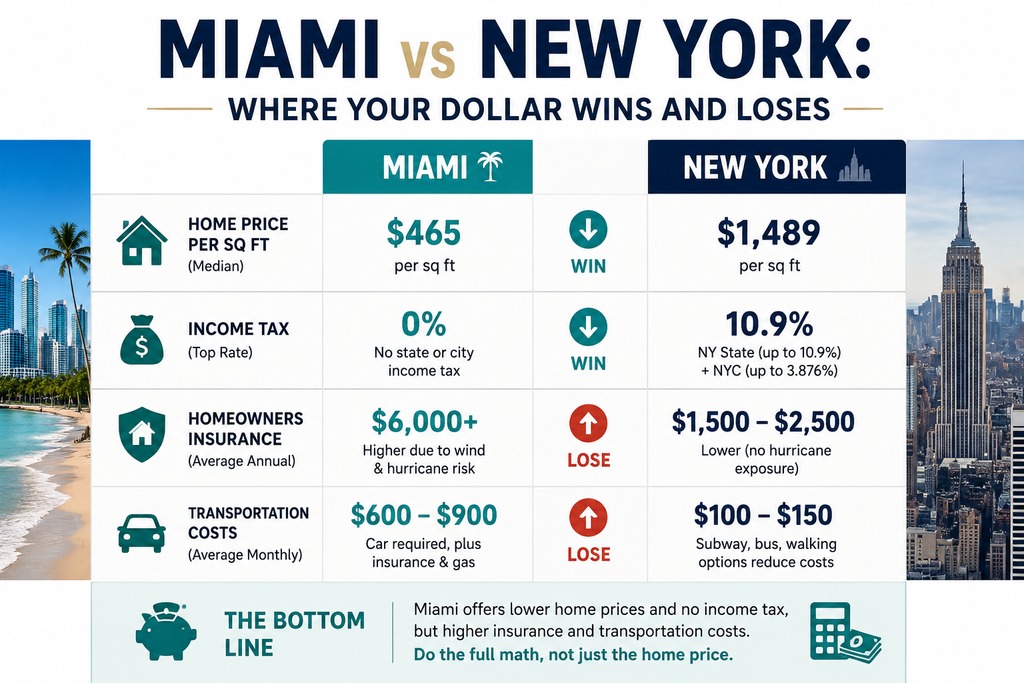
Most New Yorkers arrive at the idea of buying in Miami with one number in their head: the price per square foot. In Manhattan it runs around $1,489. In Miami-Dade it is closer to $465. So the assumption writes itself, Miami is the cheap option. Learning how to buy a house in Miami starts with unlearning that reflex. The purchase price is only the part of the math that favors you. The carrying costs, insurance, property taxes that reset the day you close, and a car you never needed on the subway, are where the real difference lives. For anyone moving to Miami from New York, getting that full picture right before you make an offer is the difference between a smart relocation and an expensive surprise.
Why New Yorkers Get the Miami Cost Math Backward
For years the pitch was simple. Leave New York, keep your salary, pay no state income tax, and watch your money go further. The first half still holds. The second half stopped being automatically true. In the federal government's most recent regional price comparison, the Bureau of Economic Analysis found the Miami metro area's overall cost of living has passed the New York metro area for the first time on record, trailing only San Francisco.
None of that means a house here costs more than a comparable one in Manhattan. It does not. It means the gap narrowed everywhere except the sticker price of the home itself. Housing still scores higher in Miami on the index, and South Florida's consumer prices have climbed 36 percent since 2019, faster than any large metro except Tampa. Property taxes across the region are up 62 percent over the same stretch.
The no-income-tax advantage is real money, and I will get to exactly how real. It can also create an illusion. A New York City earner escapes both the state income tax, which tops out near 10.9 percent, and the city income tax layered on top of it. Bank that saving and forget the rest, and the cost of living in Miami vs New York looks like a landslide. Add back what the index actually measures, and it looks like a trade, a good one for many people, but a trade.
How to Buy a House in Miami on a Budget Built Around a New York Salary
Here is the piece most people get wrong. New Yorkers often assume that no state income tax means a lender will approve them for a bigger mortgage in Florida. It does not work that way. Lenders qualify you on gross income, the number before any state or city tax, so your pre-approval amount looks the same whether the paycheck was issued in Brooklyn or Brickell.
What changes is how the payment feels against your real take-home. A New York City household keeping an extra $12,000 to $18,000 a year in former state and city income tax does not get a larger loan. It gets more breathing room underneath the same loan, and in Miami that breathing room is not a luxury. It is what absorbs the insurance bill and the property tax a New York buyer never had to plan around.
Knowing how to buy a house in Miami on a New York salary means budgeting the payment against your Florida take-home, then stress testing it with taxes and insurance as separate line items rather than a rounding error. For a fuller breakdown of what living here actually costs month to month, whether the cost of living in Miami is worth it lays out the categories that sit beyond the mortgage payment itself.
Cost of Living in Miami vs New York: The Line Items That Move the Most
Strip the comparison down to the lines that actually change your monthly budget and a clear pattern shows up. On the cost of living in Miami vs New York, three categories swing hard in Miami's favor and three swing hard against it.
In your favor: no state or city income tax, utilities that run meaningfully cheaper than New York's, and everyday goods that price slightly lower. Against you: homeowners insurance, property taxes on a newly purchased home, and the simple fact that Miami is a car city. A household that never owned a vehicle on the Upper East Side suddenly needs one, sometimes two, with insurance, parking, and gas attached.
Insurance is the line that shocks New Yorkers most. Florida carries the highest average home insurance premiums in the country, near $8,300 a year, roughly four times what a New York State homeowner pays. One piece of good news arrived recently. With more than a dozen private insurers back in the Florida market, Citizens Property Insurance rolled out premium reductions in spring 2026 that averaged around 14 percent for Miami-Dade policyholders. The market is easing, but insurance is still the single biggest carrying-cost gap in any honest look at the cost of living in Miami vs New York.
How to Buy a House in Miami From Out of State Before You Move
Plenty of New Yorkers try to time the purchase perfectly, closing on the Miami house the same week the New York lease ends. It rarely lines up, and forcing it usually costs you leverage. The better sequence is to get fully pre-approved while you are still in New York, tour on focused trips or by video with an agent who previews in person, and keep your move date flexible enough that you negotiate from patience rather than panic.
Financing from out of state works exactly like an in-state purchase, with one caution. A New York buyer competing in Miami is often bidding against cash. Cash made up 44 percent of Miami-Dade closings in early 2026, well above the national average of about 27 percent, and in the condo and luxury tiers it is the majority. A financed offer can still win, but it wins on terms, a clean inspection window, a realistic closing date, a seller-friendly rent-back, not on price alone. For the mechanical sequence once you are under contract, the full Miami-Dade buying timeline from pre-approval to closing walks through each stage and how long it really takes.
Here is the mistake I catch most often with buyers moving to Miami from New York, and it is expensive. They read the property tax line on a listing, see something like $9,000 a year, and budget around it. What they do not know is that Florida's Save Our Homes cap freezes a homeowner's assessed value at up to 3 percent growth per year, so a seller who bought in 2009 has been taxed on a value far below today's market. The day you close, the cap disappears and the assessment resets to what you paid.
I worked with a couple relocating from the Upper West Side who found a $950,000 house in Coral Gables, near the Miracle Mile, and assumed the taxes would match the roughly $9,000 the seller was paying. Reset to market, their first bill came to just over $19,000. We caught it before the offer went in, adjusted their budget, and they still bought. A buyer who does not know to check that number can be $10,000 a year over budget from the very first statement. You can confirm how the cap and reset work directly through the Miami-Dade Property Appraiser, and you should, before you sign anything.
Where New Yorkers Actually Land in Miami, and What It Costs
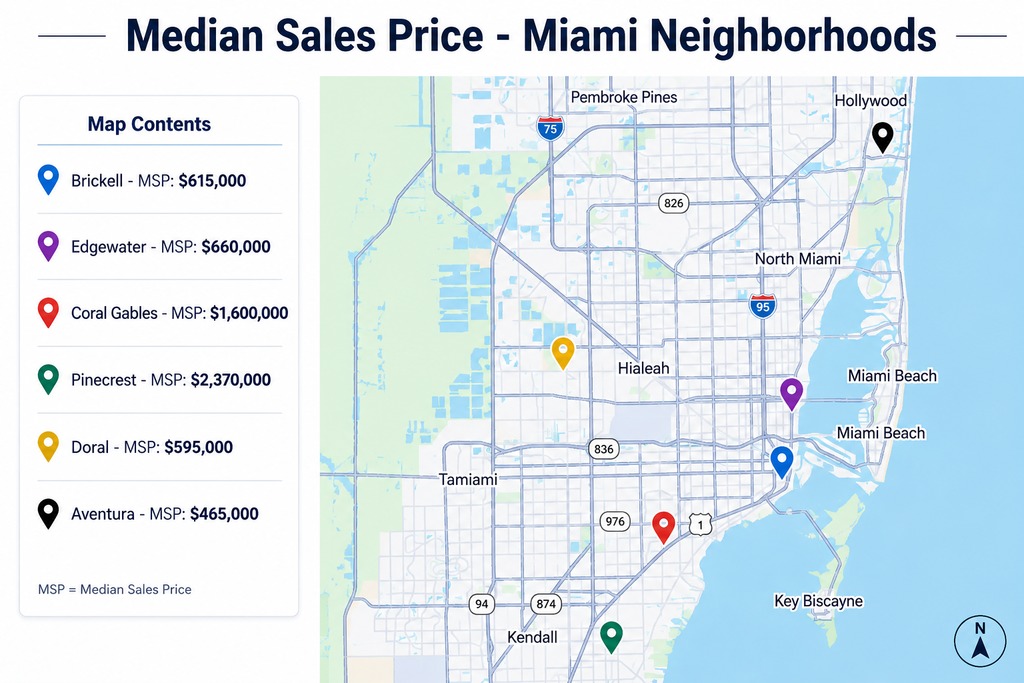
After hundreds of relocation buyers, the map of where New Yorkers land is fairly predictable, and it usually tracks the life they had up north.
If you want walkability and a doorman-building rhythm, you look at Brickell first. It is the closest thing Miami has to Manhattan density, with high-rise condos, the shops at Brickell City Centre, Mary Brickell Village, and a free Metromover loop that lets some residents go car-light. Just north, Edgewater offers the same bayfront high-rise living with a bit more space per dollar and quick access to Margaret Pace Park, which is why it pulls a lot of former downtown and Brooklyn renters who finally want to own.
Families leaving Westchester or Long Island tend to gravitate to Coral Gables for its tree-lined streets and established feel, or to Pinecrest, where large single-family lots and top-rated public schools draw buyers willing to spend. The higher end of Pinecrest runs from roughly $5 million to $8 million and up. Doral appeals to buyers who want newer construction and planned communities, and Aventura has been a Northeast-transplant magnet for decades, pairing condo living with the Aventura Mall and an easy reach to the beaches.
The important shift for 2026 is leverage. Miami-Dade single-family homes sit around 4.9 months of supply, still a seller's market, while existing condos sit near 12.3 months, firmly a buyer's market. A New Yorker set on a Brickell or Edgewater condo has real room to negotiate right now, provided the building's finances check out, which is its own Miami story. Before you commit to any single area, a framework for choosing your Miami area is worth a read to match the area to how you actually live.
The Miami Realities That Blindside New York Buyers
A few local mechanics decide Miami deals in ways that never come up in a New York co-op board packet.
Condo buildings now come with a financial background check
Since the 2021 Surfside collapse, Florida requires older condo buildings of three stories or more to complete milestone structural inspections and fully fund their reserves. The result is a wave of special assessments moving through Brickell, Edgewater, and the beaches. This is part of why condo inventory sits so high. A New York buyer eyeing a well-priced unit has to read the building's reserve study and inspection status the way an investor reads a balance sheet, because a $60,000 special assessment can erase a great price overnight.
Insurance underwriting sets your closing speed
A roof older than 15 years can trigger a separate wind mitigation inspection and slow your loan, since the lender needs a bindable policy before funding. Buyers who line up insurance early close on schedule. Buyers who treat it as a formality lose days they never budgeted.
The calendar runs opposite to what you expect
Miami stays busy through late fall as snowbirds and relocators arrive, while entry-level demand softens in the summer heat. A financed buyer under $700,000 often finds the most room to negotiate from July through September, the exact months New York families are trying to close before a school year starts.
You are often negotiating against someone paying cash from abroad
Foreign buyers accounted for more than half of new-construction sales in late 2025. Their offers move fast and clean, and understanding that rhythm changes how you structure your own bid.
Every one of these variables lives at a handoff, between your agent, your lender, your insurance, and your title company. When those are four separate companies and you are coordinating from New York, the delays compound. I hold licenses as a Florida real estate broker, mortgage broker, and title agent, which means the pre-approval, the offer, the financing, and the title work run through one office and one conversation. For an out-of-state buyer who cannot drop by three vendors in person, that structure is not a convenience, it is what keeps a remote closing from unraveling.
How to Buy a House in Miami Without Giving Back the Savings
The New Yorkers who relocate well are not the ones chasing the lowest price. They are the ones who ran the whole calculation before they fell in love with a listing. Learning how to buy a house in Miami as a former New York resident comes down to holding two truths at once: the purchase price genuinely favors you, and the carrying costs genuinely do not, so the win is real only if you plan for both.
Get pre-approved on your Florida take-home, price the insurance and the reset property tax before you tour, read the condo building's finances if you go that route, and negotiate on terms in a market that still runs heavy on cash. Do that, and the move delivers what the brochure promised. Skip it, and you hand the savings back one surprise at a time. The difference is preparation, and preparation is the part you fully control.
Frequently Asked Questions
Is it cheaper to buy a house in Miami than to rent in New York?
Monthly, the raw housing number usually favors Miami. Average New York City rent sat near $4,843 in early 2026 against roughly $2,732 in Miami, and buying converts that spend into equity instead of a landlord's pocket. The honest catch is that a Miami mortgage arrives with homeowners insurance near $8,300 a year and a property tax bill that resets to your purchase price. Run the full carrying cost, not just principal and interest, before you call it cheaper.
How much does moving to Miami from New York actually save on taxes?
A New York City resident pays state income tax topping out near 10.9 percent plus a city income tax reaching about 3.876 percent, and Florida charges neither. For a household in the $200,000 income range, that difference commonly lands between $12,000 and $18,000 a year in kept income. The savings are genuine, but they are best treated as the fund that covers Miami's higher insurance and property taxes rather than as pure profit you can spend elsewhere.
Can I buy a house in Miami before I move out of New York?
Yes, and most of my relocation clients do exactly that. You can complete pre-approval, touring by video or on short trips, offer, inspection, and even the closing itself from New York, since remote and mail-away closings are routine here. You do not need Florida residency to purchase. Residency matters later, for the homestead exemption, but it never blocks the actual buying process from starting while your feet are still in Manhattan.
What is the cost of living in Miami vs New York for a family of four?
On the federal price-parity index, the Miami metro now edges out the New York metro overall, largely because of housing, insurance, and car costs. A family still buys far more square footage per dollar here, roughly $465 against Manhattan's $1,489 per square foot, but adds two cars, higher insurance, and often private school tuition. The purchase is cheaper while the monthly life is closer to even than the sunshine narrative suggests.
Do I need to be a Florida resident to buy a house in Miami?
No. Buying requires no residency at all, and plenty of second-home and investment purchases here are made by people who never move. Residency becomes relevant only for tax benefits. To claim the homestead exemption and its Save Our Homes cap, you must own and occupy the home as your permanent residence by January 1 and file with the county by March 1. Miss that window and the protection waits a full tax year.
Before you fall for a specific house, put your real Miami number on paper. Run your budget through my mortgage calculator with taxes, insurance, and any HOA entered as their own line items, and you will see the payment the way a Miami closing actually delivers it, not the way a listing makes it look.
Check out this article next