
Most buyers assume affordable homes in Miami disappeared years ago, priced out by cash investors and international buyers. This assumption stops people who actually qualify for real assistance from ever applying. Teachers, nurses, firefighters, police officers, and veterans across Miami-Dade have access to two programs that change what a home actually costs at closing and every month after: the Florida Hometown Heroes program and VA loan Florida financing. Few buyers understand how these programs stack, or that skipping the right sequence with a lender can knock them out of eligibility entirely. This article walks through what each program covers, who qualifies, and the mistake that costs eligible buyers thousands before they ever reach the closing table. If you haven't already, it's worth pairing this with my broader first-time home buyer tips for Miami, since program eligibility is just one piece of a first-timer's overall strategy.
Why Affordable Homes in Miami Don't Mean What Most Buyers Think
Searching for affordable homes in Miami usually pulls up the same discouraging result: median prices that feel out of reach on a teacher's or firefighter's salary. Most buyers stop there and assume the search is over before it started.
The number that actually matters isn't the list price. It's the gap between list price and what a buyer in an eligible profession pays after down payment assistance and a zero-down VA loan Florida option are applied. This gap can run into tens of thousands of dollars.
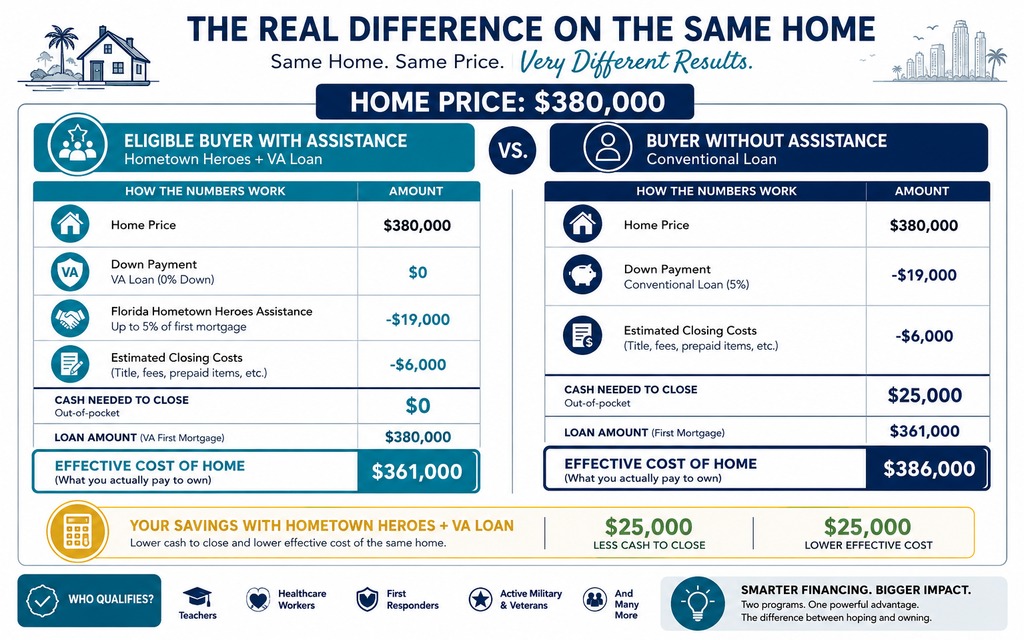
A nurse earning $68,000 a year and a corporate employee earning the same salary are not looking at the same effective price on the same $380,000 home once one of them qualifies for Hometown Heroes assistance and the other doesn't. The home is priced the same. The buyer's actual cost is not.
Most agents never walk a buyer through this comparison because most agents aren't licensed to originate the loan itself. They can point a buyer toward a lender, but they aren't the one running the numbers, checking eligibility, or catching a disqualifying detail before an offer gets written. This gap between agent and lender is where a lot of eligible buyers fall through, not because the programs are hard to qualify for, but because nobody connected the two conversations early enough.
The Florida Hometown Heroes Program: What It Actually Covers
The Florida Hometown Heroes program, administered through Florida Housing Finance Corporation, provides down payment and closing cost assistance to first-time, income-qualified buyers working in a defined list of community-critical professions: teachers, healthcare workers, first responders, active military, veterans, and a range of public service roles. The assistance comes as a second mortgage, and in most cases it carries a 0% interest rate with no monthly payment, repaid only when the home is sold, refinanced, or the first mortgage is paid off. First-time buyer status here follows the standard federal definition, meaning it generally includes anyone who hasn't owned a primary residence in the past three years, not only someone buying their first home ever.
Income limits apply and are set by county, adjusted annually based on area median income. Miami-Dade's limit is higher than many counties because of the area's cost of living, which opens the program to more buyers than people expect.
The assistance amount is capped, typically up to 5% of the first mortgage amount, with a maximum dollar cap set by the state. On a $380,000 purchase, that can mean roughly $19,000 toward down payment and closing costs, money that would otherwise come straight out of a buyer's savings.
Eligible buyers still need to qualify for a first mortgage through an approved lender. The Florida Hometown Heroes program is not a stand-alone loan. It layers on top of a conventional, FHA, or VA loan Florida buyers already qualify for.
One detail buyers rarely hear from a listing agent: the second mortgage behind Hometown Heroes assistance doesn't disappear at closing. It sits silently against the property until a sale, refinance, or payoff event triggers repayment. For a buyer planning to stay put for several years, this rarely matters. For a buyer expecting to sell within eighteen to twenty-four months, it changes the net proceeds calculation at resale, and it's worth running that scenario before accepting the assistance, not after listing the home again.
VA Loans in Florida: The Advantage Most Veterans Underuse
Veterans and active-duty service members have access to a VA loan Florida benefit that most civilians would consider unbeatable: zero down payment, no private mortgage insurance, and a funding fee that can be rolled into the loan itself rather than paid up front. Eligibility depends on service history and duty status, and the VA's own eligibility requirements cover Reserves, National Guard service, and certain surviving spouses in addition to active-duty veterans.
This combination matters more in Miami-Dade than almost anywhere else in the state, because PMI on a conventional loan here often runs higher than the national average due to elevated insurance costs tied to hurricane exposure. A VA loan Florida borrower skips that cost entirely.
Homestead, close to Homestead Air Reserve Base, has one of the highest concentrations of active military and veteran homebuyers in Miami-Dade. Many of these buyers don't realize their VA entitlement can be combined with Hometown Heroes assistance on the same purchase, effectively removing both the down payment and a meaningful chunk of closing costs.
The trade-off worth understanding: VA loans require the property to meet minimum property requirements, which can eliminate some fixer-upper listings that cash or conventional buyers would otherwise consider. Sellers in competitive price points sometimes hesitate on VA offers for this reason, which is exactly why sequencing and presentation matter later in this article.
The funding fee itself scales with down payment and whether it's a first or subsequent use of the benefit, typically landing between roughly 1.25% and 3.3% of the loan amount for buyers putting little or nothing down. Veterans with a service-connected disability rating are exempt from the funding fee entirely, a detail that gets missed often enough that I check it on every VA file before we even discuss loan amount.
Real Numbers: Stacking a VA Loan With Hometown Heroes in Homestead
A firefighter and his spouse, an active-duty service member, found a $365,000 single-family home near Homestead. Using the VA loan Florida benefit, they put zero down. Hometown Heroes assistance covered roughly $14,000 of closing costs, prepaid taxes, and insurance, funds that would have otherwise come from their own savings.
Their total cash to close came in under $1,500, mostly earnest money that was later credited back at closing. On a conventional loan without either program, the same purchase would have required roughly $25,000 to $30,000 in cash between down payment and closing costs.
The monthly payment difference mattered too. Because the VA loan carried no PMI, their monthly payment came in about $180 lower than a conventional loan on the same price point would have carried, even with a slightly higher note rate.
The Mistake That Locks Buyers Out of Affordable Homes in Miami
The most common mistake eligible buyers make: applying with a lender who doesn't originate Hometown Heroes assistance before locking in a first mortgage. Once a loan is underwritten and moving toward closing with a lender who doesn't participate in the program, adding the assistance later usually isn't possible.
This costs buyers real money, not just inconvenience. A buyer who discovers the mistake after already being under contract with a non-participating lender typically loses the ability to add assistance retroactively, and either brings tens of thousands more to closing than necessary or restarts the loan process, which can add two to four weeks to a transaction and risk the contract entirely if the seller isn't willing to extend the closing date.
The fix is sequencing, not luck. Getting pre-approved through a lender who explicitly originates Hometown Heroes assistance, before writing an offer, protects the eligibility from day one instead of trying to rescue it mid-contract.
This is one version of a broader pattern I cover in first home buyer mistakes that cost the most: sequencing errors rarely feel urgent until they've already cost money. I've seen a version of this play out with a teacher who found a home in Kendall, got pre-approved with a lender referred by the listing agent, and only asked about Hometown Heroes assistance a week before closing. The lender didn't originate the program. Switching lenders that late meant a new appraisal, a new underwriting file, and a closing delay that nearly cost her the contract when the seller's relocation timeline wouldn't stretch. She closed, but with less negotiating room than she would have had walking in with the right pre-approval from day one.
How to Actually Buy Affordable Homes in Miami the Right Way
This is where having a broker who is also a licensed mortgage broker changes the outcome. Sequencing a Hometown Heroes application, a VA loan Florida pre-approval, and an offer strategy that doesn't scare off a seller worried about VA property requirements is not something a buyer should be piecing together from three different professionals who have never spoken to each other.
Working through pre-approval, program eligibility, and offer strategy under one roof means nothing gets lost in translation between a lender, an agent, and a title company. The buyer walks into a negotiation already knowing their real number, not an estimate that changes twice before closing.
Buyers exploring affordable homes in Miami through these programs do best when the pre-approval conversation happens before the home search, not after finding a listing they love. This single sequencing decision is often the difference between a smooth closing and a scramble.
Affordable homes in Miami still exist for buyers who know which programs apply to them and get the sequencing right from the first phone call. The homes themselves haven't gotten cheaper. What's changed is how many eligible buyers still don't know these programs exist, or assume they don't qualify without ever checking. A teacher, a nurse, a firefighter, or a veteran reading this today has a real path to ownership in this market, one that a cash investor or an out-of-state buyer simply doesn't have access to.
Miami-Specific Realities That Affect These Programs
Insurance market impact on financing speed
Miami-Dade's property insurance market has tightened considerably in recent years, and lenders now require binder quotes earlier in the process than they used to. A VA loan Florida file can stall at underwriting if a wind mitigation inspection or insurance binder isn't ordered in the first week after contract, regardless of how strong the buyer's approval otherwise looks.
Condo association rules and approval timelines
Buyers hoping to use Hometown Heroes or VA financing on a condo need the building's association to clear specific approval requirements, and some associations still carry restrictions tied to prior Fannie Mae or VA project approval status. This can add one to three weeks to a condo closing that a single-family purchase wouldn't face.
Seasonal demand patterns by price point
Homes in the price range these programs typically apply to, roughly $300,000 to $420,000, see the heaviest buyer competition between January and April, a pattern consistent with the seasonal trends Florida Realtors tracks statewide each year, when both seasonal residents and traditional buyers are active. Sellers in this range often have multiple offers by the second week of listing during that window, which makes early pre-approval even more valuable for buyers using assistance programs.
Micro-market differences across Miami-Dade
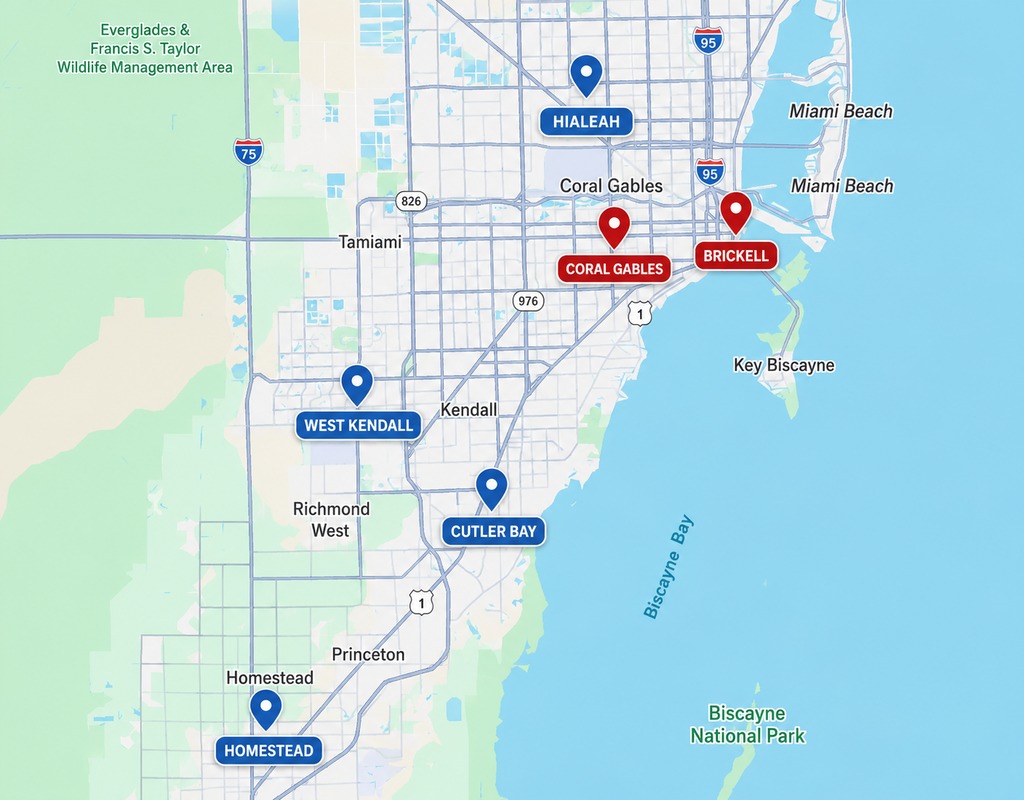
Homestead and parts of West Kendall still have inventory in the $300,000 to $400,000 range where these programs stretch furthest. Brickell and most of Coral Gables sit well above the price points where Hometown Heroes assistance makes a meaningful dent, since the assistance cap doesn't scale with luxury pricing. Buyers using these programs typically find the best fit in Homestead, West Kendall, Hialeah, and parts of Cutler Bay, not in the higher-priced urban core.
Frequently Asked Questions
Q: Can I combine the Florida Hometown Heroes program with a VA loan?
A: Yes. The Florida Hometown Heroes program is designed to layer on top of a first mortgage, including VA, FHA, and conventional loans. A veteran using a VA loan Florida benefit for zero down payment can still receive Hometown Heroes assistance toward closing costs and prepaid items, provided the lender originates both programs and the buyer meets the income limit for Miami-Dade County.
Q: Who qualifies as a hero under the Florida Hometown Heroes program?
A: Eligible professions include full-time teachers, healthcare workers, law enforcement officers, firefighters, active military members, veterans, and a broader list of community-critical public service roles defined by the state. Income limits are set by county, and Miami-Dade's limit runs higher than many other Florida counties because of local cost-of-living adjustments, which qualifies more buyers than the program's name might suggest. Applicants also need first-time buyer status under the standard three-year rule and must complete a required homebuyer education course before funds are released.
Q: Does a VA loan work on condos in Miami-Dade?
A: It can, but the building has to carry VA project approval, which not every Miami-Dade condo association has secured. Buildings that primarily sell to cash or investor buyers sometimes never pursue this approval, which narrows the pool of condo options for VA buyers. Checking a building's VA approval status before writing an offer saves weeks of wasted time later, since a rejected building can force a buyer to restart their search from scratch mid-transaction.
Q: How much can Florida Hometown Heroes actually save a buyer at closing?
A: Assistance is typically capped at up to 5% of the first mortgage amount, with a maximum dollar limit set by the state. On a $380,000 home, that has translated to roughly $14,000 to $19,000 toward down payment and closing costs for buyers who qualify, money that otherwise comes directly from a buyer's own savings. The exact figure depends on the first mortgage type and current program funding availability, so confirming the number with a participating lender before writing an offer is worth the extra step.
If you want to know whether you qualify for Hometown Heroes, a VA loan Florida benefit, or both, run your numbers on the mortgage calculator first. It takes a few minutes and gives you a real monthly payment to work from before you ever look at a listing.
Check out this article next