

The difference between a buyer who closes on a West Kendall townhome with under $2,000 out of pocket and one who brings $28,000 to the same closing table is rarely income, credit score, or how hard they searched. It comes down to whether they knew which first time home buyer programs Miami-Dade County offers, and whether they accessed them in the right order before an offer was ever written.
Miami-Dade has overlapping layers of assistance available right now: a county deferred loan program, a local Housing Finance Authority with its own mortgage products, a statewide workforce assistance program, and federal financing options that allow zero down in parts of the county buyers frequently overlook. These programs can be stacked. They can eliminate tens of thousands of dollars from what you need at closing. But they come with income limits, lender requirements, and sequencing rules that, if missed, can close the door on eligibility permanently mid-transaction.
This is a breakdown of every program available to a first time home buyer Miami-Dade residents qualify for right now: what each covers, who qualifies, how much assistance you can access, and how to use them together correctly.
What First Time Home Buyer Programs Miami Actually Offers
Miami-Dade sits at the intersection of three separate program systems that any first time home buyer Miami resident can potentially access. Understanding these as distinct layers, rather than interchangeable options, is what separates buyers who walk away from closing with minimal cash spent from those who underestimated the cost by $20,000 or more.
The three layers are:
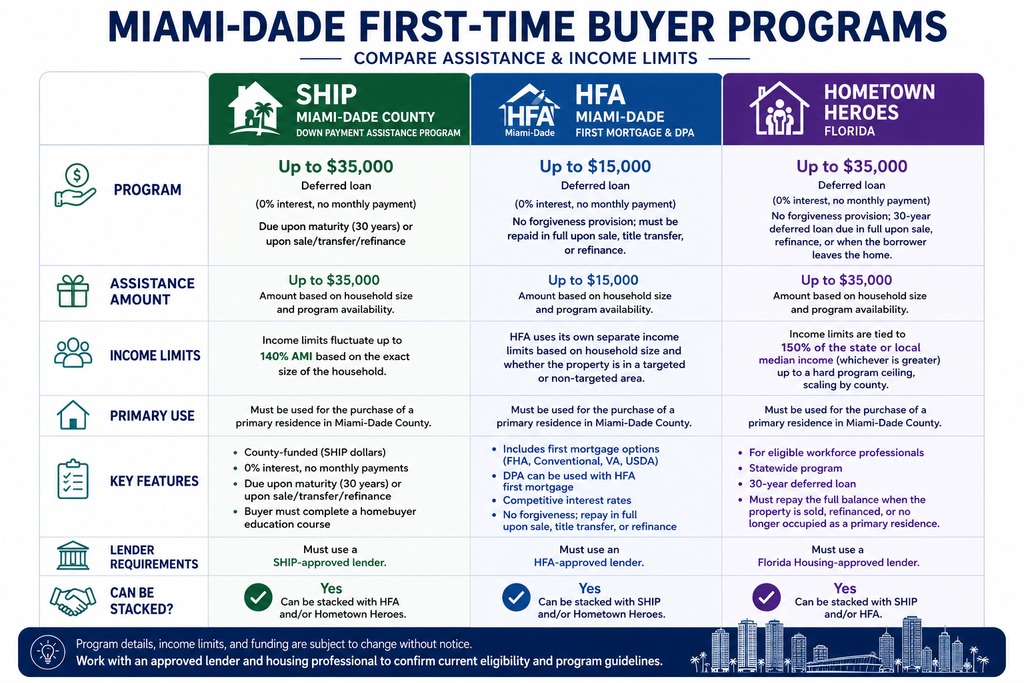
- The county layer: The Miami-Dade County Department of Housing and Community Development administers a Down Payment Assistance Program funded through State Housing Initiatives Partnership (SHIP) dollars. This is county-specific money, income-qualified, and limited by annual funding allocations.
- The local authority layer: The Housing Finance Authority (HFA) of Miami-Dade operates its own first mortgage product alongside a separate down payment assistance product. This is a distinct entity from the county housing department, with different income limits and different lender requirements.
- The statewide layer: Florida Hometown Heroes, administered through the Florida Housing Finance Corporation, provides assistance to income-eligible buyers working in qualifying professions. This program attaches to a first mortgage and can be layered with county-level programs for eligible buyers.
A fourth component ties the structure together: the type of first mortgage a buyer uses determines which programs can attach to it. FHA loans unlock the widest range of program combinations in Miami-Dade. USDA Rural Development loans add a zero-down option for buyers targeting specific zip codes in Homestead and Florida City.
Not every mortgage lender Miami first-time buyers work with is approved to originate all three layers. Choosing a lender who participates in all the programs you intend to use is not a detail to confirm at closing. It must happen at pre-approval.
Miami-Dade County Down Payment Assistance: The SHIP Program
The Miami-Dade County Homebuyer Down Payment Assistance Program provides qualifying buyers with up to $35,000 as a deferred, zero-interest loan toward down payment and closing costs. No monthly payment is required. The loan sits against the property and becomes due when the home is sold, the title transfers, the property is refinanced, or upon the borrower's death during the loan term. Full program details are available at the Miami-Dade County Down Payment Assistance page.
Income limits (current figures):
- Individual: under $95,620
- Two-person household: under $109,200
- Three-person household: under $122,920
- Four-person household: under $136,500
These figures are higher than buyers expect. Many buyers who assume they earn too much for county assistance qualify comfortably.
Two program details most buyers never hear until after closing:
The property must serve as the buyer's primary residence in Miami-Dade County. Investment properties and vacation homes do not qualify, and the buyer must be a Miami-Dade County resident at the time of application and at closing.
The program carries a shared equity requirement tied to when you resell. Sellers who exit the home within one to three years of purchase repay 100 percent of the down payment assistance to the county from the sale proceeds. Sellers who exit between four and six years repay 50 percent. After six years, no repayment is required. For buyers planning to stay long term, this has no practical impact. For anyone expecting to sell or upsize within a few years of closing, the shared equity provision changes the net proceeds calculation significantly. Run that scenario before accepting the assistance.
Applicants must complete a Homebuyer Education and Counseling course through an approved agency before funds are released. SHIP funding is not a revolving line. Allocations open periodically and close when funds are exhausted. In strong buying years in Miami-Dade, this can happen as early as March.
Housing Finance Authority of Miami-Dade: A Different Path to $15,000
The Housing Finance Authority of Miami-Dade operates a program that runs parallel to the county SHIP product and serves a partially different buyer profile.
The HFA's offering combines a 30-year fixed-rate first mortgage with down payment assistance of up to $15,000 in the form of a deferred zero-percent second mortgage. Unlike the SHIP program, the HFA's second mortgage carries no forgiveness provision. No monthly payment is required during the loan term, but the balance is repaid when the property is sold or refinanced.
The income limits differ from SHIP in a way that opens the program to more buyers. For FHA, VA, and Freddie Mac HFA Advantage loans, a one- to two-person household can earn up to $142,485. A household of three or more can earn up to $148,680. This is substantially higher than the SHIP income ceiling. A first time home buyer Miami residents would consider middle-income, someone who earns $120,000 in a two-person household, is ineligible for SHIP but qualifies for HFA assistance with room to spare.
The HFA program carries no purchase price limit, which is an advantage over some state bond programs that cap eligible purchase prices at a level that excludes a portion of Miami-Dade inventory.
Eligibility requires a minimum credit score of 640, employment in the same line of work for at least 24 months, U.S. citizenship or permanent residency, and completion of an 8-hour HUD-approved homebuyer education course. The HFA program is administered through approved lenders only. Not all lenders in Miami-Dade originate HFA products, so confirming lender approval status before beginning the pre-approval process is essential.
Florida Hometown Heroes: The Statewide Layer for Eligible Workers
The Florida Hometown Heroes program, administered through the Florida Housing Finance Corporation, provides down payment and closing cost assistance to first-time, income-qualified buyers working in specific workforce professions: teachers, healthcare workers, first responders, law enforcement officers, active military members, veterans, and a broader list of community-critical roles defined by the state.
Assistance is typically up to 5 percent of the first mortgage loan amount, with a dollar cap set by the state. On a $350,000 purchase, this represents roughly $17,000 to $18,000 applied toward down payment and closing costs as a zero-interest second mortgage with no monthly payment.
Miami-Dade County's income limits for Hometown Heroes are set higher than many other Florida counties because of the local cost of living. More buyers in this county qualify than assume they do when they hear the program described as a benefit for essential workers.
The Hometown Heroes layer attaches to a first mortgage: conventional, FHA, or VA. A buyer using a VA loan for zero down can combine it with Hometown Heroes to cover closing costs, effectively eliminating their cash requirement at closing.
Because the VA loan and Hometown Heroes combination is the most powerful stacking scenario available in this market, and because the sequencing details are where most eligible buyers lose access, I covered those mechanics in detail in the post on how Hometown Heroes stacks with a VA loan in Miami. If either a VA benefit or a qualifying profession applies to you, that post covers the specific numbers and the sequencing mistake that costs eligible buyers thousands before they realize it happened.
FHA and USDA Loans: The Financing Vehicles That Unlock Programs
Every program covered above needs to attach to a first mortgage. The loan type a buyer chooses determines which programs can stack on top of it.
FHA 203(b) loans are the base layer for the largest share of program combinations available to a first time home buyer Miami-Dade residents work with. FHA allows a minimum down payment of 3.5 percent with a credit score of 580 or above, or 10 percent with a score between 500 and 579. The mortgage insurance premium adds an upfront cost (typically 1.75 percent of the loan amount) and an ongoing annual premium. These costs are offset in program-stacked scenarios because the buyer brings significantly less cash to closing than a conventional loan would require.
The Miami-Dade SHIP program, the HFA first mortgage, and Hometown Heroes all work with FHA loans.
USDA Rural Development loans are available in specific areas of southern Miami-Dade that many buyers and agents are unaware of. Parts of Homestead and Florida City fall within USDA-eligible boundaries. Buyers targeting homes in those areas can access a federal loan with no down payment requirement. Income limits for USDA are set at 115 percent of the area median income for the specific county. A broader overview of the Florida Housing homebuyer program options is available through the Florida Housing Finance Corporation.
USDA loans can be stacked with Hometown Heroes for qualifying profession buyers, creating a scenario where a buyer in Homestead or Florida City can eliminate both the down payment and a significant portion of closing costs.
One important caution: USDA eligibility boundaries in Miami-Dade are specific at the address level. A property two streets outside the boundary does not qualify. Verifying eligibility for any specific property before making an offer is a necessary step.
How to Stack First Time Home Buyer Programs Miami the Right Way
This is where the real planning happens. Three stacks apply to the majority of buyers accessing first time home buyer programs Miami-Dade County offers, depending on occupation, income, and target area.
Stack A: SHIP + FHA (no profession requirement)
A buyer earning $78,000 in Hialeah purchasing a $360,000 single-family home qualifies for both FHA financing and Miami-Dade SHIP assistance. Without programs: FHA at 3.5 percent down requires $12,600 for the down payment, plus $7,200 to $9,000 in estimated closing costs. Total out of pocket: roughly $20,000 to $22,000.
With SHIP applied: up to $35,000 in assistance covers the full down payment and a significant portion of closing costs. The buyer's actual cash to close can fall under $2,000 after the deferred loan is applied and earnest money is credited back at closing. The monthly mortgage payment does not change because the SHIP second mortgage carries no monthly payment.
Stack B: Hometown Heroes + FHA (profession-eligible buyers)
A teacher purchasing a $365,000 home in Kendall near area schools uses FHA financing with a base loan of approximately $352,125. Hometown Heroes provides up to 5 percent assistance, roughly $17,600, toward down payment and closing costs. Combined with the FHA 3.5 percent down requirement of $12,775, the assistance covers the full down payment and closing costs for most buyers in this range, leaving minimal cash required.
Stack C: USDA + Hometown Heroes (southern Miami-Dade, profession-eligible buyers)
A buyer in an eligible profession targeting Florida City or rural Homestead uses USDA for zero down and Hometown Heroes to cover closing costs. Total cash to close on a $280,000 purchase can drop to earnest money only for buyers who qualify for both layers.
The sequencing rule that applies to all three stacks: the mortgage lender Miami buyers partner with for program-stacked purchases must be approved to originate every program in the stack before the pre-approval letter is issued. Switching lenders after going under contract to add a program the original lender does not originate typically requires a new underwriting file, a new appraisal in some cases, and a closing delay that can cost the contract. Confirm lender program approval before choosing a lender, not after receiving an accepted offer.
Before modeling payment scenarios, the mortgage calculator at Labrada Realty lets you build a real monthly payment using the first mortgage principal only, which is all that changes when a deferred second mortgage is added to the structure. Once you have that number, you can evaluate the actual monthly impact of any program stack.
For a full breakdown of what closing costs look like across Miami-Dade transactions, the guide on the hidden costs of buying a home walks through every line item buyers often miss.
What Miami-Dade Does to These Programs That Other Counties Don't
Program eligibility describes what you qualify for on paper. Miami-Dade's specific market conditions determine whether you can actually use that eligibility without losing the contract.
Condo inventory restrictions
A large portion of Miami-Dade's condo inventory under $400,000 either lacks FHA project approval or carries pending compliance issues tied to the structural milestone inspection requirements that took effect after 2021. Buildings without FHA approval cannot serve as the collateral for an FHA loan, which eliminates access to any program requiring FHA financing. SHIP and HFA assistance attached to FHA cannot be used in an unapproved building, regardless of how otherwise eligible the buyer is. Verify condo building approval status before writing an offer, not after the inspection period expires.
Insurance market and lender document timing
Florida's property insurance market has tightened considerably. Lenders in Miami-Dade now require insurance binders much earlier in the transaction than they did five years ago. On a program-assisted transaction, the county's DPA file processing runs as a parallel track alongside the lender's underwriting. If insurance binder requirements stall, both timelines shift simultaneously. Transactions involving SHIP assistance have less scheduling flexibility than a single-lender conventional transaction, and closing date extensions can be harder to negotiate when a seller has already had one program-related delay.
SHIP funds and seasonal demand
Miami-Dade SHIP allocations are not unlimited and are not replenished mid-cycle when depleted. Funds move fastest between January and April, when buyer competition peaks at the entry-level price range. A buyer who waits until February to begin pre-approval for a spring purchase may find the allocation window already closed. Beginning pre-approval with a SHIP-approved lender in the fall, for a spring closing target, is not overcautious. It is how buyers who actually access the program approach it.
Foreign buyer presence and offer perception
Miami-Dade's active foreign buyer market creates an unusual dynamic at the entry-level price range. A seller in West Kendall or Hialeah who receives a competing cash offer may perceive a program-assisted FHA offer as weaker on its face. An experienced agent who structures the offer correctly, with strong earnest money, a clear pre-approval letter that addresses program participation, and flexibility on the closing date, can neutralize that concern. How the offer is packaged and presented matters as much as what programs it involves.
What to Do With This Information
The first time home buyer programs Miami makes available have helped buyers close on homes across Miami-Dade with a fraction of what they assumed they would need. The programs are real. The stacking math works. What trips buyers is not the programs themselves. It is arriving at the process too late, choosing a mortgage lender Miami buyers using these programs work with who is not approved for the programs they qualify for, or discovering that SHIP funding closed for the cycle after the home search was already underway.
Run your income against each program's threshold separately. Confirm lender approval status for every program in your intended stack before the pre-approval conversation begins. And start that conversation before the home search, not during it.
If you are ready to understand how the buying process in Miami-Dade actually works once you know your program options, the first-time buyer process guide for Miami-Dade covers every stage from pre-approval through closing, and pairs directly with the program knowledge from this post.
FAQ
What income limits apply to first time home buyer programs in Miami-Dade County?
A: Income limits vary by program and by household size, and the differences between programs matter more than buyers expect. The Miami-Dade County SHIP Down Payment Assistance Program qualifies individuals earning under $95,620, with thresholds scaling to $136,500 for a household of four. The HFA of Miami-Dade's program serves buyers at a higher ceiling: up to $142,485 for a one- to two-person household, and up to $148,680 for three or more persons. Florida Hometown Heroes uses Miami-Dade's area median income to set its limit, adjusted annually, which currently qualifies buyers who earn more than the program's name typically suggests. A buyer who earns too much for SHIP may still qualify for HFA or Hometown Heroes assistance, which is why checking all three programs separately matters before drawing any conclusions about eligibility.
Can I stack the Miami-Dade SHIP program with Florida Hometown Heroes on the same purchase?
A: Yes, but the details of how those funds interact depend on lender approval for both programs and the specific loan type used as the first mortgage. The Miami-Dade SHIP DPA and Florida Hometown Heroes both operate as second mortgages layered behind a first mortgage, and Florida Housing's Hometown Heroes program explicitly permits layering with other local assistance funds. The practical requirement is finding a lender approved for both programs simultaneously, which not all participating lenders are set up to do. Buyers who attempt to add SHIP assistance after locking in with a Hometown Heroes-approved lender that does not also originate SHIP can lose access to the county program mid-transaction. Confirm both approvals before the pre-approval letter is issued.
Do first time home buyer programs in Miami work on condos?
A: Condo purchases can qualify for assistance programs, but the building itself creates the most common disqualifier in Miami-Dade. The HFA of Miami-Dade's program supports condos when they meet the relevant approval requirements. SHIP-funded assistance can be used on condos that are immediately habitable and meet county property guidelines. The complication is that many program stacks require FHA financing as the first mortgage, and a large portion of Miami-Dade's condo inventory either lacks FHA project approval or carries pending structural compliance issues tied to the milestone inspection legislation that took effect after 2021. This shrinks the practical pool of program-eligible condos considerably below the overall condo inventory count. Verify FHA project approval status for any specific building before investing time in a pre-approval structured around that building.
What credit score do I need to qualify for Miami-Dade down payment assistance?
A: For the Miami-Dade County SHIP Down Payment Assistance Program, the program itself does not publish a standalone minimum score, but because SHIP funds must attach to an approved first mortgage, the credit requirements of that underlying loan apply. FHA loans require a minimum score of 580 for the 3.5 percent down option. The HFA of Miami-Dade sets its own minimum at 640 for DPA eligibility. Florida Hometown Heroes generally requires 640 as well. A buyer with a score between 580 and 639 has access to FHA financing and potentially SHIP assistance, but HFA and Hometown Heroes products are out of reach until the score improves. Twelve months of consistent on-time payment history and keeping revolving credit utilization below 30 percent are the two fastest levers for improving a score meaningfully before applying.
How long does it take to close on a home when using assistance programs in Miami?
A: A standard financed transaction in Miami-Dade runs 30 to 45 days from accepted offer to closing. Adding a program layer extends this because the county or program administrator processes a parallel approval file alongside the lender's underwriting. SHIP-assisted transactions typically require the county housing department to review and approve the DPA file, which adds one to two weeks under normal conditions and longer during peak application periods in early spring. HFA transactions process through a participating lender using the eHP digital portal, which can move faster when the lender is experienced with the submission process. Buyers who begin program pre-approval at least 60 days before their target offer date have the best chance of avoiding closing date pressure from program processing timelines that run on their own clock, separate from the lender's.
Once you know which programs apply to your income, profession, and target area, the next step is understanding how the buying process in Miami-Dade actually works from pre-approval through closing. The first-time buyer process guide for Miami-Dade walks through every stage in the order it actually happens, and pairs directly with the program knowledge from this post.
Check out this article next