
Most buyers searching for homes for sale Key Biscayne Florida approach it the same way they'd approach any other Miami-Dade market: open a portal, scroll through houses for sale in Key Biscayne, and start filtering by price. Within a few minutes, something feels off. The listings span an enormous range, from $500K condos to $30M waterfront estates. Days on market stretch well past 100 in some cases. The gap between list price and sale price seems to shift depending on which building or block you're looking at.
None of that signals a broken market. It signals a market with two completely different dynamics operating side by side on four square miles of barrier island. Buyers who understand this before they start searching spend less time chasing the wrong listings and make stronger offers when the right one appears.
Here is how the market actually works.
What Homes for Sale Key Biscayne Florida Actually Look Like Right Now
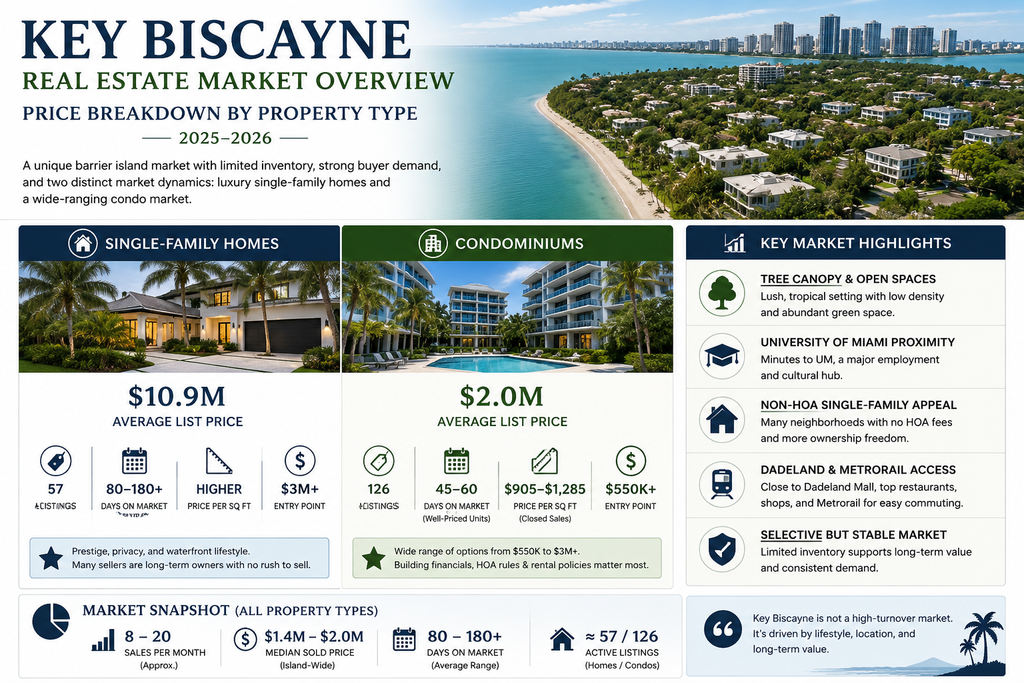
At any given time, the island carries roughly 57 single-family homes and 126 condo units in active inventory. For comparison, a single zip code in Kendall or Doral might have five times that number on the single-family side alone. Key Biscayne's thin inventory is not a temporary condition, it is a structural feature of a small, geographically constrained island with no room to build outward.
The pricing split between property types is dramatic. The average list price for houses runs near $10.9 million. The condo side averages around $2 million at list, though that number covers a wide spectrum, a compact older one-bedroom at $550,000 and a renovated water-view three-bedroom at $3 million both pull that average in different directions. The island-wide median sold price across all types has ranged between $1.4 million and $2 million depending on the month, which tells you that condos are driving most of the transaction volume.
Days on market average 80 to 180 days or more, depending on price point and property type. A condo priced correctly in a well-regarded building might move in 45 to 60 days. A single-family home listed at $8 million may sit for six months before finding the right buyer. Extended days on market in Key Biscayne do not carry the same meaning they would in a denser Miami-Dade market, more on that shortly.
Price per square foot on closed condo sales runs approximately $905 to $1,285, depending on the building, floor, and finish level. Single-family homes in the upper ranges push considerably higher, particularly on lots with bay or ocean frontage.
Browse current Key Biscayne real estate listings to see what is active by property type and price band.
Two Very Different Markets on One Small Island
When you browse key biscayne florida houses for sale, you are entering a market where the entry point for a move-in ready single-family home starts around $3 million and climbs quickly. Waterfront estates on Grand Bay Drive, Harbor Point Road, and Crandon Boulevard reach $20 million or more. Inventory in this segment is genuinely limited. Fewer than 60 homes list at any one time, many sellers have owned for years with low cost basis, and most are under no meaningful financial pressure to negotiate.
For buyers looking at luxury homes in Miami, Key Biscayne sits at the top of the residential market alongside Star Island and Fisher Island. The lifestyle is different, though: gated privacy and open green space rather than high-rise density, surrounded by Crandon Park and Bill Baggs Cape Florida State Park instead of Brickell's financial district energy.
The condo market is a separate conversation entirely. Buildings like the Towers of Key Biscayne, Botanica, and Oceania offer units across a wide price range. An older, smaller configuration in a building with deferred maintenance might list at $550,000. A renovated three-bedroom with direct bay views in a building with strong reserves and attentive management can push past $3 million. Choosing between these options is not simply a function of price — it is a function of the building's financial health, HOA structure, association approval timeline, and rental restrictions.
The buyer profiles differ on each side of the market. The single-family segment draws primarily European and South American high-net-worth buyers, many purchasing in cash. The condo market attracts buyers from Venezuela, Colombia, Argentina, and Brazil, alongside domestic buyers relocating from New York, California, and other high-tax states. Understanding who you are competing with in your specific price band tells you more about what a competitive offer looks like than any general market stat ever will.
What the Listing Price Is and Isn't Telling You
Here is where buyers make the most expensive mistake in this market.
A listing with 120 days on market in Doral or Homestead typically signals a pricing problem. The seller has misjudged the market, comparable sales have kept closing without them, and those days are adding up as leverage for the buyer. In Key Biscayne, that same assumption frequently backfires.
The reason is transaction volume. In a typical month, somewhere between eight and twenty sales close across all property types on the island. With that kind of thin volume, a seller can sit on a listing for months without the competitive pressure that forces repricing in higher-density markets. Several Key Biscayne sellers carry properties for sale alongside active rentals, collecting income while they wait for the right buyer. They are not in a hurry. Extended days on market often reflects patience, not mispricing.
A concrete example: a mid-rise condo unit listed at $2.1 million in late 2024 received two offers over 90 days, both under $1.9 million. The seller declined both. A third buyer came in at $1.97 million, fully pre-approved, with the ability to close in 45 days. The seller accepted — not because the price was meaningfully higher than the earlier offers, but because the certainty of that close was worth the modest difference. The first two buyers spent months tracking the listing, assumed the days on market gave them leverage, and watched someone else take it.
Sale-to-list ratios on Key Biscayne condos typically run 93 to 97 percent. Single-family homes at the upper price levels show more variance, often closing between 88 and 95 percent of list, because the buyer pool is thinner and each negotiation is more individually driven. Knowing which side you are on shapes your entire offer strategy.
This pattern plays out differently than the Brickell buyer's market in 2026, where higher transaction volumes create more predictable price behavior and faster negotiating cycles.
The Costs Most Buyers Underestimate Before They Close
The listing price captures most of the attention. These are the costs that change the real number.
Most buyers browsing houses for sale in key biscayne calculate their budget based on the purchase price alone, then encounter insurance costs and HOA fees during the inspection period. By that point, they are either surprised or already emotionally committed. Neither is a good position for making a clear-headed financial decision.
Condo Reserve Funding and Structural Requirements
After the Surfside collapse, Florida law now requires condominium buildings to complete milestone structural inspections at 30 years of age and conduct a Structural Integrity Reserve Study every 10 years. Associations that have underfunded reserves are required to collect those funds. For buyers, this means a condo with a $1,500 monthly HOA fee could face a special assessment in the tens of thousands, or more, shortly after closing if the association has not gotten ahead of these requirements.
Before making any offer on a condo in Key Biscayne, pull the most recent reserve study. Look at the funded percentage. Ask whether any assessments are pending, under discussion, or anticipated in the next 24 months. A building at 30 percent reserve funding with an aging structure is a materially different financial commitment than a building at 75 percent with a clean recent inspection. Key Biscayne has a significant share of buildings constructed in the 1970s and 1980s, many of which are now squarely inside the inspection and reserve scrutiny window.
Windstorm and Flood Insurance
Key Biscayne sits on a coastal barrier island. Wind mitigation features, impact windows, roof-to-wall connections, opening protection, matter more here than in any inland area of Miami-Dade. Buildings without these features carry windstorm premiums that reliably surprise buyers who have only shopped properties on the mainland. A $2 million condo with $18,000 in annual insurance looks entirely different on paper than a $2 million condo in a mainland building at $6,000 per year. Get insurance quotes before you get attached to the property.
HOA Fees and Financing Qualification
Monthly HOA fees in Key Biscayne's condo buildings range from roughly $800 in smaller, older buildings to $3,500 or more in full-service properties with concierge, valet, and resort-style amenities. These fees count directly against your debt-to-income ratio for mortgage qualification. Run the combined mortgage and HOA payment through the mortgage calculator before you set your search criteria, and confirm with your lender that they have reviewed the condo's financial documents before any offer is submitted.
How the Buyer Pool Shapes Your Negotiating Position
Key Biscayne carries one of the most cash-heavy buyer pools in Miami-Dade. A meaningful share of single-family transactions and a significant portion of higher-end condo closings happen without financing. For a buyer using a conventional mortgage, that creates real competitive challenges, but also openings that buyers frequently miss.
The conventional view is that cash always wins. In the sub-$1.5 million condo range, that is often accurate. But in buildings with condo association approval requirements, the board review process takes 30 to 60 days regardless of how the buyer is paying. A cash buyer does not close any faster when the association's timeline is the binding constraint. In those buildings, a fully pre-approved buyer who is organized and working with a broker familiar with that specific association's process can match a cash offer on practical terms. The speed advantage disappears when the bottleneck shifts to the board, not the bank.
Seasonally, Key Biscayne Florida houses for sale that sit through the summer without going under contract tend to offer more negotiating room from August through October. The luxury segment here follows Miami's broader seasonal rhythm: active from November through April when international buyers are most present, quieter through the summer months. A prepared buyer who is ready to move in August is shopping against less competition than the same buyer in February.
The international buyer mix in Key Biscayne's condo segment is concentrated among Venezuelan, Colombian, Argentine, and Brazilian buyers, many with pre-arranged U.S. banking or entity structures that allow them to close efficiently. Working with a Miami-Dade buyer's agent who understands this buyer culture helps you position your offer as the cleaner, more certain choice, rather than just the lower-priced one.
How to Search Homes for Sale Key Biscayne Florida Without Wasting Time
Searching homes for sale Key Biscayne Florida on public portals is a reasonable starting point, but the data lags the market. Listings that show as active on Zillow or Realtor.com can already have accepted offers, be under board review with a committed buyer, or have conditions that make them effectively unavailable to a financed purchaser without significant delays. With the island's thin volume, that gap between what the portal shows and what is actually available is more costly here than it would be in a high-inventory market.
A more effective approach: identify your property type, your price band, and your realistic closing timeline. Then work with a broker who tracks what is coming before it is publicly listed, knows the association histories of the buildings you are considering, and can structure an offer that moves quickly once the right property surfaces.
For buyers financing the purchase, having your broker also manage the mortgage removes the coordination delays that cost buyers properties in thin-inventory markets. By the time a separate lender processes a pre-approval, reviews the condo association documents, and issues a loan commitment, another buyer may have already gone under contract. Handling real estate, financing, and title under one roof means that Key Biscayne real estate listings you want to move on go from identified to under contract without losing days in the gaps between three separate offices.
Use the VIP home search to set personalized alerts for Key Biscayne listings filtered by zip code 33149, property type, and price range, before they surface on the open portals.
The homes for sale Key Biscayne Florida market rewards preparation more than almost any other segment in Miami-Dade. The inventory is thin, the price points are real, and the hidden costs are significant enough to change your financial picture before you make an offer. Buyers who understand the two-market structure, read days on market correctly, and show up pre-approved with a clear strategy consistently close the properties they want. Buyers who don't spend months watching those properties go to someone else.
FAQ
Q: What is the price range for homes for sale in Key Biscayne, Florida right now?
A: The range is wider than most buyers expect. On the condo side, older one-bedroom units in buildings with higher age and lower finishes can start around $500,000 to $700,000. Renovated two- and three-bedroom condos with water views typically run $1.5 million to $3 million-plus. Single-family homes begin around $2.5 million to $3 million for entry-level and climb well past $20 million for waterfront estates. A starting benchmark of roughly $1,285 per square foot works for condos, with single-family values considerably higher depending on lot size, water frontage, and renovation status.
Q: Is Key Biscayne a buyer's market or a seller's market in 2026?
A: Pricing power depends heavily on which segment you are shopping. The condo market has seen inventory expand and days on market lengthen compared to prior years, giving buyers more room to negotiate on both price and terms in mid-tier buildings. The single-family market behaves differently. Fewer than 60 homes list at any one time, sellers tend to be financially insulated from market pressure, and well-positioned waterfront properties rarely trade at meaningful discounts. In short: more buyer-friendly conditions in condos, seller-controlled conditions in single-family. Know which market you are entering before you calibrate your offer.
Q: How long does closing typically take in Key Biscayne compared to the rest of Miami-Dade?
A: Standard Miami-Dade closing timelines run 30 to 45 days for cash transactions and 45 to 60 days for financed ones. Key Biscayne adds a layer that buyers regularly underestimate: condo association approval. Most buildings on the island require the buyer to submit a full application, financial documents, personal references, sometimes an interview, for board review. That process takes 30 to 60 days in many buildings. Smart buyers submit the association package simultaneously with the mortgage application, not after. Sequencing this incorrectly can extend the closing by weeks, which frustrates sellers and occasionally costs buyers the deal entirely.
Q: What should I know about condo rules and reserves before buying in Key Biscayne?
A: Reserve funding is the piece buyers most commonly skip during due diligence. Florida's updated condo laws now require buildings to maintain a Structural Integrity Reserve Study every 10 years and complete milestone structural inspections at 30 years of age. A building with reserves funded at 30 percent of required levels is not just a maintenance red flag — it signals a likely special assessment. With a significant share of Key Biscayne's condo inventory constructed in the 1970s and 1980s, many buildings fall squarely into this inspection and reserve scrutiny window right now. Review the reserve study before you make an offer, not during the inspection period when you are already emotionally committed.
Q: Does buying on an island affect my mortgage or insurance options in Key Biscayne?
A: Yes, meaningfully, on both fronts. Insurance-wise, Key Biscayne's coastal barrier island position places properties in elevated wind risk zones. Wind mitigation features, impact windows, opening protection, roof-to-wall connections, matter more here than they do for comparable properties in Pinecrest or Kendall. Buildings without these features can carry windstorm premiums two to three times higher than a similar mainland property. On the mortgage side, lenders financing condos require a condo questionnaire covering the association's financial health, litigation status, and owner-occupancy ratio. Buildings under 51 percent owner occupancy may not qualify for conventional financing at all, which meaningfully narrows your loan options for certain Key Biscayne addresses before you ever reach underwriting.
If you want early access to Key Biscayne listings before they surface on the open portals, and want to work with someone who handles real estate, financing, and title from a single office, start your VIP home search and set your criteria now. One conversation covers what three separate offices usually can't.
Check out this article next