

Sellers in Miami are losing buyers over a cost that never appears in the listing description. hurricane insurance Miami homeowners are paying has become one of the most significant factors in whether a financed deal actually closes, and most sellers do not realize it until the transaction is already in trouble.
I have watched offers fall apart in the final stretch because the insurance quote came back at $900 a month on a home listed below $600,000. The buyer was qualified. The price worked. The deal fell apart when the lender recalculated the debt-to-income ratio with the actual insurance number, not the national-average placeholder the pre-approval assumed.
If you own a home in Miami-Dade and plan to sell, or if you are preparing to buy, understanding how hurricane coverage works here is one of the most concrete things you can do to protect your transaction before it starts. This guide covers what the policies actually do, what they don't, how Miami's insurance market has shifted in 2026, and what both sides of a deal need to know before signing anything.
Hurricane Insurance Miami: What Your Policy Actually Covers
The most common misconception I hear from Miami-Dade homeowners is that their standard policy covers hurricane damage. Some do. Many don't, not in the way people assume.
A standard HO-3 homeowner's policy covers wind damage from a named storm only if windstorm is explicitly included in the policy. In South Florida, a significant number of carriers exclude windstorm entirely or write it as a separate policy through a private insurer. If you have never read your declarations page carefully, you may not know which situation you are in.
Flood damage is categorically different. A standard homeowner's policy never covers flooding, storm surge, or rising water from any source. After a hurricane, the distinction between wind damage and flood damage becomes the central argument between insurers over what they owe. What looks like rain penetration to a homeowner may be classified as storm surge by an insurer, and that classification determines which policy, if any, pays the claim.
For sellers, this matters because buyers are checking your coverage before they commit. Buyers who have been through a failed closing know to ask. Buyers who haven't been yet, will be told to ask by their lender.
The Three Policies That Actually Cover Hurricane Damage in Miami
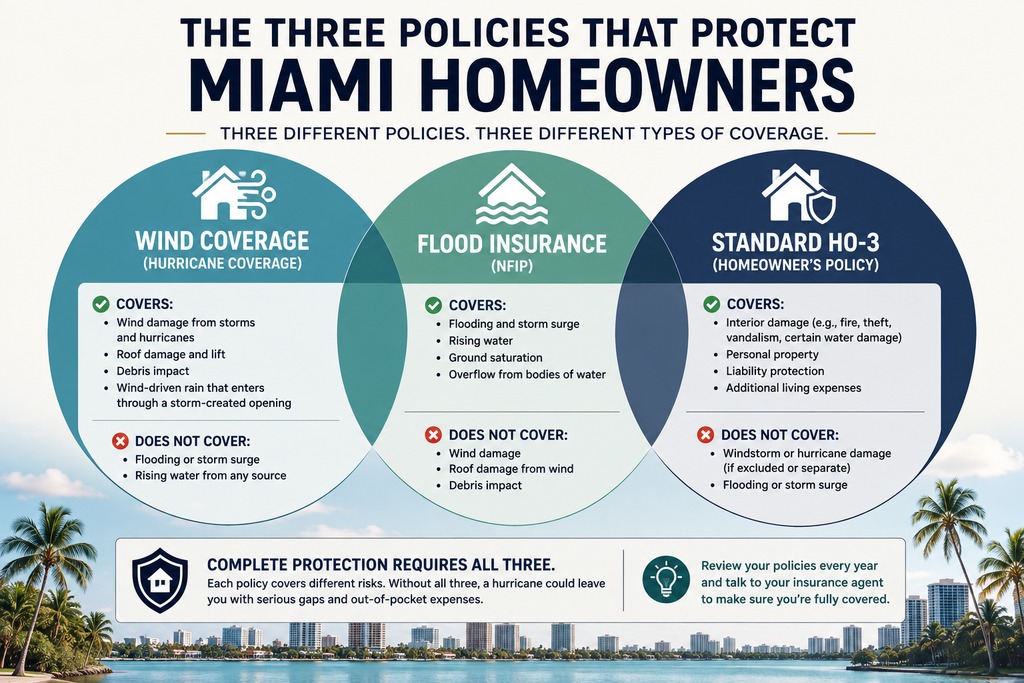
A Miami-Dade homeowner who is fully protected typically carries three separate policies, sometimes with three different insurers, each covering a distinct layer of hurricane risk.
The first is windstorm or hurricane coverage. In Florida, this is either bundled into the HO-3 or written as a standalone windstorm policy. It covers structural damage from wind, debris impact, roof loss, and wind-driven rain that enters through a storm-created opening. It does not cover flooding.
The second is flood insurance, purchased separately through the NFIP or a private flood carrier. It covers storm surge, rising groundwater, and floodwater entering the structure. Even homeowners outside a FEMA-designated Special Flood Hazard Area should consider it in South Florida. Miami-Dade County has extensive low-elevation areas where flooding occurs without a formal zone classification to trigger a lender mandate. You can look up your property's flood zone designation at floodsmart.gov.
The third is the base homeowner's policy, which after a hurricane typically handles secondary damage, a broken pipe triggered by a power failure, theft that occurs during evacuation, or fire damage unrelated to wind or water. For the major perils a hurricane actually produces, it is largely uninvolved.
One useful way to frame hurricane insurance Florida: a single storm event can generate three simultaneous claims from three separate insurers, each applying its own deductible, processing the claim on its own timeline, and enforcing its own exclusions. Sellers who understand this before they list can explain the full picture to a buyer. Sellers who don't, often learn the hard way when a buyer's agent or lender raises the question mid-contract.
How the Insurance Market Is Affecting Miami Home Sales Right Now
This is the part sellers need to pay close attention to.
In Miami-Dade County, the average homeowner's insurance premium runs around $6,045 annually in 2026, and coastal properties in Brickell, Miami Beach, and Key Biscayne regularly reach $8,000 to $12,000 or more per year. Roughly 60% of that premium comes directly from hurricane and windstorm coverage. On a financed purchase, the lender calculates the full insurance payment as part of the buyer's monthly debt obligation.
At $8,000 a year, that is $667 per month added to the mortgage before property taxes or HOA fees. On a $700,000 home in Hialeah or a $750,000 property in Miami Gardens, an insurance payment that size can push an otherwise qualified buyer outside the debt-to-income window a lender will approve. The buyer does not need a lower asking price. They need a lower insurance number. If they cannot get one, they walk.
The market has genuinely improved in 2026. Citizens Property Insurance Corporation approved its largest rate reduction in 24 years, cutting statewide premiums an average of 8.8%, with Miami-Dade homeowners seeing reductions closer to 14%. More than 20 private insurers have re-entered the Florida market since the 2022 legislative reforms, and several are now writing below Citizens rates on certain South Florida properties. For more on Citizens policies and the depopulation program, visit citizensfla.com.
Even with that improvement, Florida premiums remain the highest in the country by a substantial margin. A seller who approaches the listing without a current insurance picture is handing buyers a negotiating point they did not need to have. As I talk about when covering the hidden costs of buying a home in Miami-Dade, insurance is one of the line items that blindsides buyers most often, and sellers who can eliminate that surprise bring more buyers to the finish line.
Hurricane Deductibles in Florida: The Number That Surprises Everyone
A hurricane deductible in Florida is not a flat dollar amount. It is calculated as a percentage of your home's insured dwelling value, typically 2%, 5%, or 10%.
On a $600,000 single-family home in Kendall with a 2% hurricane deductible, the out-of-pocket threshold before the insurer pays a dollar on wind damage is $12,000. On a $1.1 million Coral Gables property with a 5% deductible, it is $55,000. On a Miami Beach condo with $900,000 in dwelling coverage and a 10% deductible, the exposure is $90,000 before any claim payment is issued.
Sellers often encounter this detail at the worst possible moment: when a buyer's insurance agent explains it during due diligence. Buyers who went into the deal assuming a flat $2,000 or $5,000 deductible structure get a materially different picture when they see the percentage applied to a high-value South Florida property, and some renegotiate the sale price to reflect it.
A second piece catches people off guard. The hurricane deductible applies whenever a named storm triggers the policy, not only if your home sustains severe damage. A tropical storm that clips Miami-Dade and produces qualifying wind damage under the policy definition triggers the hurricane deductible, not the standard one. If damage exists but falls below the deductible threshold, the insurer pays nothing.
Choosing a 5% deductible instead of 2% on the same property can reduce your annual premium by 15% to 25%, but it means your out-of-pocket threshold before any payout is two and a half times higher. Sellers who have not reviewed their deductible structure before listing are often surprised when buyers start asking about it. Buyers who have not calculated this number before writing an offer sometimes find it changes their math significantly.
Disclaimer: Alberto Labrada is a licensed Florida real estate broker, not a licensed insurance agent or attorney. The information in this post is educational only. Consult a licensed insurance professional for guidance specific to your property and coverage needs.
Hurricane Insurance Miami: How to Find the Right Agency and Policy
Hurricane insurance Florida is not something you shop through a comparison website and expect to get the best result. The market here is specific, and the agent you work with matters as much as the carrier you end up with.
Working with a hurricane insurance agency Miami Fl that operates as an independent broker gives you access to multiple carriers at once. In 2026, the spread between the highest and lowest competitive quotes on the same Miami-Dade property can run $2,000 to $3,000 annually. A captive agent at one carrier cannot show you that range. An independent hurricane insurance agency Miami Fl can, and given how variable rates are across South Florida zip codes right now, that comparison is worth having.
Several factors move your quote significantly in this market:
A wind mitigation inspection costs $100 to $150 and can reduce the windstorm portion of your premium 20% to 45%. The inspector documents your roof's attachment method, its secondary water resistance, and whether your home has impact-resistant windows or reinforced garage doors. Insurers price each of those features as measurable risk reduction.
Roof age and material matter more in South Florida than anywhere else in the country. Carriers typically decline to write new policies on homes with roofs older than 15 years, or they offer actual cash value coverage instead of replacement cost. A new roof expands your carrier options materially and can reduce premiums 15% to 30%.
Timing is critical. When a named storm enters a watch or warning zone, most insurers stop binding new policies or changing existing coverage. If you are between carriers or closing on a home during hurricane season, do not wait. Coverage gaps during storm season are not just a financial risk, they are a lender violation if the property carries a mortgage.
The Florida Office of Insurance Regulation maintains a public database where you can verify any carrier's financial health, review complaint histories, and confirm their licensing before you commit to a policy.
Disclaimer: Alberto Labrada is a licensed Florida real estate broker, not a licensed insurance agent or attorney. Consult a licensed insurance professional for coverage decisions specific to your property.
What Miami Sellers and Buyers Should Do Before Their Next Transaction
Sellers who get their insurance documentation in order before they list remove one of the most common friction points in a Miami-Dade transaction.
Start by pulling your current declarations page and reviewing three things: your hurricane deductible percentage, whether windstorm and flood are included in your policy or sit in separate contracts, and whether your dwelling coverage limit reflects what it would actually cost to rebuild the home at today's South Florida construction prices. Rebuilding costs have increased substantially over the past three years, and many homeowners are insuring at values well below current replacement cost.
If you have not had a wind mitigation inspection in the past five years, schedule one before you go live on the market. It typically costs under $150, takes about an hour on site, and produces a report that directly lowers your premium if your home has qualifying features. That same report is something a buyer's insurer will want during underwriting anyway. Having it ready speeds the process and signals to buyers that the property has been maintained correctly.
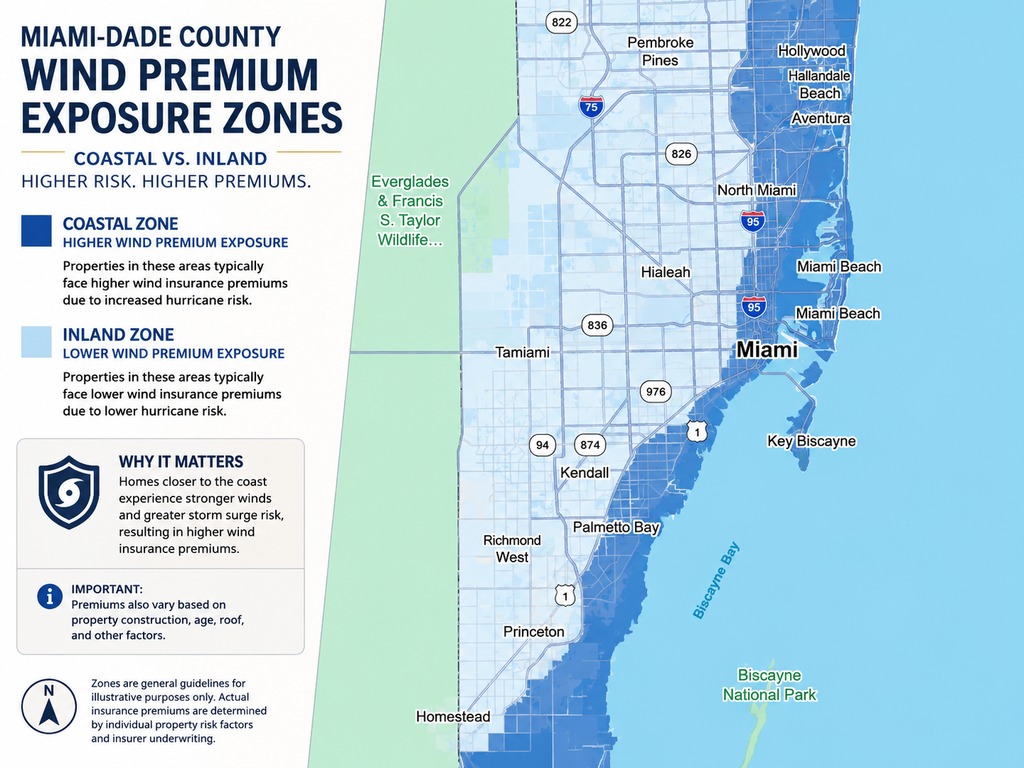
Sellers in Homestead and West Kendall often carry a real cost advantage over coastal sellers that rarely gets surfaced in the listing. Distance from open water is the single largest driver of windstorm reinsurance pricing. A comparable home in West Kendall's 33196 zip code may carry a materially lower annual wind premium than the same home near Biscayne Bay, and that difference is a concrete financial advantage for a financed buyer. Sellers who can document that lower premium number attract buyers who know how to run the math.
For buyers, I recommend getting a preliminary insurance quote before you write an offer, not after. Lenders default to a national-average placeholder in pre-approvals, which is typically $150 to $200 a month. The real number in coastal Miami-Dade can run $500 to $1,000 a month or more. Use the Mortgage Calculator to recalculate your actual monthly payment with a real insurance estimate before you are emotionally committed to a property.
Understanding the full picture of what homeownership costs in Miami, including insurance, taxes, and HOA fees, is also part of the home buying process steps most buyers rush through. Lenders verify the insurance policy in the final stages of underwriting for a reason. A coverage gap or premium surprise at that point does not just delay closing. It can end the deal.
Both sides of this transaction benefit from understanding the insurance picture before the contract is signed.
What Every Miami Homeowner Should Know Before They List
As a licensed real estate broker, mortgage broker, and title agent, I see how hurricane insurance Miami affects a transaction from every angle simultaneously. I see it from the seller's side when a premium deters buyers. I see it from the mortgage side when an insurance payment blows a buyer's DTI. I see it at the title table when a coverage gap surfaces in the final review.
The sellers who navigate this market best are not the ones with the lowest premiums. They are the ones who understand their coverage, can document it clearly, and have done the work before the buyer's agent starts asking questions.
I have closed over $100 million in real estate across Miami-Dade. The deals that go smoothly are not the ones where nothing goes wrong. They are the ones where both sides understood what they were walking into before they signed anything. hurricane insurance Miami is part of that picture on every transaction I handle, and I make sure my clients are prepared for it.
For a clear picture of what your home is worth and how your insurance position affects what buyers will actually offer, I can walk you through both in a single conversation.
Frequently Asked Questions
Does homeowners insurance cover hurricane damage in Florida?
A: Partially, but not in the way most Florida homeowners expect. A standard HO-3 policy covers wind damage from a named storm only if windstorm is explicitly included in the contract, which is not guaranteed in South Florida. Many Miami-Dade carriers exclude wind entirely or write it as a separate policy through Citizens or a private windstorm insurer. Flood damage from a hurricane is never covered by a standard homeowner's policy under any circumstance. For a home in coastal Miami-Dade, complete hurricane protection typically requires two or three separate policies from two or three different insurers, each with its own deductible and coverage terms.
What is a hurricane deductible and how does it work in Miami?
A: Florida is one of the few states where hurricane deductibles are calculated as a percentage of your home's insured value, not a flat dollar amount. Options are typically 2%, 5%, or 10% of the dwelling coverage limit. On a $700,000 home in Coral Gables with a 2% hurricane deductible, the threshold before the insurer pays anything on wind damage is $14,000 out of pocket. On the same home with a 5% deductible, it is $35,000. The deductible applies to any named storm event, not only a direct landfall. Sellers who list without disclosing or explaining this structure sometimes face renegotiation when buyers calculate the number for the first time during due diligence.
How much does hurricane insurance cost in Miami-Dade County?
A: In 2026, the average annual homeowner's insurance premium in Miami-Dade County is approximately $6,045, but that figure varies significantly by location and property type. Coastal homes in areas like Miami Beach or Key Biscayne regularly run $8,000 to $12,000 a year, with roughly 60% of the premium tied to hurricane and windstorm coverage. Inland properties in areas like Kendall or West Kendall typically see lower quotes because their distance from the coast reduces windstorm reinsurance costs. A wind mitigation inspection, typically $100 to $150, can reduce the windstorm portion of a premium by 20% to 45% and is one of the fastest ways to lower costs before listing or closing.
Is flood insurance required if my home is in a Miami hurricane zone?
A: Flood insurance is required by most mortgage lenders if the property sits in a FEMA Special Flood Hazard Area, typically Zone A or Zone V on the flood map. Properties outside those zones are not automatically required to carry flood coverage, but absence of a zone designation does not mean the property is safe from flooding. Miami-Dade County has extensive low-elevation areas where storm flooding occurs without the designation that triggers a lender mandate. Before selling or buying in Miami-Dade, it is worth looking up the specific property at floodsmart.gov and understanding what zone classification the lender will see during underwriting.
What is Citizens Property Insurance and should Miami homeowners use it?
A: Citizens Property Insurance Corporation is Florida's state-backed insurer of last resort, created for homeowners who cannot find coverage in the private market. It has historically carried higher premiums than private-market alternatives, but in 2026 it approved its largest rate reduction in its 24-year history, averaging 8.8% statewide and approximately 14% in Miami-Dade County. Citizens is not automatically the strongest option for every Miami-Dade homeowner. In 2026, several private carriers are quoting below Citizens rates on certain properties. If a Citizens policyholder receives a depopulation offer from a private carrier at renewal, an independent agent should compare the terms before accepting or declining. Citizens policies also now require separate flood coverage for all policyholders, an added cost worth factoring into the total.
Disclaimer: Alberto Labrada is a licensed Florida real estate broker, not a licensed insurance agent or attorney. The information in this post is educational only. For coverage decisions specific to your property, consult a licensed insurance professional.
If you want to know exactly what your home is worth right now, and how your current insurance position will look to the buyers who are likely to make an offer, request a free VIP Home Valuation and I will walk you through both in a single conversation. It takes a few minutes and gives you a real number to work with before you go to market.
Check out this article next