

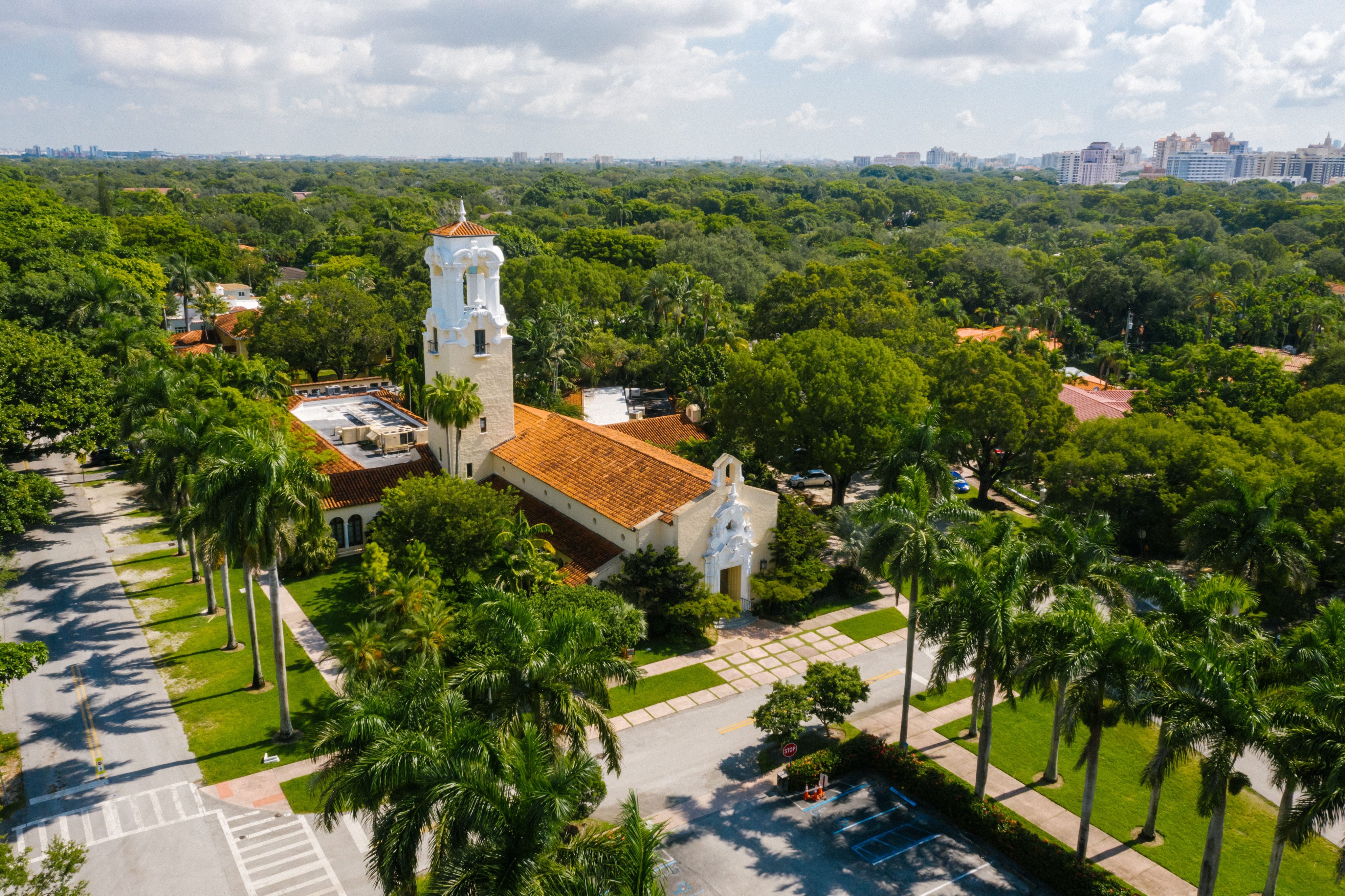
Buyers who put Coconut Grove, Coral Gables, and Pinecrest on the same shortlist almost always assume they're comparing versions of the same thing: established, tree-lined, good schools, south of downtown. Then they spend four weekends touring and realize the three areas don't feel anything alike from the inside. Living in Coconut Grove means something specific. So does living in Coral Gables. So does living in Pinecrest, and the buyer who picks the wrong one often doesn't figure that out until they're six months in, wondering why the neighborhood isn't quite working the way they pictured.
This article goes past price per square foot and school ratings. It covers what each area actually delivers on a regular Tuesday, who belongs in each one, and what you give up regardless of which way you go.
Why the Same Buyer Ends Up Comparing All Three
These three areas attract a specific buyer profile: household income well above the county median, one or two kids in or approaching school age, wants a house with a yard and not a high-rise tower, and wants to be done with the idea of living near downtown Miami traffic. That profile is consistent across all three.
Beyond that shared starting point, the areas have almost nothing in common. One is walkable and slightly eccentric. One is planned and controlled, with a city government that functions like an ever-present design authority whether you want it or not. One has no commercial strip at all and does not apologize for it. Buyers relocating from out of state treat proximity as equivalence, since Coconut Grove, Coral Gables, and Pinecrest all sit within a few miles of each other in the south-central section of Miami-Dade County. The problem is that proximity tells you almost nothing about how the three areas actually feel to live in.
For anyone still working through the broader Miami decision before narrowing to these three, the broader Miami relocation framework covers the full sequence from commute to budget to HOA tolerance. If you're already down to this specific comparison, read on.
Living in Coconut Grove: What the Neighborhood Actually Feels Like
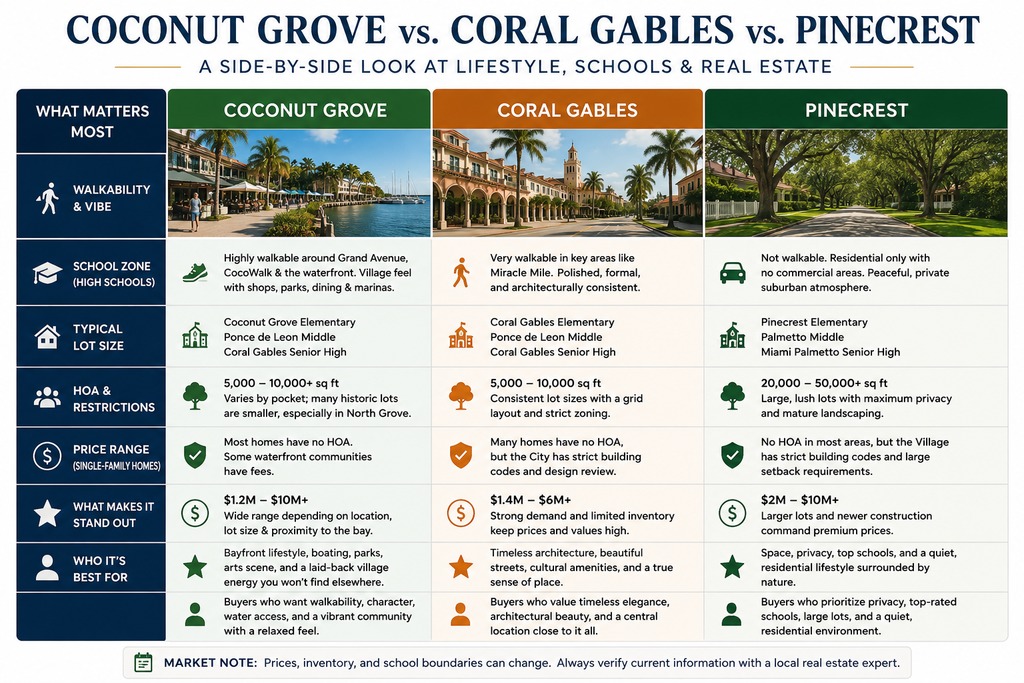
Living in Coconut Grove is the closest thing Miami has to a neighborhood with its own identity that predates the rest of the city. The Grove was a functioning village before Miami was incorporated, and that history shows in the physical fabric. Grand Avenue has restaurants that have been operating for decades. Peacock Park fronts the bay with a weekend farmers market and enough open space to make it feel like the neighborhood has room to breathe. Dinner Key Marina gives the area a nautical anchor at a scale no other Miami area can match, with the converted City Hall facility and sailboats visible from the street.
The housing stock is genuinely mixed. Early 20th century cottages occupy narrow lots in the North Grove. Post-war concrete houses fill the middle sections. Newer construction on larger lots appears at the upper price tiers. Bay Heights and The Moorings represent the top of the market, where single-family homes on deep, tree-covered lots trade at $6M and above, often without any HOA involvement.
CocoWalk creates a small walkable retail core right at the center of the neighborhood. A resident on Main Highway or Aviation Avenue can walk to dinner on a Tuesday without planning anything in advance. In most of Miami-Dade, that capability does not exist.
The character tension is worth naming directly. Coconut Grove is simultaneously the most bohemian and one of the most expensive areas in the county. Long-term residents who shaped the neighborhood's identity coexist with newer buyers who discovered it recently and paid $4M to $5M for the privilege. That tension surfaces in community meetings, in what gets approved for construction, and in the mixed vibe on a Saturday afternoon along Grand Avenue.
Who fits: buyers who want walkability, architectural character, and proximity to the water without trading it for a tower. Who tends to be frustrated: buyers who want uniformity, a predictable HOA, and the quiet of a true suburb. The Grove is not a suburb, and buyers who need it to behave like one should keep looking.
For what is currently available, the current Coconut Grove inventory shows active listings. For the full area profile, explore Coconut Grove.
Living in Coral Gables: What You Are Paying For Beyond Price Per Square Foot
Living in Coral Gables is different from living anywhere else in Miami-Dade in one specific way: the city controls what you can do with your property at a level no other municipality in the county replicates.
George Merrick designed the Gables as a planned city in the 1920s, and the building covenant structure that came with it never went away. Renovations here require City of Coral Gables permits on top of standard Miami-Dade permits. Exterior changes on certain streets go through a design review process. Even on blocks with no HOA, the city acts as the effective oversight body on anything that changes the appearance of your home. Buyers who understand this tend to see it as a feature: it is why the tree canopy remains intact, why Alhambra Circle reads the way it does after a hundred years, and why the neighborhood holds a visual consistency that most Miami areas lose to incremental redevelopment over time.
Miracle Mile runs along Salzedo Street through the center of the city. Restaurants, boutiques, and professional services create a walkable corridor that gives the Gables its own downtown in miniature. The Biltmore Hotel anchors the western side of the neighborhood as a landmark and a social venue. The University of Miami runs through the southern sections and shapes the local economy, the rental market, and the demographic mix in ways that compound over decades.
School zones in Coral Gables are strong and well-established. Coral Gables Senior High carries name recognition and consistent academic results. The elementary feeders are among the highest rated in Miami-Dade County, and buyers purchase into these zones with a confidence that is uncommon in other parts of the county where school quality varies dramatically by block.
Price per square foot in Coral Gables runs $600 to $900 or above depending on street and condition. A 4-bedroom single-family home trades at $2.5M to $4.5M across most of the market. The trade-off for that price is structure and visual consistency, not space. Lots in the Gables are smaller than Pinecrest lots at comparable price points, and renovation scope is more tightly managed.
For the full area overview, explore Coral Gables.
Living in Pinecrest Florida: Who Actually Chooses This Area and Why
Living in Pinecrest Florida is the choice that makes sense once a buyer has looked seriously at Coral Gables and decided they would rather have the land.
Pinecrest is an incorporated village with essentially no commercial zoning. There is no Miracle Mile, no Main Street, no restaurant strip. Old Cutler Road runs north to south as the primary spine, lined by a tree canopy dense enough to block direct sunlight through most of the year. Pinecrest Gardens sits near the center of the village as a botanical garden and event venue, which is about as commercial as the area gets by design.
The lots are the primary reason buyers choose Pinecrest over the alternatives. A half-acre or larger lot is standard across most of the market. An acre-plus is reachable without entering the ultra-luxury tier. Buyers who've been priced off that kind of land in Coral Gables, or who want more space per dollar than the Gables delivers at $600-plus per square foot, often discover that Pinecrest offers comparable square footage on significantly more land at a lower per-foot cost.
Most single-family stock in Pinecrest carries no HOA. The village government handles certain services, but property owners have considerably more control over what happens on their lot than they would inside a Coral Gables renovation project or a community with active shared-space rules. Buyers who've lived under HOA or covenant restrictions elsewhere tend to respond to this immediately.
Pinecrest Elementary is the school zone anchor for younger children. Palmetto Senior High covers the secondary level and is one of the strongest public high schools in Miami-Dade County, consistently in the same academic tier as Coral Gables Senior High. Buyers who target these specific zones factor them in before looking at a single listing. For a deeper look at inventory and the buying mechanics specific to this village, what Pinecrest real estate actually looks like covers the specifics.
Explore Pinecrest for the full area profile.
Side by Side: The Real Differences Across All Three
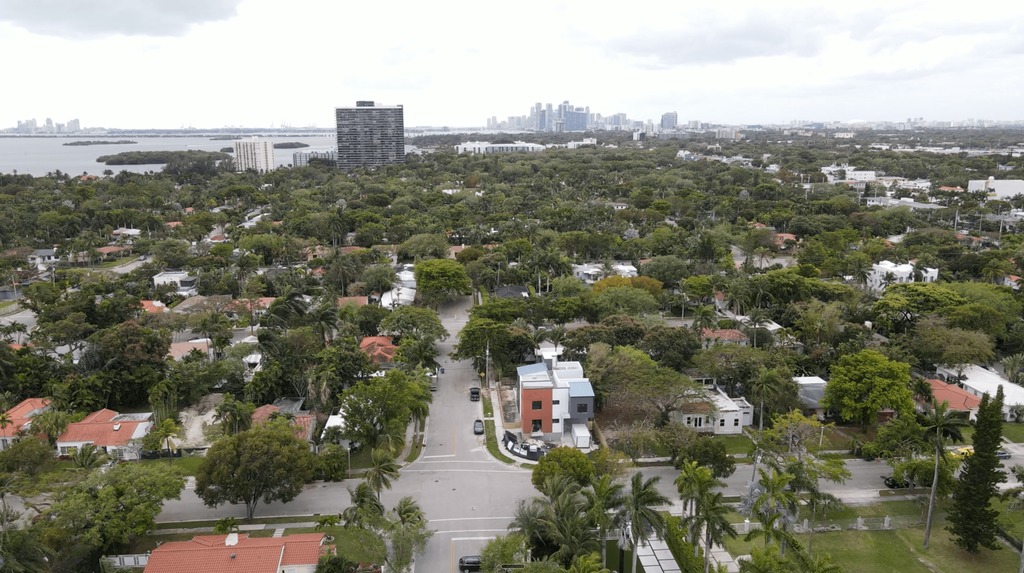
This is the section most comparisons skip because it requires taking actual positions rather than hedging on priorities. Here is where the three areas diverge in ways that matter to a real buyer.
Walkability
Coconut Grove leads. Grand Avenue, CocoWalk, and the bayfront are walkable from most of the residential core. Coral Gables is walkable within a few blocks of Miracle Mile but car-dependent in the residential sections further from that corridor. Pinecrest is car-dependent from the first day. Groceries, coffee, school pickup, and dinner all require driving regardless of how close they appear on a map.
School zones
All three carry strong public options, but the certainty of the assignment differs. Coral Gables feeds into Coral Gables Senior High with consistent results and strong name recognition. Pinecrest feeds into Palmetto Senior High, which competes at the same level and frequently ranks above the Gables on specific program metrics. Coconut Grove school zoning splits by block: some Grove addresses fall into strong zones, others do not. Verifying the specific zone for any address through Miami-Dade County Public Schools is the only reliable method before writing an offer.
Price and what the money buys
Coral Gables and Pinecrest overlap in the $2M to $4.5M range for single-family homes, but the trade-off is different. Coral Gables buys a well-located house on a more modest lot inside a city with active planning oversight. Pinecrest buys significantly more land with more renovation freedom. Coconut Grove ranges more widely by block and condition, from $1.2M for an older cottage to $6M and above in Bay Heights and The Moorings.
HOA and renovation freedom
Pinecrest leads. Most single-family stock carries no HOA. Coconut Grove is mixed across the neighborhood. Coral Gables substitutes city oversight for HOA oversight, which is more consistent across all blocks but also more involved depending on the renovation scope. Buyers who plan to add a pool, change an exterior facade, or reconfigure a floor plan need to factor in the approval layer before they close on anything in the Gables.
Pace
Coconut Grove generates the most street activity during the week. Coral Gables runs quieter and more structured. Pinecrest is deliberately still.
A real example worth naming: a family of four relocating from New York with a $2.8M budget spent six weeks comparing a 4-bedroom on Alhambra Circle in Coral Gables at $2.6M against a home off SW 104th Street in Pinecrest at $2.35M on nearly double the lot size. Both properties were in strong school zones, both in move-in condition. The Coral Gables house sat closer to Miracle Mile. The Pinecrest house had a yard large enough to actually use. They had spent years in a 900-square-foot Brooklyn apartment and had been mentally designing a yard for most of that time. They closed in Pinecrest. Six months later, neither one mentioned the school zone or the list price when I followed up. They mentioned the yard.
Seasonal demand patterns play differently across the three as well. All three areas see heavier buyer activity from November through April, when northeastern relocators and international buyers are active across Miami-Dade. Foreign buyers, who represent a meaningful share of the upper price tier in these markets, often negotiate on closing speed and cash positioning rather than price, a pattern tracked in Florida Realtors statewide market data. Domestic financed buyers competing against that cohort need a different offer strategy. Lot dimensions and zoning classification for any parcel can be verified through the Miami-Dade Property Appraiser at miamidade.gov, which matters especially in Pinecrest where lot size is often the primary differentiator between otherwise similar listings.
How to Know If Living in Coconut Grove, Coral Gables, or Pinecrest Is Right for You
There is a question I ask every buyer who comes in with these three areas on the list: what does your Monday-through-Friday actually look like between 6pm and 9pm?
Not the weekend fantasy. The regular Tuesday after work when you're tired and want something without having planned it.
If that answer involves walking to dinner, running an errand on foot, or having a social environment nearby without coordination, living in Coconut Grove is likely the answer. If the answer involves coming home, making dinner, putting kids to bed, and not needing walkability because the week is already full, the decision between Pinecrest and the Gables becomes the one that matters.
The split between Coral Gables and Pinecrest for that second buyer usually comes down to one thing: whether they value city-managed visual consistency or personal control over their lot. Buyers who've lived under HOA restrictions and want more autonomy tend to choose Pinecrest. Buyers who want the neighborhood to stay predictable over decades and trust a city planning structure to hold that line tend to choose the Gables.
Buyers who get this wrong pay for it in real costs. One pattern I see regularly: a buyer chooses a car-dependent, quiet area while still single with no kids and a downtown office. Eighteen months in, the house is fighting the daily routine. They list. They absorb carrying costs, transaction fees, and the soft drag of an off-season market. They reset to a different area and pay transaction costs a second time. The mistake is not the neighborhood. It is choosing the lifestyle they expect to want in three years instead of the one they are actually living right now.
Living in Coconut Grove, living in Coral Gables, and living in Pinecrest Florida are all legitimate answers to the same question. The job before any of them is being accurate about whose week that answer actually fits.
Running real estate, mortgage, and title from one office means the conversation about which area matches your life and the conversation about what you can realistically carry happen at the same table. By the time we look at listings, you already know your realistic budget in each market and the closing timeline for each area. That sequence changes the way a search goes.
FAQ
What is the biggest day-to-day lifestyle difference between living in Coconut Grove and living in Coral Gables?
The biggest difference is how the week moves outside the house. Coconut Grove has genuine street life: Grand Avenue, CocoWalk, Peacock Park, and the bayfront create a neighborhood you can engage with on foot without planning anything. Coral Gables is quieter and more self-contained. Miracle Mile provides a functional walkable corridor, but the residential streets further from it feel more like a polished suburb than a village core. Coconut Grove generates energy throughout the week from foot traffic and a mixed-use fabric that Coral Gables does not try to replicate. Buyers who want to walk somewhere on a Tuesday evening tend to prefer the Grove. Buyers who want the neighborhood to stay visually predictable and controlled over decades tend to prefer the Gables. The choice is less about which one is better and more about which version of a Tuesday you actually want to live in.
Is living in Pinecrest Florida worth the commute and the price for families?
A: For families who prioritize lot size, school zone quality, and no HOA, Pinecrest delivers something neither Coconut Grove nor Coral Gables can match at the same price level. The trade-off is total car dependence, which is absolute. There is no walking to dinner, no commercial district, no errand you run on foot. Families who go into Pinecrest knowing this tend to stay long-term. The ones who assumed they would find some version of walkability tend to be frustrated within two years. Pinecrest Elementary consistently rates among the top public elementaries in Miami-Dade, and Palmetto Senior High carries comparable academic standing to Coral Gables Senior High with less competition for the specific zone. A 4-bedroom home on a real Pinecrest lot typically prices between $2M and $4.5M, reflecting the combination of school zone strength, lot size, and no-HOA freedom that is difficult to find anywhere else in the county at this price point.
Which of the three areas is most walkable for someone who does not want to drive everywhere?
Coconut Grove by a significant margin. Grand Avenue, CocoWalk, and Dinner Key Marina sit within walking distance of most of the residential core, meaning a resident near Main Highway can handle dinner, a coffee run, and a Saturday morning walk without touching the car. Coral Gables offers walkability within a few blocks of Miracle Mile, but the residential streets further from that corridor require a car for most daily errands. Pinecrest is not walkable by design and does not pretend to be. The village has no commercial zoning by intent, which creates the quiet and the space residents choose it for, but a Pinecrest resident drives to get groceries, drives to get coffee, and drives to every school pickup regardless of how nearby those destinations are. If walkability is a genuine daily requirement and not just a weekend preference, Coconut Grove is the only one of the three that delivers it consistently.
How do the school zones compare across Coconut Grove, Coral Gables, and Pinecrest for families with elementary-age kids?
School zone quality is strong in all three, but the certainty of the assignment differs meaningfully. Coral Gables feeds into well-regarded elementaries and Coral Gables Senior High, which carries consistent academic results and high name recognition across the county. Pinecrest feeds into Pinecrest Elementary and Palmetto Senior High, both of which compete at the same level and sometimes above it on specific program metrics. Coconut Grove is the outlier: zone assignment there depends heavily on which block a home sits on, and it can change street by street. Some Grove addresses fall into strong zones; others do not. Verifying the exact assignment for any specific address through the Miami-Dade County Public Schools district tool before writing an offer is the only reliable method. Buyers should never assume school zone based on neighborhood name alone, and this matters most in Coconut Grove where the variation is widest.
Can buyers negotiate more in Coconut Grove than in Coral Gables or Pinecrest, or do all three areas move at the same pace?
The three areas move differently. Coconut Grove has more inventory variation than the other two, which creates more room for negotiation on homes that have accumulated time on market. The North Grove and mid-Grove stock includes older homes that do not always photograph well and tend to sit longer than comparable listings in the Gables or Pinecrest. A buyer whose agent knows which Grove blocks are slow can find genuine leverage there. Coral Gables listings in move-in condition near Miracle Mile tend to close near asking price, especially in the $2M to $3M range where demand is consistent year-round. Pinecrest moves steadily, but estate-scale listings above $4M can accumulate days depending on how the initial price was set. In all three areas, the first ten days of market exposure determine whether a listing gets negotiated or gets a price cut. Buyers who understand that dynamic can time their offers in ways that price alone does not explain.
If you have narrowed it to one of these three areas and want to see what is actually available right now, the VIP Home Search shows new listings the moment they hit the market, filtered by area and price, so you are not chasing stale inventory when you are ready to move.
Check out this article next