


Many Miami homeowners assume they cannot move forward until the mortgage is paid down or the lease runs out. Both assumptions are wrong, but acting on them without understanding the mechanics costs real money.
If you want to sell my house Miami FL and you currently have a mortgage balance or tenants living in the property, the process does not stop. It changes. The complication is not a dead end. It is a variable that needs to be understood, modeled, and managed before you list. Sellers who approach it that way close successfully. Sellers who either ignore it or panic over it tend to end up with an outcome worse than the situation required.
This covers both scenarios specifically: what happens to your mortgage at closing, what Florida law requires when tenants are in the picture, and what each decision actually does to your price and your timeline. For a broader look at how a Miami home sale works from prep to close under normal conditions, that post covers the general mechanics that apply once both complications are resolved.
Sell My House Miami FL With a Mortgage: How the Payoff Affects Your Numbers
Selling a house with a mortgage is the standard scenario in Miami-Dade. Sellers in Miami-Dade typically carry some balance, whether a first mortgage, a HELOC, or both. That balance does not prevent a sale. It comes out of your proceeds at closing, settled through the title company, and the transaction moves forward. But how that balance interacts with your sale price is where sellers routinely make costly assumptions.
Your payoff amount is not the remaining balance on your monthly statement. When you request a formal payoff letter from your mortgage servicer, it includes the principal balance, interest accrued through the projected closing date, any prepayment penalty if your loan carries one, and any outstanding fees on the account. In Miami-Dade, where closing dates shift regularly due to insurance delays or condo association approval timelines, you may need to request an updated payoff if the original statement expires. Most payoff letters are valid for 30 days.
The number that actually matters is what remains when you subtract the payoff, closing costs, commissions, and prorated property taxes from your sale price. Many sellers price based on what they want to walk away with without calculating whether the market will support the number required to get them there. The result is an overpriced listing, no offers, a price reduction that signals weakness to every buyer watching, and a negotiation position already damaged before the contract even starts. For the full breakdown of what comes out before you see a dollar, the Florida seller net sheet covers every closing line item so you can model your real number before committing to a price.
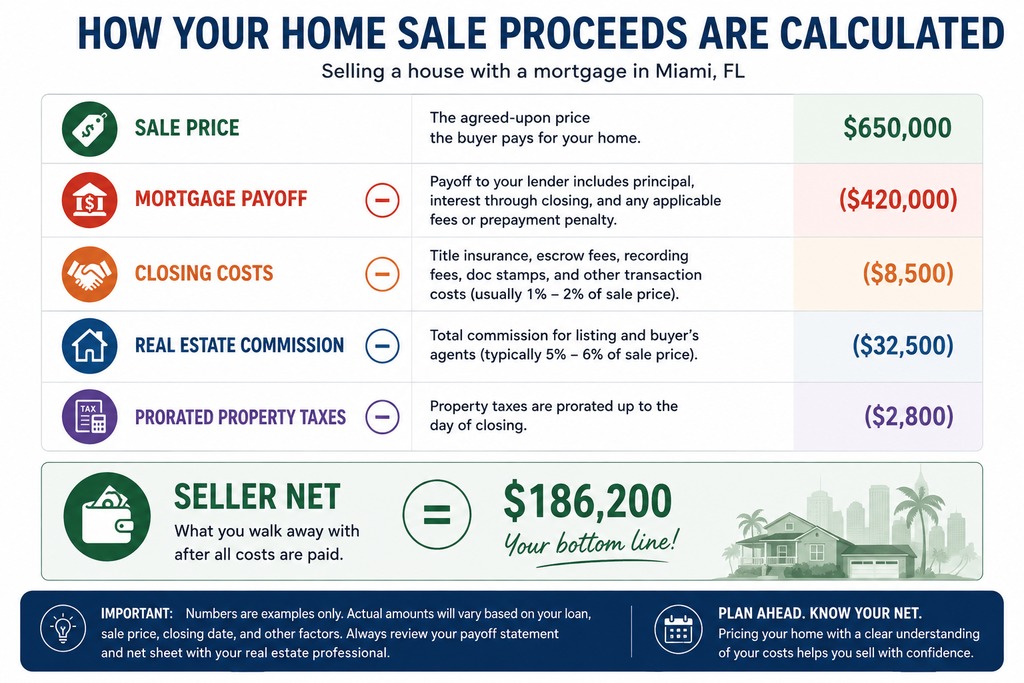
When Selling a House With a Mortgage Means You Owe More Than the Home Is Worth
This is where selling a house with a mortgage gets genuinely complicated, and where the path forward branches into three distinct situations.
Equity sale
Your payoff is comfortably below what you can realistically sell for. Standard transaction. Model your net and price from there.
Break-even sale
Your payoff is close to your market value. Small changes in commission structure, seller concessions, or final sale price determine whether you walk away with anything or write a check at the table. Precise modeling before you commit to a list price is non-negotiable here.
Upside-down sale
You owe more than market value will support. Your mortgage servicer must approve the transaction, agreeing to accept less than the full payoff to release the lien. In Miami-Dade, lender response timelines on short sales typically run 60 to 120 days from contract submission. Some lenders move faster; some stretch considerably longer. The buyer has to be willing to wait, and you must provide financial hardship documentation to the servicer. A short sale affects your credit, but meaningfully less than a foreclosure. The IRS treats certain forgiven mortgage debt as potentially taxable income in a short sale context, so a conversation with a tax professional before proceeding is worth the time.
A real example from Kendall: I worked with an owner near SW 107th Avenue on the N Kendall Drive corridor who purchased in 2022 and later took out a HELOC for renovations. By the time he came to me ready to sell, the first mortgage and HELOC combined for a payoff of $598,000. Comparable sales in that pocket were running $561,000 to $580,000 at the time. He was upside down by $18,000 to $37,000 before closing costs. We had two honest conversations: one about what a short sale with his specific servicer would realistically look like, and one about whether 12 to 18 months of principal paydown and appreciation would close that gap. He chose to wait. Six months later, comparable sales in that corridor had moved to $598,000 to $612,000 and he closed clean, no short sale required. Not every situation resolves that way, but running the math before deciding the sale is urgent saves many sellers from a short sale they did not actually need.
Selling a House With Tenants in Miami: What Florida Law Actually Requires
Selling a house with tenants in the property is legal and common in Miami-Dade. Sellers who act before understanding the legal framework, though, create problems that are expensive to undo.
Florida Statutes Chapter 83 governs landlord-tenant relationships in the state, and the key rules for a seller break down by lease type.
Fixed-term lease
The lease transfers with the property. Your buyer inherits your tenant and the existing terms in full. You cannot terminate a fixed-term lease because you decided to sell. If the lease runs through March and you want to close in September, your options are to sell with the tenant in place or negotiate a voluntary termination separately with the tenant.
Month-to-month tenancy
Florida Statute 83.57 requires at least 15 days written notice before the end of the rental period to terminate a month-to-month tenancy. Giving notice on the 1st of a month typically results in the tenant having through the end of the following month. Plan on 45 to 60 days of practical lead time. The notice requirements under Florida landlord-tenant law must be in writing. Verbal conversations do not satisfy the statutory requirement.
Security deposits
The deposit must transfer to the buyer at closing, or your tenant must receive written notice of the new owner's responsibility within 30 days of the sale. The buyer becomes responsible for proper handling and return at the end of the tenancy. Sellers who pocket the deposit at closing hand the buyer a liability and expose themselves to a potential claim.
Estoppel letters
In a condo or HOA-governed property, an estoppel letter from the association is required to confirm your account status, outstanding dues, and any pending violations or assessments. Miami-Dade associations have up to 15 business days to respond and may charge a fee. Factor that window into your closing date from the start.
One thing sellers consistently underestimate: owning the property does not give you the right to pressure a tenant out by changing locks, removing belongings, or cutting utilities. Those actions expose a seller to civil liability under Florida Statute 83.67 regardless of the circumstances. The legal process exists for a reason. Use it.
How the Tenant Decision Changes Your Buyer Pool and Your Final Number
Once you understand what Florida law allows, the strategic decision is: vacant delivery or tenant-in-place sale. These are not equal paths, and the pricing gap between them is real money.
Selling a house with tenants in place in Miami-Dade means selling to investors. Owner-occupants, who make up the dominant buyer segment in Kendall, along the N Kendall Drive corridor, Doral, Palmetto Bay, and similar family-oriented areas across Miami-Dade, cannot commit to a purchase when someone else is living in the home on an active lease. They tour, they appreciate the property, and then they move on to a home they can plan a move-in date around. When you eliminate that buyer pool, you are selling to investors who evaluate returns rather than emotion, who open lower, and who negotiate harder.
The pricing spread between an investor-targeted sale and a retail owner-occupant sale in Miami-Dade single-family typically ranges from 5 to 12 percent depending on the property and the submarket. On a $560,000 home, that spread is $28,000 to $67,000. A tenant buyout, which involves negotiating a voluntary early lease termination with the tenant in exchange for one to two months of rent as an incentive, typically costs $4,000 to $8,000 in the Kendall price range. The math on whether to buy out versus sell occupied is usually straightforward once you run it honestly against your specific numbers.
The common mistake is listing a tenant-occupied property at retail pricing hoping to attract owner-occupants anyway. What actually happens: owner-occupants tour, discover the lease situation, and walk. Days on market accumulate past 30. The listing develops the appearance of a problem property. The investors who were going to negotiate hard from the start now have leverage because the home looks unwanted. The seller ends up at or below the original investor price, but from a position of weakness. Selling occupied to an investor from the outset, at a price calibrated to the investor pool, nearly always produces a better outcome than this sequence.
For sellers still working through whether to sell or hold the asset first, the guide on landlord burnout and the sell-or-hold decision covers that financial framework before you get to the execution layer.
How Miami-Dade Complicates Both Scenarios

Miami-Dade adds complications to both the mortgage scenario and the tenant scenario that most other U.S. markets do not carry.
Insurance documentation and financed buyers
Buyers using conventional financing must bind a homeowners policy before closing. In South Florida's current insurance market, older roofs and certain construction types can delay that step or price a financed buyer out entirely in the final two weeks of a transaction. If your property has a roof older than 15 years, have the permit, the four-point inspection, and your current policy documentation ready before the first showing. Being prepared shortens the friction window that kills otherwise clean contracts at the worst possible moment.
HOA and condo rental caps for tenant-occupied sales
Some condo buildings in Brickell and Miami Beach cap the percentage of units that can be rented at any given time. If the building has hit its rental cap, an investor buyer cannot rent the unit after purchasing it, which eliminates the economic reason to buy it tenant-occupied. Before listing a condo with a tenant in place, pull the building's rental-cap status from the association documents. Also confirm the buyer approval timeline, because a building requiring a full board review adds 30 to 45 days to a transaction that may already carry a complicated tenant situation.
Foreign buyer behavior with occupied or upside-down properties
Buyers from Venezuela, Colombia, and Brazil are active in Miami-Dade investment property and typically move quickly once they identify a deal. However, international buyers in a short sale or tenant-occupied transaction face additional friction on documentation: proof of funds verification, international wire coordination, and currency conversion timing. Build that into any contract timeline where international funds are involved.
Both complications at once
A seller with a mortgage balance and a tenant in the property is not in an impossible position. The sequence matters more than anything else. First, model the payoff against current market value to determine which of the three equity scenarios applies. Second, decide on vacant delivery versus tenant-in-place sale based on which buyer pool serves your net goal. Third, price and launch into the right buyer pool from day one. Trying to resolve both variables simultaneously without modeling them in order is where sellers end up stuck for months while the clock on their mortgage and the tenant's lease run independently in the background.
Sell My House Miami FL With Complications: This Is What We Handle Every Day
Selling with a mortgage balance, a tenant in the property, or both is not unusual in Miami-Dade. A significant share of the sellers I work with arrive at exactly one of these positions. The ones who close cleanly are the ones who mapped the variables before committing to a price and a list date.
When you want to sell my house Miami FL and the situation is complicated, the triple-license structure at Labrada Realty changes what a single conversation can accomplish. I hold a Florida real estate broker license, a mortgage broker license, and a title agent license. When a seller comes to me with a payoff question, a HELOC balance, and a tenant with four months left on a lease, I do not send them to three separate offices. I model the payoff on current market data, walk through what Florida law allows on the tenant side, and coordinate the title process in-house. Every variable in one place, on one set of real numbers.
Sellers carrying one of these complications often spend weeks assembling partial answers from people who do not talk to each other. A real estate agent quotes a price. The mortgage servicer quotes a payoff. An attorney explains what the lease requires. None of them synthesizes a single integrated recommendation. The gap between those disconnected conversations is where expensive decisions get made under incomplete information.
Before making any commitments on timing or pricing, reviewing what the full sellers process looks like gives you a clear picture of what each step involves and where the complication variables fit into the larger sequence.
FAQ
Can I sell my house in Miami FL if I still owe more than it's worth?
A: Yes, through a short sale, but it requires your lender's approval. When your total payoff exceeds what the market will support as a sale price, your mortgage servicer must agree to accept a discounted payoff to release the lien. In Miami-Dade, lender response timelines on short sales typically run 60 to 120 days from the time a contract is submitted for approval, and you will need to document your financial hardship to the servicer. Your buyer has to be willing to wait out that approval window. The credit impact of a short sale is real but substantially less than a foreclosure, which is the alternative if the mortgage cannot be carried. If appreciation and principal paydown would close the gap within 12 to 18 months, waiting is often the better financial path before resorting to a short sale.
How much written notice am I required to give a tenant before selling my home in Miami FL?
A: For a fixed-term lease, no notice is required at all. The lease transfers to the buyer and your tenant remains through the lease term regardless of the sale. Florida law does not allow a landlord to terminate a fixed-term lease simply by selling the property. For a month-to-month tenancy, Florida Statute 83.57 requires at least 15 days written notice before the end of the rental period. In practice, giving notice on the 1st of a month means the tenant typically has through the end of the following month. Plan on 45 to 60 days of actual lead time. The notice must be in writing. Verbal agreements do not satisfy the statutory requirement, and acting outside these rules exposes you to civil liability.
Does selling a house with a mortgage affect how much I walk away with at closing?
A: Directly, and in ways that catch sellers off guard. Your payoff amount, which includes principal, accrued interest, and any outstanding lender fees, comes out of your proceeds before you receive anything. Add commission, title charges, prorated property taxes, and any seller concessions, and your net can look very different from your sale price. Miami-Dade sellers who price based on what they want to net rather than what the market will actually support for their specific property and zip code set themselves up for a surprise at the closing table or a listing that goes stale waiting for a price the market will not deliver. Running a seller net sheet before you list eliminates that surprise and gives you a real number to make decisions from.
What happens to my tenant's lease when I sell my Miami FL home?
A: Under Florida law, the lease transfers with the property and the buyer inherits both the tenant and every existing lease term. Your tenant has the legal right to remain through the end of the fixed-term lease regardless of who purchases the home. The security deposit must also transfer to the buyer at closing, or your tenant must receive written notice of the new owner's responsibility within 30 days. Buyers who are not informed of an existing lease before going under contract sometimes use that disclosure gap as grounds to exit. Providing the full lease documents, the deposit amount, and a written confirmation of the remaining term as part of your standard seller disclosures prevents that from becoming a contract problem late in the transaction.
Should I wait for the lease to expire before listing my house in Miami FL?
A: In most Kendall and Miami-Dade owner-occupant markets, yes, if the timeline is reasonable. The pricing spread between what an investor pays for an occupied property and what an owner-occupant pays for a vacant, retail-ready home ranges from 5 to 12 percent in Miami-Dade single-family. If the lease has two or three months remaining, waiting almost always nets more. If the lease runs another 12 to 14 months, a tenant buyout, typically one to two months of rent paid as an incentive for a voluntary early termination, often recovers its cost many times over in the final sale price. Running the specific numbers for your property, your remaining lease term, and your local buyer pool is the only way to answer this correctly for your situation.
If you want to know what your Miami home is actually worth right now, with your mortgage payoff and tenant situation already in the picture, a free VIP home valuation gives you a real starting number before you make any decisions on timing or pricing. It takes about 60 seconds and there is no commitment attached.
Check out this article next