


Most sellers think their net number is the sale price minus the mortgage payoff and the commission. A shortcut like that is not a Florida seller net sheet, it is a rough guess, and it is usually wrong by tens of thousands of dollars. In Miami-Dade specifically, sellers carry a line item that catches almost everyone off guard: the owner's title insurance policy, which is customarily paid by the seller here, unlike much of the rest of the state. The people who get hurt by this gap are sellers who price their move, their next purchase, or a payoff to a family member around a number that was never real to begin with. This article walks through every line item that actually shows up on a Florida seller net sheet, with real numbers from Kendall, Pinecrest, and Coral Gables sales.
What a Florida Seller Net Sheet Actually Is
A net sheet is not a home value estimate and it is not your list price. It is a line-by-line calculation, built by your closing agent or agent, that starts with your expected sale price and subtracts every cost tied to the transfer of the property. The output is the actual wire amount that lands in your account after closing.
Sellers searching for how much are closing costs in Miami usually stop at commission and stop there, but commission is one line among seven or eight that regularly appear on a Miami-Dade closing statement. Skipping the rest is how a seller ends up short on the down payment for their next home, sometimes by a number large enough to delay the next closing entirely.
The Line Items That Actually Hit a Miami-Dade Seller's Net Sheet
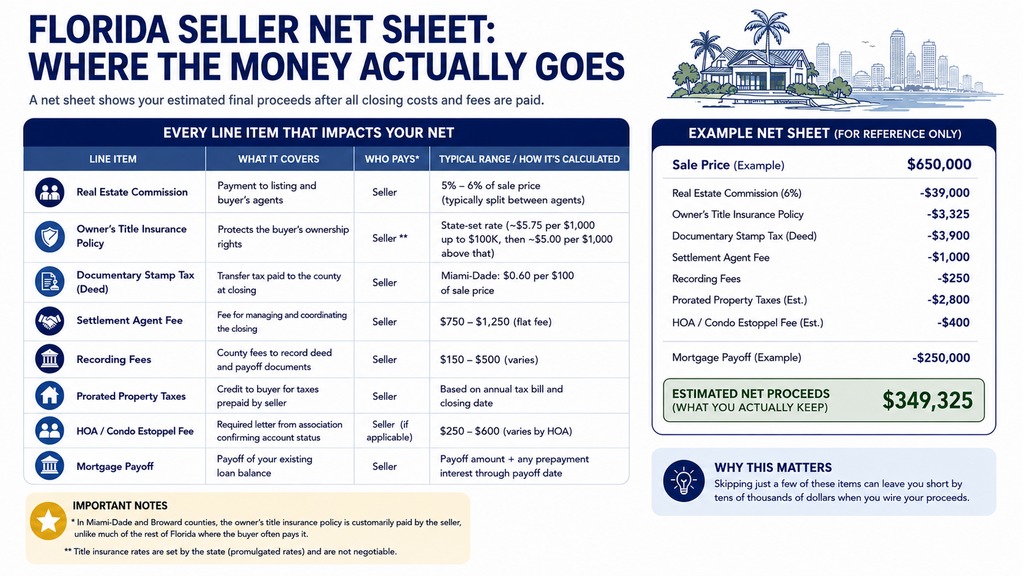
Here is what actually appears on a Florida seller net sheet in this county, in the order it usually gets deducted:
- Real estate commission, typically 5 to 6 percent of sale price, split between listing and buyer's agent
- Owner's title insurance policy, a promulgated state rate that is customarily seller-paid in Miami-Dade and Broward, unlike much of north and central Florida where the buyer often pays it
- Documentary stamp tax on the deed, charged at the time of transfer
- Closing or settlement agent fee, usually a flat charge for handling the transaction
- Recording fees for the deed and any satisfaction of mortgage
- Prorated property tax credit to the buyer, since Florida property taxes are paid in arrears
- HOA or condo estoppel certificate fee, if the property sits inside an association
- Payoff of the existing mortgage balance, plus any prepayment interest through the payoff date
Title insurance cost Florida is set by the state as a promulgated rate, so it is not something you negotiate the way you'd negotiate commission. The rate runs roughly $5.75 per $1,000 of sale price for the first $100,000, then closer to $5.00 per $1,000 above that. On a $650,000 sale, that lands around $3,325, and in this market, that cost typically falls on the seller's side of the ledger.
Documentary stamp tax Florida charges $0.70 per $100 of sale price in most counties, but Miami-Dade's rate is $0.60 per $100 on single-family transfers. On that same $650,000 sale, documentary stamp tax Florida adds up to $3,900, paid by the seller at closing regardless of who negotiated what on commission.
How Much Are Closing Costs in Miami: A Real Seller's Math
Take a seller near Pinecrest Gardens, where single-family homes typically sell in the $5 million to $8 million range. This one sells for $6,000,000, no HOA, with $2,500,000 left on the mortgage.
Commission at 6 percent: $360,000. Owner's title policy, calculated on the state's tiered promulgated rate once a sale price crosses $1 million: $17,575. Documentary stamp tax on the deed at Miami-Dade's rate: $36,000. Closing agent fee: $1,000. Recording fees: $250. Prorated property tax credit to the buyer for the partial year, on a tax bill that runs well into six figures at this value: $28,000.
Add those up and the seller is down $442,825 before the mortgage payoff even enters the math. Subtract the $2,500,000 payoff from the $6,000,000 sale price, then subtract the $442,825 in costs, and this Pinecrest seller nets $3,057,175, not the $3,500,000 figure a quick mental calculation might have suggested.
This gap, over $440,000, is the difference between a seller who priced their next purchase correctly and one who finds out at the closing table that their available cash is short by nearly half a million dollars.
The mortgage payoff line item adds one more wrinkle sellers rarely plan for, and it matters more at this price point than at a modest one. Your lender does not calculate your payoff as of your listing date, they calculate it as of the actual closing date, which means per diem interest accrues every day the loan stays open. A seller with a $2,500,000 balance at a 6 percent rate is accruing roughly $411 a day in interest alone, and if closing slips two weeks past the original target date, that is nearly $5,800 added to the payoff figure with nothing to show for it. Lenders also charge a satisfaction of mortgage recording fee once the payoff clears, usually under $100, but it is still a real line that belongs on the sheet.
The Mistake That Shrinks a Seller's Net Proceeds the Most
The single most expensive mistake I see is a seller who quotes their list price to a lender, a builder, or a family member as their available cash, without ever running a real net sheet first. Seller closing costs Florida wide tend to run 8 to 10 percent of sale price once title insurance, doc stamps, and prorations are added to commission, and that gap does not show up until the closing disclosure lands three days before signing.
A Kendall seller I worked with near Kendall Drive had already put down a deposit on a new construction home in Doral based on their expected net, calculated without the title policy or doc stamps included. The shortfall surfaced two weeks before their own closing, forcing a scramble for a bridge loan that cost more in interest than the number they'd missed in the first place. Running the actual net sheet before listing, not after an offer arrives, is what prevents that.
Seller Closing Costs Florida: What's Negotiable and What Isn't
Some of these costs are fixed by statute or state-set rate, and some are open to negotiation. Documentary stamp tax and the promulgated portion of title insurance cost Florida are not negotiable. They are set by law and apply the same way regardless of who you use as your closing agent.
Commission, closing agent fee, and who pays for certain buyer concessions are all negotiable, and this is where an experienced agent's positioning matters. A seller who understands which costs are fixed walks into an offer negotiation focused on the parts that actually move, instead of spending energy trying to shave a rate that no one involved has the authority to change.
This is also where having a broker who holds a real estate license alongside a mortgage broker license and title agent license changes the math for a client. I can model the buyer's financing scenario, the title costs, and the net sheet under one roof instead of sending a seller to three separate professionals who never talk to each other before the contract is signed.
Buyer concessions are the piece most sellers underestimate during negotiation. A buyer asking for a two percent credit toward their closing costs on a $650,000 sale is asking for $13,000 off the seller's net sheet, on top of everything already listed above. Sellers who walk into that conversation without a current net sheet often accept a concession they cannot actually absorb without renegotiating their own purchase timeline. Sellers who walk in with the real number can counter with a smaller credit, a price adjustment instead of a cash concession, or a firm decline, because they know exactly what each option costs them in real terms rather than in theory.
Miami-Specific Factors That Move the Net Sheet
Condo and HOA estoppel timing.
Any Miami-Dade property inside an association needs an estoppel certificate before closing, confirming the seller owes nothing outstanding to the association. Florida law caps standard estoppel fees, but rush requests cost extra, and a Kendall condo seller who waits until the week of closing to request one can delay the closing date entirely while the association processes it.
The estoppel certificate also discloses whether the association has an active or pending special assessment, and this is where a Kendall condo net sheet can shift after the fact. A seller who lists before checking on assessment status can find out mid-contract that a new roof or reserve-funding assessment applies to their unit, sometimes running into the thousands, and depending on the association's payment terms, that balance may need to be settled before the estoppel clears. Checking assessment status before listing, not after an offer is accepted, keeps that number out of the net sheet as a surprise.
Micro-market differences in negotiating room
A Coral Gables seller near the Biltmore area, selling in the $1.5 million-plus range, typically has more room to negotiate commission structure and closing agent fees than a Kendall seller in a more price-competitive tier, simply because the dollar amounts at stake are larger and buyers in that tier expect more customized terms. On a $1.5 million Coral Gables sale, the same 8 to 10 percent range in costs translates to $120,000 to $150,000, which is exactly why sellers at that price point tend to negotiate the closing agent fee and commission split more actively than a Pinecrest or Kendall seller would. A Pinecrest seller sits somewhere in between, with enough equity typically built up that the net sheet conversation is more about timing the next purchase than about affording it.
Foreign seller withholding
If the seller is a foreign national, FIRPTA withholding of 15 percent of the gross sale price gets held back at closing before the net sheet is even finalized, separate from any of the costs above. This withholding interacts with, but is not the same calculation as, the standard net sheet math covered here. My breakdown of capital gains tax on a Florida home sale walks through FIRPTA and the tax side in full.
What This Means Before You List
A Florida seller net sheet built before you sign a listing agreement, not after an offer arrives, is what lets you negotiate from a position of knowing your real number. Sellers who skip this step end up negotiating price without knowing what actually changes in their pocket when a buyer asks for a credit or a lower commission split.
If you are weighing whether now is even the right time to sell, my guide on getting ready to sell your house in Miami covers the timing questions that should come before the net sheet conversation.
According to the Florida Department of Revenue, documentary stamp tax rates and county-specific variations are published directly from the source, and Florida Realtors tracks standard commission and closing custom data by region.
Disclaimer: This article is for general informational purposes only and does not constitute tax, legal, or accounting advice. Closing costs, promulgated title rates, and documentary stamp tax figures cited here reflect publicly available data as of the date noted above and can change. Alberto Labrada is a licensed Florida real estate broker, mortgage broker, and title agent, and is not a CPA or tax attorney. Consult a licensed closing agent, title company, or tax professional before finalizing your numbers.

FAQ
Q: How much are closing costs in Miami for a seller?
A: Miami-Dade sellers typically see total closing costs, including commission, land somewhere between 8 and 10 percent of the sale price. This total includes the owner's title insurance policy, which is customarily seller-paid here, documentary stamp tax on the deed, a closing agent fee, and prorated property taxes. A $650,000 sale can easily carry $49,000 or more in combined costs before the mortgage payoff is even subtracted, which is why sellers who ask how much are closing costs in Miami before listing avoid an unpleasant surprise at the closing table.
Q: Who pays for title insurance in a Florida home sale?
A: It depends on the county, and this is one of the most misunderstood parts of a Florida closing. In Miami-Dade and Broward, custom has the seller paying for the buyer's owner's title policy. In much of north and central Florida, the buyer typically pays. Title insurance cost Florida is a state-promulgated rate either way, so the dollar amount does not change based on who pays, only whose net sheet absorbs it.
Q: Does an HOA or condo estoppel fee come out of my net proceeds?
A: Yes. Any Miami-Dade property inside a homeowners association or condo association requires an estoppel certificate before closing, and the fee for that certificate is typically a seller-paid line item on the closing statement. Standard estoppel fees are capped by Florida statute, but rush processing adds a surcharge, and waiting until the final week before closing to request one can delay your closing date while the association processes the paperwork.
Q: Can I get a real net sheet before I even list my house?
A: Yes, and you should. A preliminary net sheet built from your expected sale price, your current mortgage payoff, and current promulgated title and doc stamp rates gives you a real number to plan around, not a guess. This matters most when you are timing a purchase that depends on your proceeds, since finding out your actual net three days before closing leaves no room to adjust financing on the home you are buying next.
Q: Is documentary stamp tax the same everywhere in Florida?
A: No. Documentary stamp tax Florida runs $0.70 per $100 of sale price in most counties, but Miami-Dade charges $0.60 per $100 on single-family residential transfers, with an additional surtax that can apply to certain multi-family and commercial property types. On a $650,000 single-family sale in Miami-Dade, that difference is a real number, not a rounding error, and it always shows up as a seller-paid line on the closing statement.
If you want a real Florida seller net sheet built around your actual sale price, payoff, and today's rates, not a rough guess, get a free home valuation and I'll walk through the full math with you before you decide when to list.
Check out this article next