


Most owners who are tired of being a landlord treat that feeling like a confession, something to apologize for before they ask a real question. I hear it constantly. A good property, a decent tenant, years of ownership, and still the person across the table feels like they failed because they no longer want the job. The framing there is the problem. Burnout is not weakness. It is information. It usually means the return you are earning no longer justifies the time, risk, and mental cost you are paying for it, and that is a business fact, not a character flaw. The owners who get hurt are the ones who either quit in a panic and sell a great asset at the wrong moment, or grind on for years out of guilt. This walks through how to tell which one you are.
Being Tired of Being a Landlord Is Data, Not Weakness
Owners rarely burn out on the property. They burn out on the unpredictability.
The 11 p.m. call about a water heater. The tenant who pays on the 6th every month and dares you to say something. The special assessment that eats a year of cash flow in one letter. None of that shows up on a spreadsheet, but it is the real cost of the asset, and it compounds quietly.
Here is the reframe I give owners. Being tired of being a landlord is your own risk-tolerance signal firing. When you first bought, you had the appetite for hands-on management and the upside justified it. If that appetite is gone, the property has not changed, but its fit for your life has. A rental you would never buy today is a rental you are choosing to keep every single month by not selling. Naming it that way turns a guilt spiral into a decision.
Should I Sell My Rental Property? Run These Numbers First
Every landlord who lands on the question "should I sell my rental property" is really asking three smaller questions at once, and answering them separately makes the fog lift fast.
First, what is my actual cash-on-cash return right now, not the day I bought? Rents in Miami-Dade have moved, but so have insurance premiums, property taxes after any reassessment, and HOA dues. I have seen owners in Hialeah who believed they were earning 6 percent still discover their real return had drifted under 3 after insurance renewals doubled their carrying cost.
Second, how much equity is trapped in the property, and what is that equity earning? A paid-down rental worth $600,000 with $450,000 in equity throwing off $9,000 a year in net cash is earning about 2 percent on that equity. Sitting still.
Third, what is the opportunity cost of leaving it there? So when you ask should I sell my rental property, you are not looking for a yes or a no. You are looking for the number that makes the decision obvious. Most owners have never run the return on equity, only the return on purchase price, and those two figures tell completely different stories.
What You Actually Net When You Sell Rental Property in Miami
The listing price is the headline. The net is the story.
Before you sell rental property in Miami, you need to model two numbers the sale price never shows: depreciation recapture and capital gains on an investment property. These are different from the tax treatment on a primary residence, and owners who assume the Florida homestead rules protect them get an unpleasant surprise at closing.
When you sell rental property that you have depreciated for years, the IRS taxes those prior deductions back at a rate up to 25 percent. Depreciation recapture works exactly that way, and on a property you have owned for a decade it can reach into the tens of thousands. On top of that sits the capital gains on the appreciation itself. Florida has no state income tax, which helps, but the federal exposure is real, and the IRS treats the sale of a rental differently from a primary residence. I break the full mechanics down in the guide on capital gains tax on a Florida sale, and I always tell owners to model the after-tax number before they fall in love with the sale price.
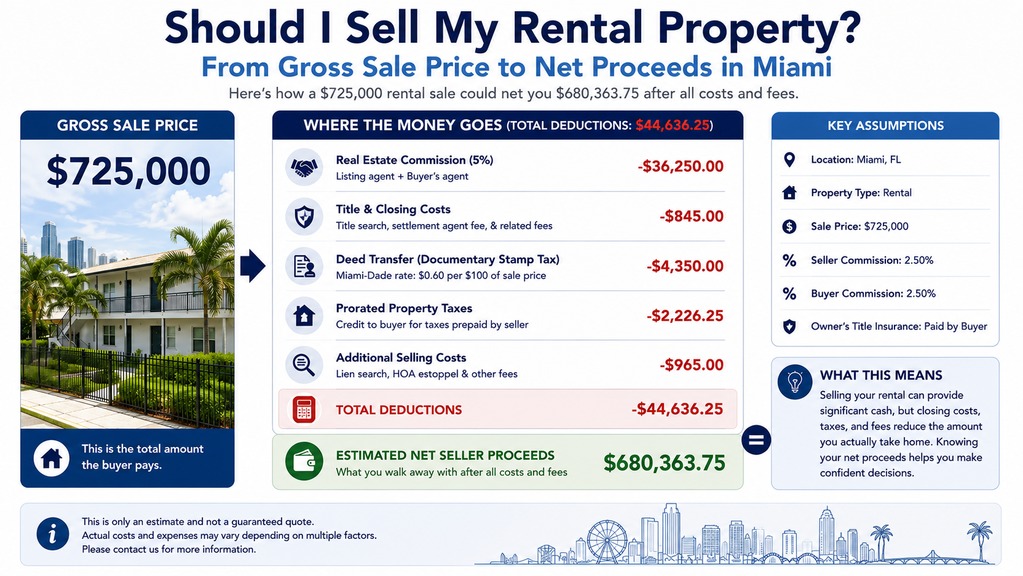
The other number that surprises people is closing-side cost. Commission, title, prorated taxes, and any tenant deposit you are transferring all come out before you see a dollar. The full picture of what lands in your account is laid out in the seller net sheet breakdown. Model that first, because a $600,000 sale can net very differently depending on your basis and your recapture exposure.
Note: I am a licensed Florida real estate broker, not a CPA or a tax attorney. The figures here are general and meant to help you ask the right questions. Confirm your specific numbers with a tax professional before you list.
Selling With a Tenant in Place vs. Delivering Vacant
This single decision moves your price, your buyer pool, and your timeline more than almost anything else, and most owners never think it through.
Under Florida law, the lease transfers with the property and the buyer inherits your tenant, and any security deposits must move to the new owner at closing. If you sell with a tenant in place, your buyer pool narrows to investors, because an owner-occupant cannot move in until the lease ends. Investors buy on the numbers, and they negotiate harder. If you deliver the property vacant, you open it to the full retail buyer pool along the US-1 corridor and out through West Kendall, where owner-occupants pay for the emotion of a move-in-ready home. The spread between those two pools is real money.
A real example. I worked with an owner near SW 137th Avenue in West Kendall who was ready to sell a three-bedroom rental fast because he was done managing it. His tenant was locked into a lease at $3,700 through the following spring. Sold tenant-occupied to an investor, the realistic number was around $565,000, and the pool was thin. We ran the other path: buy the tenant out of the lease for two months of rent, deliver vacant, refresh paint and landscaping, and list into the winter buyer wave. The home closed at $611,000 to an owner-occupant. After the buyout and the refresh, he netted roughly $38,000 more by delivering vacant. The lease was not a floor. It was a ceiling he did not know he was standing under.
The common mistake here is listing a tenant-occupied home for a retail price and hoping. What actually happens is a stack of showings that never convert because owner-occupants tour it, love it, and then learn they cannot move in for eight months. The listing goes stale, days on market climb past 30, and the eventual buyer is the investor who was going to lowball you anyway, now with leverage because the property looks unwanted. You engineered the weak outcome by refusing to pick a lane.
Insurance is the other Miami variable that decides how fast a sale closes, and it hits rentals harder than owner-occupied homes. Since the market tightened, buyers using financing need a bound homeowners policy before they can close, and older roofs or older construction can slow that to a crawl or price a buyer out entirely in the final two weeks. If your rental has a roof past 15 years, expect it to shrink your financed-buyer pool and lean the deal toward cash. Owners who have the roof permit, the four-point inspection, and the current policy documentation ready before listing keep that friction from killing an otherwise clean contract.
One Miami wrinkle worth knowing. If you sell rental property inside a condo building, the association matters twice. Some Brickell buildings cap the percentage of units that can be rented, which shrinks the investor pool that would buy it tenant-occupied. Others require board approval of your buyer, adding 30 to 45 days. Pull your building's rental-cap status and approval packet before you list, because it quietly decides which of the two paths is even open to you.
When Holding Still Beats Selling (And When Tired of Being a Landlord Wins Anyway)
Selling is not always the answer, and I will talk owners out of it when the numbers say hold.
If your rental is genuinely cash-flowing at a healthy return on equity, sits in an appreciating pocket, and the only real problem is the management workload, the cleaner fix is often a property manager. Ten percent of rent to hand off the 11 p.m. calls can turn a burnout asset back into a passive one. Investors who sell rental property at the right market moment and reinvest tend to outperform, but investors who dump a strong asset just to escape the phone calls usually regret it within two years when they see what it appreciated to.
A refinance is the other overlooked path. If your equity is trapped but the property performs, pulling some of that equity out to deploy elsewhere lets you keep the appreciation while freeing capital. You get liquidity without triggering depreciation recapture or capital gains.
Then there is the 1031 exchange, which lets you roll your gain into a replacement property and defer the tax entirely. It is the tool for the owner who is tired of this specific property but not tired of owning real estate. A common move in Miami-Dade is trading a management-heavy single-family rental in an older pocket for a newer, lower-maintenance condo or a triple-net situation with far fewer touchpoints.
Timing matters more than most owners think, and it interacts with your hold-or-sell call. Miami-Dade buyer activity peaks from mid-November through April, when relocation buyers and international buyers are in market. If you decide to sell, listing a vacant, retail-ready rental into that window in a $400,000 to $700,000 pocket like West Kendall or Cutler Bay meaningfully improves your odds of multiple offers. If your only realistic buyer is an investor for a tenant-occupied property, that seasonal edge matters far less, because investors shop the numbers year round. Knowing which buyer you are actually selling to tells you whether waiting for the season is worth it or just costs you months of a job you are trying to leave.
Being tired of being a landlord still wins the argument when the return on equity is poor, the property faces a looming capital event like a roof or a special assessment, or the workload is bleeding into your health and relationships. No refinance fixes a 2 percent return on a property that needs a $40,000 roof. In that case, selling is not quitting. It is reallocating.
How I Help Miami Landlords Decide
Most owners have to assemble this decision from three different professionals who never talk to each other. A real estate agent gives them a price. A lender tells them refinance numbers. A tax preparer, months later, explains what they owe. By then the moment has passed.
I hold all three licenses. I am a licensed Florida real estate broker, a licensed mortgage broker, and a licensed title agent, which means I can sit with you and model the sale price, the refinance alternative, the after-tax net, and the reinvestment path in one conversation, on one set of numbers. When an owner asks me whether to sell or hold, I am not guessing at the parts I do not control. I can show you the vacant-versus-occupied spread for your specific zip code, the realistic net after recapture, and what a 1031 replacement in your budget actually looks like on the ground in Miami-Dade. Before you commit to either path, the mechanics of a clean listing launch are worth understanding too, which I lay out in how a Miami home sale timeline actually works.
If you are tired of being a landlord, you deserve a decision built on real numbers, not on guilt or on a portal estimate. Once you see the after-tax net next to the return you are actually earning, the answer usually stops being a hard call.
FAQ
Q: Should I sell my rental property in Miami if it still cash flows?
A: Cash flow alone does not answer it. Run your return on equity, not your return on purchase price. A Miami rental worth $600,000 with $450,000 in equity earning $9,000 a year is returning about 2 percent on that trapped equity, which many owners could beat elsewhere with far less work. If the property sits in an appreciating pocket like parts of West Kendall and the only issue is the workload, a property manager may be the smarter fix. If the return on equity is weak and a capital repair is looming, selling usually wins even with positive monthly cash flow.
Q: Do I pay capital gains tax when I sell a rental property in Florida?
A: Florida has no state income tax, so there is no state capital gains bite, but the federal exposure is fully in play on an investment property. You owe capital gains on the appreciation and, separately, depreciation recapture of up to 25 percent on the deductions you claimed over the years. A primary residence gets an exclusion that a rental does not, which trips up owners who assume homestead rules protect them. Model the after-tax number before you list, and confirm the specifics with a tax professional, because your basis drives the whole calculation.
Q: Can I sell my rental property in Miami with a tenant still living there?
A: Yes, and Florida law lets the lease transfer with the sale, meaning the buyer inherits your tenant and the existing terms. The catch is that a tenant in place narrows your buyer pool to investors, who negotiate harder and pay less than owner-occupants. In many Miami-Dade cases, buying the tenant out and delivering the home vacant nets more even after the buyout cost, because you unlock the full retail buyer pool. Provide an accurate estoppel letter and honor the deposit transfer, or you hand the buyer leverage at closing.
Q: How much does depreciation recapture cost when I sell rental property?
A: On a property held for years, it is often larger than owners expect. The IRS taxes the depreciation you deducted at a rate up to 25 percent when you sell rental property you have written down over time. On a Miami rental where you claimed roughly $10,000 a year in depreciation for a decade, that is $100,000 of recapture exposure taxed at up to 25 percent, or as much as $25,000, before capital gains even enter the picture. This is exactly why the sale price and the net proceeds are two very different numbers, and why modeling comes before listing.
Q: Is a 1031 exchange worth it if I'm just tired of being a landlord?
A: It can be, if you are tired of the property but not of owning real estate. A 1031 exchange defers both the capital gains and the depreciation recapture by rolling your proceeds into a replacement property within strict deadlines: 45 days to identify and 180 days to close. A common Miami-Dade move is trading a management-heavy single-family rental for a newer, lower-maintenance condo with fewer repair calls. If you want out of real estate entirely, though, the exchange does not help, because you have to reinvest. In that case, take the tax hit and reallocate.
Note: I am a licensed Florida real estate broker, not a CPA or a tax attorney. Confirm your specific tax figures with a qualified professional before making a decision.
If you are tired of being a landlord and want to see the real math before you decide, a free home valuation gives you an accurate number to work from in about 60 seconds. Once you see what your rental would actually net against what it earns today, the sell-or-hold question usually answers itself.
Check out this article next