

Most people researching the best retirement communities in Miami focus on the pool, the clubhouse, and whether there is a golf course nearby. Those things matter, but they are not what determines whether a purchase goes smoothly or sideways. The real variables are buried in the HOA documents: how funded the reserves are, whether the building qualifies for conventional financing, and what the insurance picture looks like after two years of serious market disruption.
Miami-Dade has a wider range of 55 plus communities Miami Fl buyers can access than most people expect. From upscale condo buildings along the Aventura corridor to affordable mid-tier options in Miami Gardens, each community operates under its own financial and operational realities. This guide walks through what is available, what each area actually delivers, and what to verify before signing anything.
What the Best Retirement Communities in Miami Have in Common
Not every complex that uses the words "active adult" or "55-plus" in its marketing qualifies as a legally age-restricted community under federal law. The Housing for Older Persons Act Q&A from Florida Realtors lays out how the standard works in practice. Three requirements must all be met: at least 80% of occupied units must have at least one resident who is 55 or older, the community must publish and follow policies demonstrating its intent to house older adults, and it must conduct age-verification surveys at least every two years. A building that markets itself as retirement-friendly but fails any of those three requirements has no legal basis to call itself age-restricted.
Section 760.29 of the Florida Statutes reinforces these federal protections at the state level and defines how age-restricted communities must operate here in Florida. Communities that let their age-verification process lapse, or that cannot demonstrate consistent 80% occupancy compliance, can lose that status entirely. Any building you are seriously considering should be able to show you how it documents and audits its compliance before you put money in escrow.
Beyond the legal baseline, the best-run 55-plus communities share a few operational traits: they publish annual budgets with clear line items, they maintain reserve funds above 70% of the recommended threshold, and they have written HOA policies on guest stays, rental restrictions, and unit modifications. Communities that meet those standards tend to hold value better and generate fewer internal disputes over time.
One detail most buyers overlook is the approval timeline. In many 55-plus buildings in Miami-Dade, the condo association runs its own approval process that is completely independent of your mortgage approval. Some require personal interviews, background checks, and financial disclosures from the buyer. Processing those applications can take 30 to 90 days depending on the building. Under a standard 45-day contract, discovering this at week three creates a real scheduling problem. Know what the building requires before your offer goes in.
The Best Retirement Communities in Miami, Area by Area
Miami-Dade County has more 55 plus communities Miami buyers can access than most realize, distributed across three distinct market tiers. Each area carries a different price point, lifestyle profile, and HOA structure. Here is what you find when you look past the brochures.
Aventura and the Country Club Drive Corridor
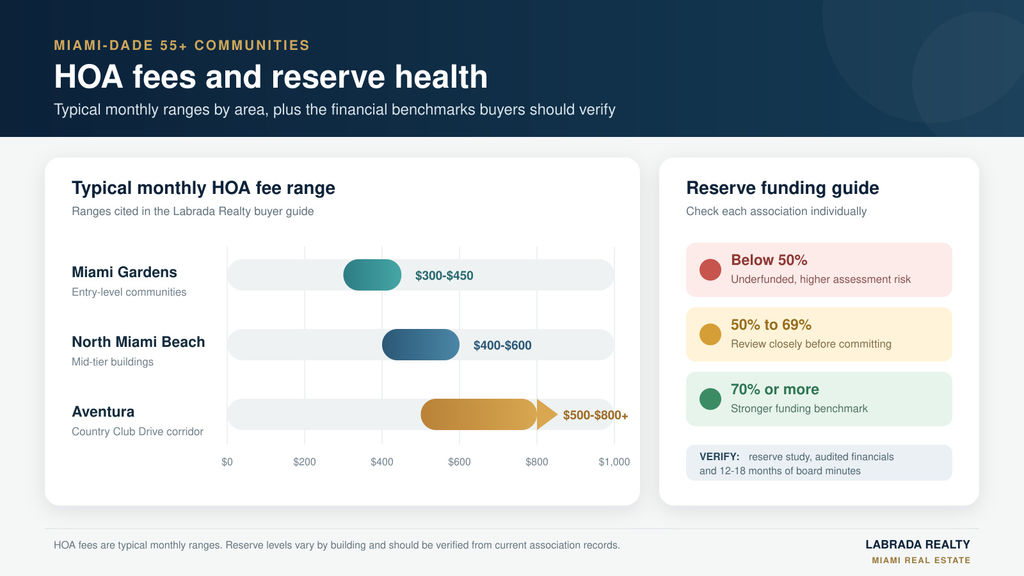
Country Club Drive carries the highest price points among 55-plus options in Miami-Dade. Units here typically run from the mid-$100s to the mid-$200s for one and two-bedroom condos, with monthly HOA fees generally between $500 and $800 depending on the building and its amenities. Golf course access, Intracoastal proximity, and easy reach of Aventura Mall make this corridor appealing to buyers who want a full-service lifestyle and have the budget to support it.
The tradeoff is building age. A buyer I worked with found a one-bedroom unit along this corridor listed at $168,000, with a $610 monthly HOA. After reviewing the financials, we found the reserve fund was sitting at 22% of the recommended level and the board had deferred a roof project for two consecutive budget cycles. Within 18 months of closing, that building issued a $5,800 per-unit special assessment. The advertised price was not the real cost of buying in.
North Miami Beach and the Ojus Area
The NE 169th and 170th Street area in North Miami Beach, along with the broader Ojus pocket anchored by NE 185th Street, holds some of the most consistent 55-plus inventory in the county. Units range from under $90,000 for a one-bedroom to the mid-$200s for a renovated two-bedroom, and the density of available options gives buyers genuine negotiating room.
This corridor draws a heavily Latin retiree population, particularly Venezuelan and Colombian buyers who want proximity to services, restaurants, and a Spanish-speaking community. For buyers from those backgrounds, that concentration is a feature worth factoring into the decision, not just a demographic footnote.
The financing concern here is real. Several buildings along the NE 185th Street corridor carry investor concentrations above 35%, meaning more units are rented than Fannie Mae or Freddie Mac will allow under conventional loan guidelines. Buyers who discover this after going under contract face either a portfolio loan at a higher rate or an all-cash close. Running a warrantability check before the offer is not optional in this part of the market.
Miami Gardens and the NW 2nd Avenue Corridor
Miami Gardens offers the most accessible price points among 55 plus communities in Miami. Camelot Lakes and nearby communities along the NW 2nd Avenue corridor carry units between $125,000 and $165,000 for one and two-bedroom condos, with HOA fees that tend to run lower than what you find further north. Two-bedroom units are common here, and the square footage per dollar is strong relative to the rest of Miami-Dade.
The tradeoff is lifestyle infrastructure. Miami Gardens does not have the walkability or Intracoastal proximity of the Aventura corridor, and most daily errands require a car. For buyers prioritizing monthly cost and unit size over location prestige, it is an area that deserves more serious consideration than it typically gets.
What to Check Before You Sign in Any 55-Plus Community
HOA documents are where retirement community purchases go wrong most often. Every 55-plus building in Florida is required to provide prospective buyers with a disclosure package, and state law gives you three business days to review and cancel without penalty once you receive those documents. Most buyers scan them quickly. Few read them carefully enough.
Three items deserve the closest attention. The first is the reserve study, which tells you how funded the reserve account is relative to the building's anticipated repair and replacement schedule. The second is the most recent audited financial statement and annual operating budget, which shows whether the HOA is running at a deficit or maintaining a surplus. The third is the board meeting minutes from the past 12 to 18 months, where deferred projects and pending special assessments almost always surface before they become official votes. A reserve fund below 50% funded is a building with a special assessment somewhere in its near future.
Pet restrictions and guest policies also deserve real attention. Many 55-plus buildings in Miami-Dade limit the size or number of pets, restrict guests from staying longer than 30 consecutive days, or prohibit family members under 19 from residing in the unit permanently. If grandchildren visit regularly or an adult child plans to stay for extended periods, confirm what the actual rules say, not what the seller's agent says they say.
Rental restrictions carry an additional layer of consequence. A building that prohibits or severely limits rentals affects not just your flexibility if circumstances change, but also the building's investor concentration ratio going forward. When investor concentration rises above the Fannie Mae threshold, it affects conventional financing eligibility for every future buyer in that building. A unit with a wide resale pool is worth more than one that limits the next buyer's options.
How Financing and Insurance Work in 55-Plus Buildings
Most buyers assume that qualifying for a mortgage means they can purchase any unit they choose. In Miami-Dade's 55-plus condo market, that assumption has cost buyers real money and lost deposits.
For a conventional loan to close in a condo building, the project itself must pass Fannie Mae or Freddie Mac eligibility review. The checklist covers owner-occupancy ratios, reserve funding levels, pending litigation against the HOA, commercial space percentages, and single-entity ownership concentration. Older 55-plus buildings frequently fail on reserve funding and investor concentration. When a project does not clear those requirements, buyers need either a portfolio lender willing to hold the loan or cash.
FHA financing adds a separate layer. A condo building must appear on the active FHA-approved project list for FHA terms to work. Approval expires and the list changes regularly. Verifying current FHA project approval status before writing an offer takes ten minutes and can prevent a deal from collapsing at the appraisal stage.
How Miami's insurance market affects what you'll pay each month is the variable that catches most buyers unprepared. Condo associations carry a master policy covering the building structure and common areas, and since 2022 the cost of those policies has roughly doubled in many Miami-Dade buildings. HOAs pass that increase to unit owners via higher monthly dues or one-time assessments. In some North Miami Beach buildings, HOA fees rose by $150 to $250 per month in a single year due entirely to insurance. Run your budget numbers with current, verified insurance costs included, not the HOA fee listed in the MLS from six months ago.
Buyers 62 or older who are considering a home equity conversion mortgage to fund the purchase should also review the Consumer Financial Protection Bureau's reverse mortgage resource before applying, as HECM eligibility carries condo-specific requirements that affect purchases in many 55-plus buildings.
Because I hold a Florida mortgage broker license alongside my real estate license, I run project financing checks before my buyers make offers. If a building does not clear conventional lending guidelines, I know it before the contract is signed. For a fuller picture of what condo financing actually involves in Miami-Dade, what FHA approval and HOA fees really mean for condo buyers covers the full set of mechanics.
The Mistakes That Cost Retirees the Most in Miami
Amenities look the same regardless of whether a building's reserves are 90% funded or 15% funded. The expensive mistakes come from not looking past the tour.
Mistake one: making an offer before checking warrantability. A buyer came to me after losing a $10,000 deposit on a North Miami Beach unit priced at $139,000. She had gone under contract without knowing the building's investor concentration exceeded 45%. Her conventional lender declined the loan at the appraisal stage, and the seller kept the deposit. Running that warrantability check before the offer would have changed the outcome entirely.
Mistake two: skipping the HOA minutes. Special assessments rarely appear without warning. Boards discuss deferred projects and funding gaps six to twelve months before they vote to levy an assessment. The minutes are part of the standard Florida disclosure package, and they are where the actual financial picture surfaces long before it becomes official.
Mistake three: treating today's HOA fee as a fixed number. Across 55 plus communities Miami Fl, fees have moved significantly since 2022 due to insurance market conditions, deferred maintenance compounding, and new reserve requirements under Florida's condo safety legislation enacted after the Surfside collapse. A fee that fits your budget today may look very different in 18 months. Ask for three years of historical budgets and study the trend, not just the current figure.
How to Find the Right 55-Plus Community Without Wasting Three Months
Buyers who move efficiently through this search start with area, not unit. Pick the corridor first based on your budget and lifestyle priorities, then narrow to specific buildings, then to individual units. Touring properties in buildings you cannot finance, or in areas that do not fit your daily routine, wastes the time most buyers cannot spare.
Once you have a building shortlist, request the HOA financials before scheduling tours. A building with a 12% funded reserve is not worth visiting regardless of how good the photos look. Narrow the field to buildings with reserves above 50%, clean financial statements, and loan-type warrantability that matches your financing plan.
The 55 plus communities in Miami that buyers ultimately feel confident about tend to be the ones where someone helped them filter out the financially troubled buildings before they fell in love with the wrong unit. If you want to see what is actually listed right now, the current 55-plus inventory across Miami-Dade is a real-time starting point, updated daily and organized by area. And because I hold both my real estate and mortgage licenses, I can tell you before your first offer whether the building you are considering will close on the terms you actually need.
Finding the right fit among the best retirement communities in Miami-Dade takes more than a strong search tool. The communities worth buying into are financially stable, legally age-restricted under HOPA, and financeable on terms that work for you. Area, price, and amenities set the frame. The HOA documents tell the real story.
FAQ
What is the minimum age requirement to live in a 55-plus community in Florida?
A: Under the federal Housing for Older Persons Act, at least one occupant per unit must be 55 or older, and the community must show that at least 80% of its occupied units meet that threshold. In Miami-Dade, most well-run 55-plus buildings require all permanent residents to be 55 or older and verify this annually through age certification. Approval also involves background checks and a financial review from the HOA itself, and processing can take anywhere from 30 to 90 days depending on the building. Plan for that timeline when structuring your contract.
Can I buy in a 55-plus community if my spouse or partner is younger than 55?
A: Yes, federal law requires only that one qualifying occupant per unit be 55 or older. The other resident can be younger. Individual community rules sometimes go beyond the federal minimum, however, and those additional restrictions are legally enforceable. Before making an offer in any Miami-Dade 55-plus building, review the community's specific age-restriction policy, not just the federal baseline. Some buildings approve couples where one spouse is in their early 50s. Others require both occupants to meet the 55 threshold. Get the actual policy in writing from the HOA before your contract period begins.
What are typical HOA fees in Miami-Dade 55-plus communities?
A: Fees vary meaningfully by area and building age. Entry-level communities in Miami Gardens typically run $300 to $450 per month. Mid-tier buildings in North Miami Beach generally fall between $400 and $600. The Country Club Drive corridor in Aventura runs $500 to $800 or higher, depending on amenities and reserve health. Since 2022, insurance cost increases have pushed many buildings' monthly fees up by $100 to $250. Before budgeting around any HOA figure, ask for the last three annual budgets. The trend line over three years tells you far more than the current number alone.
How do I know if a condo in a 55-plus building qualifies for conventional financing?
A: Conventional loan eligibility in a condo project depends on Fannie Mae or Freddie Mac project approval, not just your personal qualifications as a borrower. The building must meet standards for owner-occupancy ratios, reserve funding levels, pending litigation, and single-entity ownership concentration. In Miami-Dade's 55-plus market, investor-heavy buildings and those with underfunded reserves fail these checks regularly. The most effective approach is having a licensed mortgage broker run a project review before your offer goes in. A warrantability check takes a fraction of the time it takes to recover a lost deposit.
Are there any 55-plus communities in Miami where I can rent out my unit?
A: Rental policies in 55 plus communities Miami vary significantly by building. Some allow rentals immediately after purchase. Others impose a one to two-year wait period before a new owner can lease the unit. Some prohibit rentals entirely. The policy matters for two reasons: it affects your flexibility if circumstances change, and it directly impacts the building's investor concentration ratio, which affects conventional financing eligibility for every future buyer in that building. Always review the declaration of condominium and the current HOA rules directly. Verbal assurances from a listing agent about rental policies are not binding on the association.
If you want to see what is actually available right now across Miami-Dade's 55-plus market without sorting through the full MLS, the current 55-plus inventory across Miami-Dade is updated daily and organized by area. Browse it, bookmark anything worth a second look, and reach out when you find a unit worth discussing. I can tell you within minutes whether it will finance on the terms you need.
Check out this article next