

The common assumption is that a multiple-offer situation is something that happens to a home, not something you build. Sellers wait and see. The market either cooperates or it does not. Buyers either show up or they do not. This framing costs sellers tens of thousands of dollars every single time.
Knowing how to get multiple offers on your home is a strategy with three components that have to be sequenced correctly: pre-listing condition that signals move-in readiness, a pricing approach that draws buyers into competition rather than giving them permission to wait, and a launch structure that concentrates showing activity into a window tight enough to force a decision. When all three work together, buyers start competing with each other instead of negotiating against you. And that shift from negotiation to competition is where a listing closes above asking price.
Why Miami Sellers Get One Offer Instead of Five
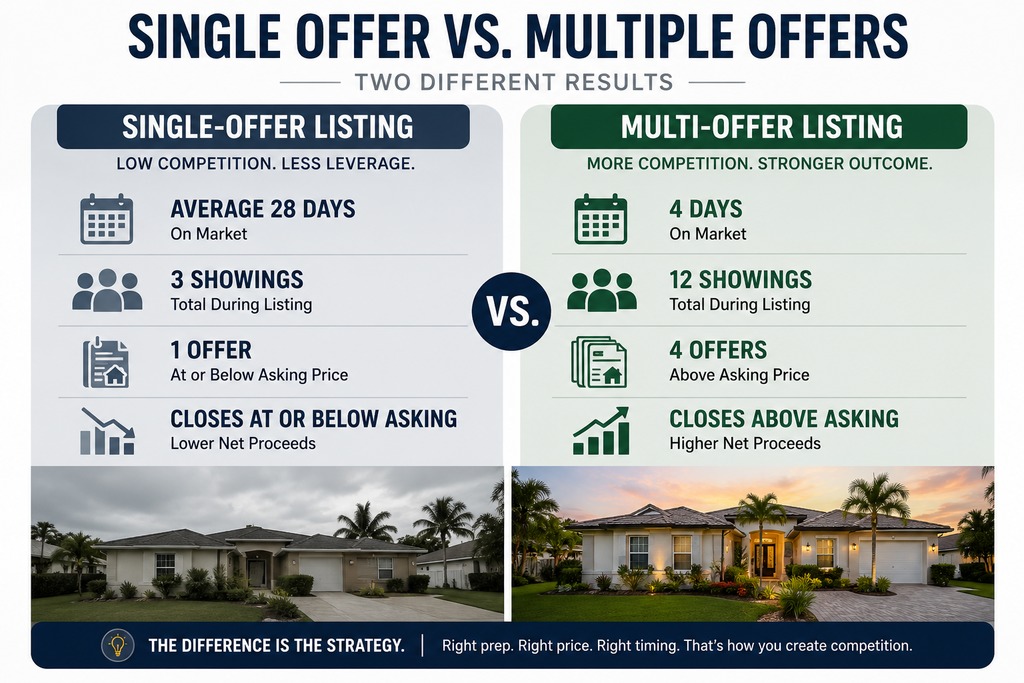
A single offer is almost always the result of the same pattern: the home hit the market at an aspirational price, was not prepared to compete visually, and had no structured offer window to create any urgency. One buyer showed up. That buyer knew they were the only one in the room. They negotiated accordingly.
In Miami-Dade, this dynamic is more costly than in most markets because buyer sophistication here runs high. Many buyers are actively comparing new construction in Doral and Homestead against existing inventory in Kendall and South Miami. They have seen enough listings to read a situation quickly. A poorly launched home signals that the seller has no leverage. A well-launched home makes the buyer feel like they might lose it.
The gap between one offer in three weeks and five offers in four days is rarely about the house itself. A Palmetto Bay seller listing a three-bedroom at $650,000 can get either result depending entirely on how the listing was constructed and launched. Same house. Different outcome.
How to Get Multiple Offers on Your Home Before You List
The first mistake most sellers make is spending money on the wrong things, spending too late, or spending nothing at all and assuming buyers will look past condition. None of those approaches work in a market where buyers filter by listing photos before they ever call an agent.
Pre-listing preparation for a competitive launch is not about renovating. It's about removing every visual signal that gives a buyer permission to negotiate down before they've asked their first question. A cracked driveway, dingy grout, outdated cabinet pulls, and a yard that photographs brown are not cosmetic inconveniences buyers overlook. They are data points buyers use to build their offer strategy.
The specific home improvements before selling that matter most in this context are the ones that change how a home photographs and shows, not the ones with the highest long-term return on investment. Those are different lists. Fresh exterior paint, power-washed driveways and pool decks, staged living areas, and updated light fixtures can collectively cost $8,000 to $12,000 and produce a listing that looks genuinely competitive. Those home improvements before selling generate showing volume. A $45,000 full kitchen gut renovation does not make a listing more competitive than a clean, refreshed $14,000 kitchen update.
A Kendall home that closed at $725,000 earlier this year spent $12,000 on exterior paint, new cabinet hardware, and professional staging. The listing drew 14 showings in its first three days and five offers by Sunday. Comparable homes on the same street that had not been prepared were averaging 25 to 40 days on market with price reductions.
For a detailed framework on which specific renovation projects recover their cost in Miami-Dade, the post on Home Improvements That Add Value Before You List in Miami covers project-level ROI and cost ranges in depth.
Pricing to Create Competition, Not Reduce It
Pricing above market in hopes of leaving room to negotiate is the single most effective way to make sure you never need to know how to negotiate home sale offers, because you will not get multiple offers to negotiate.
Miami-Dade buyers are not unsophisticated. Many are running their own comparables, working with experienced agents, and benchmarking your home against everything that sold within a half-mile in the last 90 days. A price that lands $40,000 to $50,000 above where the market sits does not invite negotiation. It invites buyers to wait. And when buyers wait, they come back after the price cut with an offer that reflects your weakness, not your home's value.
Pricing at or slightly below the top of the comparable range creates a different dynamic. A home priced with confidence floods the showing calendar. It signals the seller knows what they have. And when ten buyers walk through the same property in the same weekend, they start competing with each other rather than against the seller. That competition is worth far more than the $25,000 premium you were holding above market.
A South Miami listing came to market at $719,000 in a submarket where comps supported $710,000 to $730,000. The reasoning was a modest premium to leave negotiating room. Eleven days and zero accepted offers later, the price dropped to $699,000. Two blocks away, a near-identical home listed at $699,000 from day one, received four offers over the first weekend, and closed at $724,500. The pricing signal changed everything.
The 72-Hour Launch Window That Decides Your Outcome
The launch window is where offer count gets determined. Sellers who generate the most competitive situations treat launch day as a structured event with a specific timeline and a hard deadline. Sellers who treat it as simply the date the home goes live on the MLS get the results that approach typically produces.
A Thursday or Friday MLS launch positions the listing for maximum weekend showing volume. Buyers who see a new listing Thursday evening are booking showings for Saturday and Sunday. By Sunday, the active showing pool is at its peak. A seller who sets an offer review deadline for Monday at 5 p.m. creates 72 hours of sustained buyer urgency. Buyers do not know how many others are coming through. They act as though there are several.
Photography determines whether any of this matters. Miami listings are filtered by photos before they are filtered by location, price, or bedroom count. A buyer scrolling through a listing app on Thursday night decides whether to schedule a showing in about four seconds based on what they see. Poor photography kills showing volume before a single buyer has walked through. Professional listing photography in Miami runs $300 to $600. Its return cannot be measured precisely because the counterfactual is invisible, but agents who skip it consistently see longer days on market.
Holding offers for 48 to 72 hours after launch is the structural decision that converts showing volume into competing bids. Without a deadline, buyers feel no urgency to commit. A motivated buyer who walked through on Saturday might write an offer by Wednesday, after they've seen four other homes, had time to second-guess the decision, and lost some of their initial energy. With a deadline, that same buyer writes the offer Sunday night.
How to Negotiate Home Sale Offers When You Have More Than One
This is where the work of the previous phases pays off. Knowing how to negotiate home sale offers from a position of actual leverage changes the conversation at the offer table entirely.
Price is not always the most valuable variable in front of you. A cash offer at $720,000 with a 21-day close and no inspection contingency is a fundamentally different deal than a financed offer at $745,000 with a full inspection period, a financing contingency, and a 45-day close. Sellers who evaluate offers purely on purchase price regularly accept the wrong one.
Net proceeds are where clarity lives. Running a seller net sheet against each offer, factoring in closing cost contributions, requested repair credits, and timeline costs, often reveals that the highest-priced offer is not the cleanest deal. The post on the Florida Seller Net Sheet walks through that full calculation in detail.
When three or more offers come in, a best-and-final round is worth running. Tell each buyer to submit their highest and best by a specific time. Serious buyers respond. Buyers who were testing the situation drop out, which is useful information before you execute a contract.
A few Miami-specific patterns worth knowing at the offer table:
- HOA and condo approval timelines: In communities like The Hammocks or gated Doral subdivisions, buyers using financing need HOA approval before the lender can close. This adds 2 to 4 weeks to the timeline and affects which offer structure actually serves you.
- Escalation clauses: Some buyers submit offers with automatic escalation provisions, meaning their price adjusts upward by a set increment above any competing offer, up to a stated cap. Know the cap and the increment before deciding whether it benefits you.
- Cash offer behavior: Miami carries a higher share of cash buyers than most U.S. markets. Cash buyers often write lower initial offers and lean on closing speed as a compensating advantage. In a competitive situation, a cash offer at $710,000 and a financed offer at $730,000 can be much closer in net value than the $20,000 spread suggests once you account for contingency risk and timeline carrying costs.
How to Get Multiple Offers on Your Home Across Miami-Dade Markets
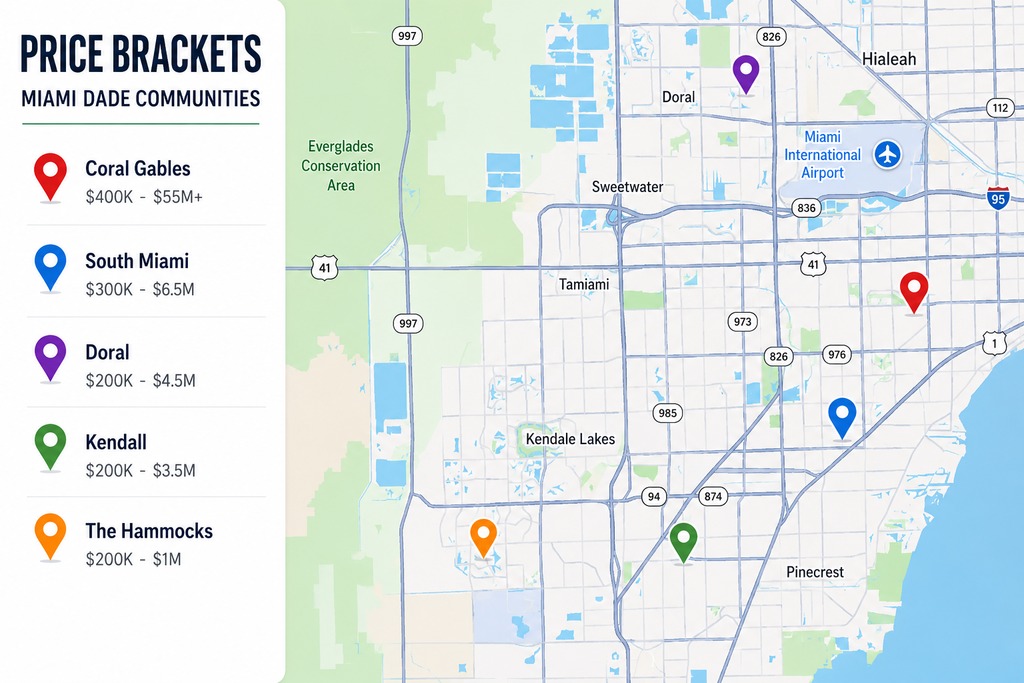
A strategy that generates five offers in Kendall at $550,000 needs real adjustments for Coral Gables at $1.4 million. The market mechanics differ enough by area that a single approach leaves money behind.
In Coral Gables and South Miami, buyer pool depth is thinner but buyer financial capacity is considerably higher. Decision cycles move slower and buyers expect a more curated experience. A 48-hour offer deadline can feel rushed in those markets in a way that pushes serious buyers away rather than creating productive urgency. A 5 to 7 day window, sometimes with private preview showings before the listing goes broad, works more effectively here.
In Doral and The Hammocks, HOA structure, school zone assignments, and commute access to the western airport corridor drive buyer urgency more directly than the home's finishes. A property in Doral zoned for high-performing schools in the Miami-Dade County Public Schools system can draw 8 to 10 showings in a weekend with minimal promotional effort. A similar home two zip codes away with a lower-rated school assignment might draw three. Understanding which signal actually drives demand in your specific submarket determines your launch strategy.
For sellers thinking about how to sell a house in Florida more broadly, a few state-specific rules matter before you are sitting across from multiple offers. Florida real estate transactions close through a title company rather than an attorney. The contract most residential transactions use is the Florida Realtors/Florida Bar AS-IS Residential Contract, which sets default inspection periods, contingency waiver timelines, and closing deadlines. Sellers who understand what they are signing before offers arrive make cleaner decisions under pressure.
Insurance market conditions in Miami-Dade affect buyer pool depth in ways that do not surface in listing statistics. Buyers in the $400,000 to $700,000 range are increasingly sensitized to insurance costs. A home with a roof older than 15 years will generate an insurance quote during due diligence that can affect financing approval. Sellers who address roof condition before listing protect the competitive situation they have built. Those who do not often watch a clean multi-offer deal unravel during the inspection period. The Florida Office of Insurance Regulation publishes carrier availability data that illustrates why this variable matters so much in South Florida specifically.
The broader principle for how to sell a house in Florida with maximum buyer competition is to remove friction at every stage. A seller who walks into launch day with a prepared home, a confident price, a structured offer window, and a clear understanding of the terms they'll accept across different offer structures does not need to react. They get to decide.
For properties above the $1.5 million mark, the post on How to Sell a Luxury Home in Miami the Smart Way covers the specific dynamics that shift in the upper segments, including buyer behavior, marketing reach, and offer structure.
Knowing how to get multiple offers on your home comes down to three decisions made before anyone sees the listing: remove the friction that justifies a low offer, price to signal confidence rather than hope, and structure your launch so buyers feel time pressure rather than patience. When all three are in place, the market does not just respond to your home. It competes for it.
FAQ
How long does it typically take to get multiple offers on a home in Miami-Dade?
A: In Miami-Dade, a well-prepared listing at a competitive price can generate multiple offers within 3 to 5 days of launch when the home goes live Thursday or Friday for weekend showings. Homes that attract 10 or more showings in the first weekend almost always see offers before the week is out. The variable that drives speed is not buyer demand in the abstract. It is how the first 72 hours of market exposure are structured. Listings that launch without a clear offer window, or that hit the MLS on a Monday, tend to lose that initial momentum and take 2 to 3 weeks to see competitive activity, if at all.
Does pricing below market value actually help you sell for more in Florida?
A: Pricing slightly below the top of the comparable range does something that pricing above market never can: it creates showing density. When more buyers see the home in the same short window, they start comparing themselves to each other rather than negotiating against the seller. In Miami-Dade, where buyer competition runs high in the $400,000 to $800,000 range, a listing that draws four offers by Sunday at $699,000 frequently closes above $720,000. A listing that opens at $739,000 to leave negotiating room often ends up accepting $695,000 three weeks later after two price reductions and diminished buyer interest.
What home improvements before selling matter most for generating buyer competition?
A: Home improvements before selling that produce the most competitive listings are not the most expensive ones. They are the ones that change how a home reads in photos and shows in person. Fresh exterior paint, professional staging, updated lighting and hardware, and clean landscaping consistently produce more showing volume than mid-range kitchen or bathroom renovations, because they shift the first impression before a buyer ever steps inside. In Miami-Dade, where listing photos are the first filter buyers use, anything that improves how the home photographs produces a measurable lift in showing volume, and showing volume is what drives competing offers.
How do I evaluate competing offers when the prices are close but the terms differ?
A: Start with net proceeds from each offer, not the purchase price line. A financed offer at $740,000 with a $10,000 closing cost credit, a 45-day close, and a full inspection contingency is not $740,000 in your pocket. A cash offer at $720,000 with no contingencies and a 21-day close is often worth more in practice after accounting for carrying costs, contingency risk, and what can surface during a financed buyer's due diligence period. In Miami-Dade specifically, watch for HOA approval timelines in gated communities, which can add 2 to 4 weeks to any financed close. Run a seller net sheet on each offer before you decide. The highest number on paper is rarely the best deal in practice.
Can I legally reject an offer in Florida without explanation, even in a multi-offer situation?
A: In Florida, a seller is not legally required to accept any offer and can reject an offer for any reason that does not constitute unlawful discrimination under the Fair Housing Act. In a multi-offer situation, you can counter some offers, reject others outright, and accept whichever offer best serves your interests. Florida law does not require sellers to disclose how many offers they have received or to give every buyer a chance at a best-and-final round. Working with a licensed Florida real estate broker during a competitive offer review protects you from procedural mistakes that can create unintended obligations before a contract is fully executed. The Florida Realtors legal resources page covers seller rights in this context in detail.
If you want to know what your home would realistically sell for right now and how a well-structured launch could generate competing offers in your zip code, a free home valuation takes 60 seconds and gives you a real number to build your strategy around.
Check out this article next